
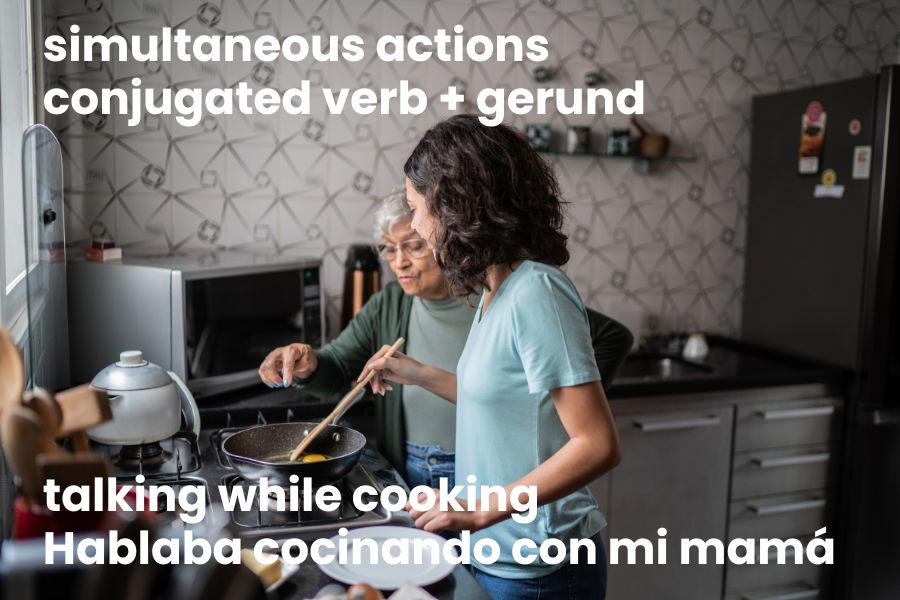
Hablaba cocinando con mi mamá
The gerund
present progressive – I am cooking – estoy cocinando
past progressive – Estuve cantando toda la mañana. (end to action)
imperfect progressive – Estaba cantando su canción favorita.
The gerund working like an adverb
But — hablaba cocinando — is slightly different. It’s not using estar; it’s just two simultaneous actions described together:
Hablaba mientras cocinaba → compressed into → Hablaba cocinando
Here the gerund (cocinando) describes how or while the main action happened. It’s like saying “I was talking while cooking” or “I talked as I cooked.”
Hablaba cocinando con mi mamá
In lessons, the progressive is taught as a formula:
estar + gerund
So learners naturally think the gerund needs estar to do its job.
Then you encounter something like hablaba cocinando and there’s no estar anywhere — it breaks the pattern you were taught.
The thing is, these are actually two different uses of the gerund:
Two different Uses of the gerund
The gerund is just a tool, and Spanish uses that tool in more than one way:
Structure 1 — estar + gerund
estar carries the meaning, the gerund completes it. They work together as a unit.
estaba cocinando — you can’t drop estar, the meaning falls apart
Structure 2 — conjugated verb + gerund
The main verb stands on its own, the gerund is just adding extra information alongside it.
They’re independent.
hablaba cocinando — hablaba works perfectly without cocinando, the gerund is bonus detail
In structure 2 it’s more like an adverb — describing how or when the main action happened.
Just as you can say she talked quietly or she talked nervously, in Spanish you can say hablaba cocinando — she talked cookingly, in a manner of cooking, while cooking. The gerund is painting the picture.
But the gerund here works as a simultaneous action or manner.
The key rule for this gerund use
The gerund can describe a secondary action happening at the same time as the main verb:
Entró corriendo. — She came in running.
Estudia escuchando música. — He studies while listening to music.
Pasé el día leyendo. — I spent the day reading.
This works in any tense, not just the imperfect.
The conjugated verb can be present, preterite or imperfect.
Very common!
It’s one of those things native speakers use constantly without thinking about it.
The pattern of verb + gerund for simultaneous actions is extremely natural in everyday speech:
Llegó llorando — she arrived crying
Me lo explicó riendo — he explained it to me laughing
Salió corriendo — he ran out (lit. he left running)
That last one (salir corriendo) is practically a fixed phrase at this point — you’ll hear it all the time.
In conversation specifically, it tends to appear more than in formal writing, because people describe scenes naturally without stopping to add mientras or restructure the sentence.
So even if it’s technically B2 to produce confidently, you’ll encounter it constantly as a listener. Recognising it now will help a lot — you’ll start noticing it everywhere.
Here are 10 very natural, everyday examples:
A pattern you’ll notice: many of these describe how someone moved or reacted — entering, leaving, arriving, staying — with the gerund painting the emotional or physical picture. That’s the sweet spot where this construction lives in real conversation.
- Llegué corriendo — I came running (I rushed over)
- Se quedó dormido viendo la tele — He fell asleep watching TV
- Me lo contó llorando — She told me while crying / through tears
- Comemos hablando — We eat and talk at the same time
- Lo escuché cantando en la ducha — I heard him singing in the shower
- Salió gritando — She stormed out screaming
- Pasé toda la tarde esperando — I spent the whole afternoon waiting
- Me fui pensando en eso — I left thinking about that / I walked away thinking about it
- Entró sonriendo — He walked in smiling
- Lo hace silbando — He does it whistling away
Once you understand the logic of Structure 1 — estar + gerund, the progressive just layers on top naturally:
- estoy cocinando — happening right now
- estuve cantando toda la mañana — happened in the past, finished, with a defined duration
- estaba cantando — was happening, with that classic imperfect “no defined endpoint” feeling, often interrupted or used as background
The imperfect progressive is probably the most useful of the three in storytelling because it sets the scene — it’s the tense of background action:
Estaba cocinando cuando llegó. — I was cooking when he arrived.
The estaba cocinando is the backdrop, and llegó (simple preterite) is the event that cuts into it. That contrast between imperfect and preterite is one of the most important patterns in Spanish storytelling.
The underlying logic is the same for Structure 2 — conjugated verb + gerund
Spanish just applies the progressive consistently across tenses the same way English does.
Once you see that, it stops feeling like a new rule and just feels like the system doing what it always does.
Lessons focus almost entirely on use #1 because it maps neatly onto English “was doing.”
Version #2 is harder to teach in a structured way, so it often gets left out — and then you encounter it in real conversation and it feels like something’s missing.
Stative verbs
Verbs that describe a state rather than an action.
The progressive (and the standalone gerund construction) both imply something is actively happening — there’s movement, process, activity. Stative verbs describe things that just are, with no sense of an unfolding action:
necesitar — to need
querer — to want/love
gustar — to like
saber — to know
tener — to have
ser / estar — to be
In English you wouldn’t naturally say “I am needing a coffee” or “she was wanting to leave.” It sounds off because needing and wanting aren’t activities, they’re states.
Same in Spanish — estoy necesitando or estaba queriendo sound unnatural in most contexts because there’s nothing to be “in progress.”
The progressive and gerund constructions work best with action verbs (correr, cocinar, hablar, cantar) and feel awkward or wrong with state verbs.
Worth mentioning though — estaba queriendo decirte algo does occasionally appear in informal Latin American Spanish, so the rule isn’t absolute, but as a general guide for learners it’s very solid.