
El Fondo
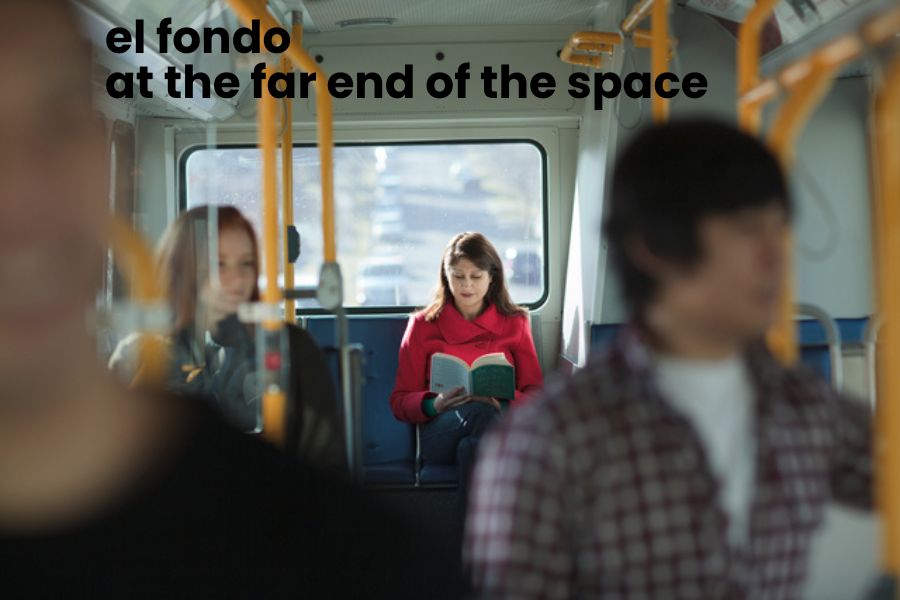
In photography, planes of depth show up because of where you focus. A camera’s focus is lateral, not linear. As a photographer, I like ‘background’, ‘foreground’, ‘middle ground’ etc when I’m describing things I see. But these can be long phrases in Spanish, harder for me to remember and they come with what seems like a lot of parts LOL
I like ‘el fondo’. I originally came across el fondo for background. But it does more.
The sentence I started with: Hay un jardín al fondo de la casa.
al fondo literally means “at the depth / at the far end.”
Not just “back” like behind the house – more like deep inside the space, at the furthest point you can see.
Fondo basically means “bottom” or “depth.” From that core idea, it branches:
Physical depth
- el fondo del mar → the bottom of the sea
- el fondo del vaso → the bottom of the glass

Visual background
- el fondo de la foto → the background of the photo

Abstract depth
- en el fondo → deep down / at heart
- el fondo del asunto → the heart of the matter
Money
- un fondo de inversión → an investment fund
prepositions
el fondo → the background
al fondo → far end of a space
en el fondo → at the bottom / deep down
de fondo → background layer
‘en’ el fondo
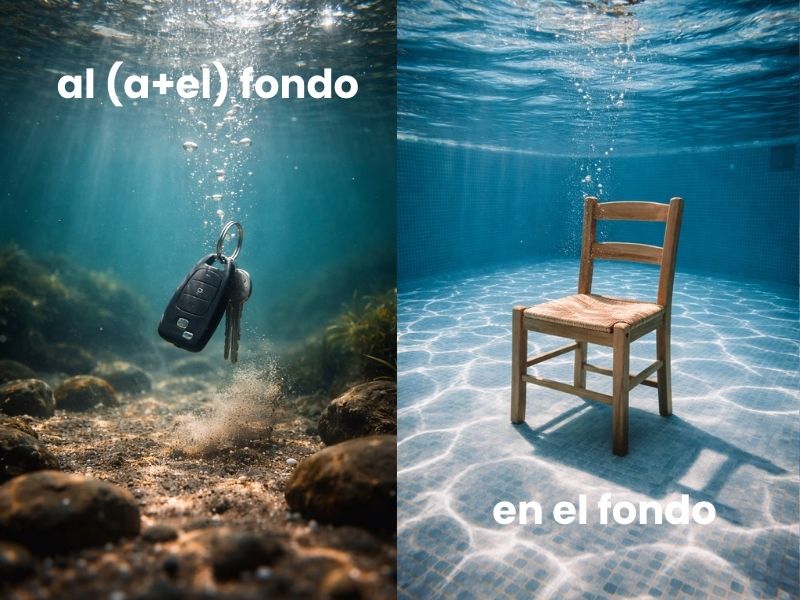
When you’re describing location (something physically sitting at the bottom), Spanish almost always uses ‘en’
Because el fondo is treated as a place. And places need a preposition.
Think structure, not vocabulary:
- Está en el fondo del mar. (location)
- Hay arena en el fondo del vaso. (location)
- La pelota está en el fondo de la piscina. (location)
‘al’ fondo (a + el)
al fondo → at the far boundary / at the depth limit.
Movement only appears if the verb expresses movement.
- La llave cayó al fondo del lago. → The key fell to the bottom of the lake. (farthest boundary)
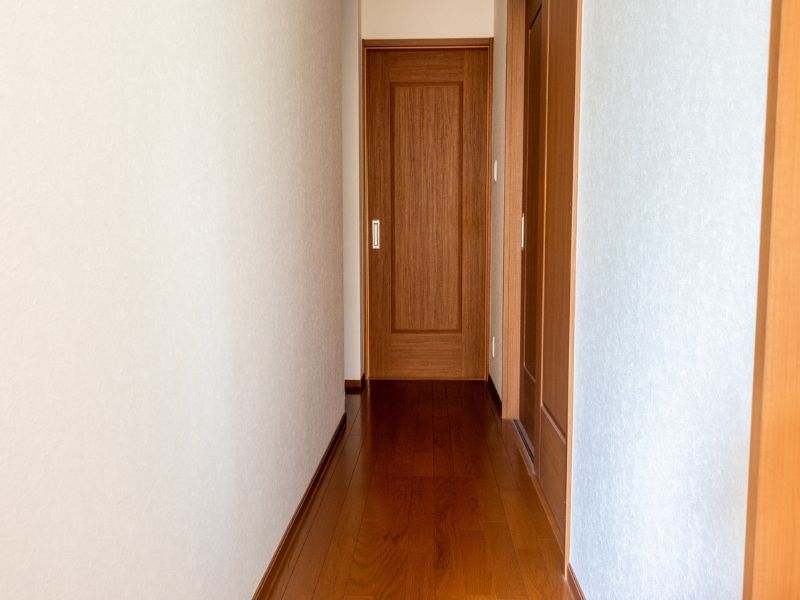
- al fondo del pasillo → at the end of the hallway (farthest boundary)
‘de’ fondo
When you say: música de fondo you’re not describing location.
You’re describing the type or role of the music.
It’s not “music at the back.” It’s “music that functions as background.”
So de fondo works like a classifier.
- ruido de fondo (background noise)
- voz de fondo (background voice)
- imagen de fondo (background image)
- color de fondo (background color)
Here, de fondo means: “serving as the background layer.”
Classifier Phrases / Noun Phrases
These are classifier phrases, also noun phrases, the noun being ruido, voz, imagen – all modified, like an adjective, with de fondo, which describes them as being background things.
In Spanish, a noun can describe another noun by being placed inside a de-phrase.
That phrase then functions like an adjective.
Example:
- ruido fuerte → strong noise (quality)
- ruido de fondo → background noise (type / role)
Both modify ruido.
One uses an adjective.
One uses a noun inside a small phrase.
Using Adjectives with fondo
If you want to say “noisy background” using fondo and an adjective, you say: fondo ruidoso
- El video tiene un fondo ruidoso.
The video has a noisy background.
Compare:
- ruido de fondo → background noise (the noise is the focus)
- fondo ruidoso → noisy background (the background is the focus)
Same words. Different perspective.
Fondo always means “the deepest layer of something.”
What changes is what kind of “something” you’re talking about.
Physical container
→ en el fondo del vaso (bottom inside a container)
Long space with a visible end
→ al fondo del pasillo (at the far boundary)
Layered context (sound, image, etc.)
→ música de fondo (background layer)
Spanish keeps one noun — fondo — and lets the preposition show what kind of depth is involved:
- en → inside depth
- al → boundary depth
- de → background layer / descriptive role
You’ll hear it all the time in everyday speech.
Physical space:
- El baño está al fondo.
- Siéntate hasta el fondo. (sit further back)
- Hay una mesa al fondo del restaurante.
Container depth:
- Está en el fondo del cajón.
- Se me cayó la moneda al fondo del vaso.
Emotional / abstract:
- En el fondo, sí quiero ir. (deep down…)
- Ese es el fondo del problema.
Photography:
- El fondo está desenfocado.
De Mis Compañeros
- Sigue derecho hasta el fondo.
Go straight all the way to the end. - Camina hasta el fondo del pasillo.
Walk all the way to the end of the hallway.
Now compare:
- Está al fondo. → It’s at the back. (location)
- Ve hasta el fondo. → Go all the way to the back. (movement)
- El ascensor está hasta el fondo. The elevator is all the way at the back.