
Ponerse
Geetha said: “Hay muchas ponerme al día.”
This sent me down the spanish rabbit hole of ‘ponerse’.
A Fixed Expression:
Ponerme al día = “To catch up”
Literally: “to put myself up to date”
You can catch up with someone or on something.
📌 1. Catching up on something (info/tasks/news/work):
- Tengo que ponerme al día con el trabajo. – I have to catch up on work.
- No he leído nada. Voy a ponerme al día con las noticias. I’m going to catch up on the news.
- Me puse al día con los correos esta mañana. I caught up on emails this morning.
🧠 Often used when you’ve fallen behind and need to get current.
📌 2. Catching up with someone (reconnecting):
- ¡Tenemos que ponernos al día pronto! We need to catch up soon!
- ¿Quieres tomar un café y ponernos al día? Want to grab coffee and catch up?
- Nos pusimos al día ayer por teléfono. We caught up yesterday on the phone.
🧠 Used like English “catch up” in the sense of sharing life updates or reconnecting
The Big Takeaway:
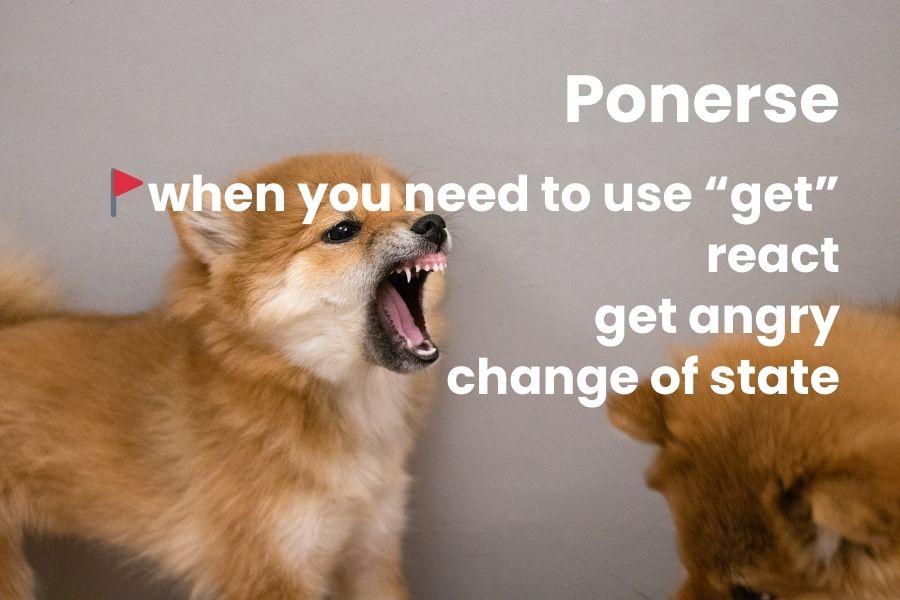
In Spanish, you often use ponerse where English would use “get.”
- Get sad → Me pongo triste
- Get nervous → Se puso nervioso
- Get started → Nos pusimos a trabajar
💡 When English says “get + [emotion/action],”
→ Spanish often says “put oneself into [emotion/action]” = ponerse
Why poner/put?
Spanish uses “poner” in tons of expressions that aren’t literally about putting something down — it’s often about bringing yourself into a state:
- Ponerme al día = get myself caught up
- Ponerme nervioso = make myself nervous
- Ponerme de pie = stand up (put myself on my feet)
- Ponerme triste = make myself sad
It’s about moving from one state to another.
It is very common to use poner this way in Spanish.
In fact, “poner + pronoun + something” is one of those super versatile, high-frequency patterns that native speakers use all the time without even thinking about it.
Because poner often means “to put [someone/something] into a state or condition” — emotionally, physically, mentally, or even situationally.
This makes it perfect for talking about how you feel, act, or adapt, which is why it shows up everywhere.
Common everyday uses of “poner + pronoun”:
| Expression | Meaning | Example |
| Ponerme al día | To catch up | Necesito ponerme al día con el trabajo. |
| Ponerme nervioso/a | To get nervous | Me pongo nerviosa antes de hablar en público. |
| Ponerme triste | To get sad | Esa canción me pone triste. |
| Ponerme contento/a | To get happy | Me puse contenta al verlo. |
| Ponerme de pie | To stand up | Me puse de pie al entrar el profesor. |
| Ponerme serio/a | To get serious | Ahora sí, me pongo serio. |
| Ponerse a + verb | To start doing something | Me puse a estudiar temprano. |
🧭 What poner really does in these cases:
| Pattern | Meaning | Example | English Logic |
| ponerse + emotion | I become / feel | Me pongo triste | I get sad |
| ponerse + adjective | I change state | Se puso nervioso | He got nervous |
| ponerse + de pie | I change physical position | Nos pusimos de pie | We stood up |
| ponerse a + verb | I begin doing something | Me puse a estudiar | I started studying |
| ponerme al día | I bring myself up to date | Tengo que ponerme al día | I need to catch up |
So ponerse is to put oneself into:
🟢 Emotional or mental states
These describe internal feelings or moods (temporary or reactive):
- Me pongo triste – I get sad
- Se puso nervioso – He got nervous
- Nos ponemos felices – We get happy
- Te pones enfermo fácilmente – You get sick easily
- Me pongo de mal humor – I get in a bad mood
Se pusieron cansados – They got tired
🟡 Physical or bodily positions
These describe posture or physical body placement:
- Me puse de pie – I stood up
- Se puso de rodillas – He got down on his knees
- Nos pusimos firmes – We stood firmly (like for attention)
- Te pusiste pálida – You went pale
- Me puse derecho/a – I straightened up
🔴 Visual or situational appearance changes
These are external changes to how someone looks or presents — often involuntary or emotional:
- Se puso rojo – He turned red (blushed)
- Te pusiste pálida – You went pale
- Ponerse en marcha – to get going / start moving (vehicles or people)
- Ponerse en camino – to set out / hit the road
- Ponerse elegante – to get dressed up
- Se pusieron serios – They became serious (this could go here or in emotions depending on context)
You will use ponerse a lot to replace “get” when talking about emotions, mood, or physical condition
- I get nervous → Me pongo nervioso
- She got sick → Se puso enferma
You will use ponerse a a lot to replace “start to” when talking about beginning an action (especially sudden or emotional)
- He started yelling → Se puso a gritar
- We started working → Nos pusimos a trabajar
You’re not really learning 10 meanings of poner.
You’re seeing one root pattern applied to multiple real-life scenarios.
And that pattern = “put yourself into something.”
My thinking: I prefer literal translation because then I can reverse engineer thinking in Spanish.
But this is:
– I put myself into sad
– He put himself into nervous
– We put ourselves into standing
These are very difficult to think of when the starting point is english and “I get sad”.
ChatGPT answer: You’re not wrong — what you’re hitting on with ponerse is deep structure, not just vocab.
Your literal translations are 100% accurate:
And you’re absolutely right — “These are very difficult to think of when the starting point is English: I get sad.
Because English starts with the result (the emotion), while Spanish starts with the action of becoming that.
💥 What you’re describing is not just a verb — but a conceptual shift: Spanish tracks the moment of transition, not just the state.
The poner structure is:
- Reflexive (it happens to me)
- Dynamic (it’s a change)
- Predictable, once you stop trying to match it to English syntax
Step 1: Understand the shape of the idea
All ponerse sentences are about this basic shift.
(Subject) + se + puso / me pongo / nos pusimos + [emotion / action]
- “I changed into a new state.”
- “They entered a new emotion.”
- “She started doing something.”
Let’s say this in English using literal Spanish logic:
- “I put myself into nervous.”
- “She put herself into crying.”
- “They put themselves into happy.”
🧠 Practice goal:
Start recognising these “state shifts” in your English before you reach for Spanish.
Practicing spotting when an idea involves a change of state, emotion, or action, especially to yourself.
Step 2: Chunks
Let’s play with building blocks in English, but following Spanish reflexive structure:
| Subject | Reflexive | Verb (tense) | State |
|---|---|---|---|
| I | me | pongo | triste |
| He | se | puso | nervioso |
| We | nos | pusimos | de pie |
| She | se | pone | contenta |
| They | se | pusieron | a estudiar |
🧠 Practice goal:
Start forming mini combos — just “subject + reflexive + ponerse + state” as a muscle memory drill. No need for full sentences yet.
Step 3: Spot the State Change
Before using ponerse in Spanish, you first need to recognize the moment of change in English.
🧠 Practice goal:
Train yourself to spot when someone enters a new emotion, action, or physical state — because this is where ponerse lives in Spanish.
Instead of translating, your job is to:
- Read a natural English sentence
- Identify the state change
Step 4: Rebuild Full Sentences with Ponerse
You’re no longer just identifying emotional shifts — you’re translating entire, natural moments using ponerse in context.
🧠 Practice goal: Use full ponerse expressions inside realistic situations — just like you would in conversation or storytelling.