
Ponerse: To Start
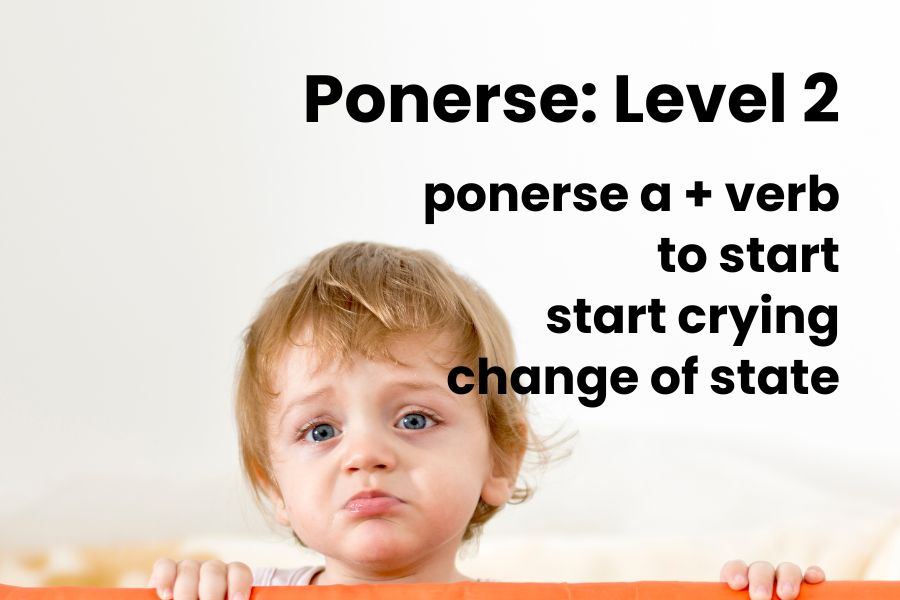
What is ponerse a + verb?
It means: To start doing something, often suddenly or emotionally.
So instead of saying “empezar a…” (which is also correct), ponerse a gives a more emotional, reaction-based feeling
Ponerse + emotion versus Ponerse a + verb
Both use the same literal idea: “to put oneself into a state”, following the same reflexive pattern.
- With ponerse + emotion, you use an adjective or state word (triste, nervioso, enojado).
- With ponerse + a + verb, you use an infinitive action (a llorar, a gritar, a trabajar).
🟥 Ponerse + emotion = “got” (got angry, got sad, got nervous)
🟩 Ponerse a + verb = “started” (started crying, started laughing, started working)
| Ponerse + emotion | Ponerse a + verb | English meaning |
|---|---|---|
| Me puse triste | Me puse a llorar | I got sad / I started crying |
| Se puso nervioso | Se puso a gritar | He got nervous / He started yelling |
| Nos ponemos serios | Nos ponemos a trabajar | We get serious / We start working |
| Te pusiste contenta | Te pusiste a cantar | You got happy / You started singing |
| Se pusieron alegres | Se pusieron a reír | They got cheerful / They started laughing |
⚡ Feel the difference:
Spanish learners:
✅ Start with empezar → because it’s simple, logical, and direct
✅ Gradually adopt ponerse a → because it feels more human and pops up constantly in real-life Spanish
Empezar is the literal act of beginning — like starting a race.
Ponerse a is the human version — emotional, reactive, and often spontaneous.
What is the “a” in ponerse a + verb?
You’re totally right — this “a” is not:
- ❌ the personal “a” (used before people: Veo a María)
- ❌ a preposition tied to direction: Voy a la tienda
Instead, this “a” is a grammatical connector — it’s required in certain verb structures when one verb is followed by another in infinitive form.
📚 It belongs to a group of “verb + a + infinitive” constructions.
Some key examples:
| Structure | Meaning | Example |
|---|---|---|
| Ponerse a + verb | to start doing something | Me puse a estudiar |
| Empezar a + verb | to begin doing something | Empezó a correr |
| Volver a + verb | to do something again | Volvieron a intentarlo |
| Aprender a + verb | to learn to do something | Aprendí a nadar |
| Comenzar a + verb | to begin doing something | Comenzó a reír |
In all of these, “a” is like a bridge — it connects the main verb to the action you’re talking about.