
Por vs. Para: #2 Duty vs. Support
Por v Para: #1 Reaction v Intention
Por vs. Para: #2 Duty vs. Support
Por vs. Para #3: In Order To
Por vs. Para #4: Direction and Movement
To Work For Someone
Use para if you work as an employee for someone.
Use por if you work because of or on behalf of someone.
Example:
Trabajo para ella. = I work for her (she’s my boss).
Trabajo por ella. = I work because of her (she’s my motivation, or maybe she’s sick and I’m filling in).
Is this only for work?
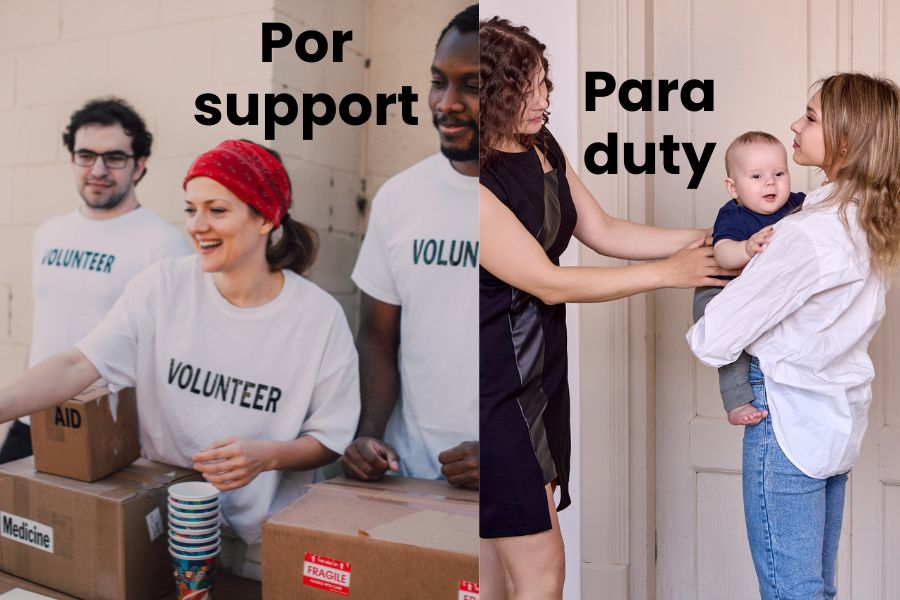
Duty vs. Support
No, this isn’t only for work. The same logic — para = under someone’s authority or benefit, por = because of or on behalf of someone — applies in many situations where one person is involved in an action that affects another.
PARA = you’ve been told to / it’s your duty
POR = you’re helping out / stepping in
| Type of situation | Use | Why |
|---|---|---|
| You’re under someone’s authority | para | They told you / assigned you the task |
| You’re doing it for someone’s benefit (like a gift or support) | para | You had them in mind, they’re the goal |
| You’re doing it because of someone | por | Their situation or need motivated you |
| You’re stepping in instead of someone | por | They couldn’t do it, so you’re covering for them |
Real Examples Beyond Jobs:
Estoy cuidando a los niños para mi hermana.
→ I’m watching the kids for my sister (she asked me, she’s in charge = she benefits)
Estoy cuidando a los niños por mi hermana.
→ I’m watching the kids because of my sister (maybe she’s sick or had an emergency = I’m stepping in)
Recojo el paquete para Miguel.
→ I’m picking up the package for Miguel (as a favor or because he asked)
Recojo el paquete por Miguel.
→ I’m picking it up because Miguel couldn’t (I’m filling in / he’s the reason)
Estoy dando clases para mi jefe.
→ I’m teaching because my boss assigned me — it’s my role = para
Estoy dando clases por mi jefe.
→ I’m teaching in his place (maybe he’s sick or on leave) = por
Cuidé la tienda para mi hermana.
→ I watched the shop because she asked me to (she delegated it) = para
Cuidé la tienda por mi hermana.
→ I watched the shop because she couldn’t (she had an emergency or was unavailable) = por
Por = Support, Motivation, Stepping In
A volunteer:
- Acts because of a cause (poverty, education, illness, injustice)
- Steps in to help even when not required
- Isn’t assigned or obligated — they’re moved to act
- Often fills a gap: “they couldn’t, so I did it” → por
Para = Duty, Role, Direction, Benefit
If you’re an employed ambulance driver, that’s para:
- You’re doing it because it’s your role
- Your actions are directed by someone else
- You have a structured duty or chain of command
Question:
Context seems important.
Which says to me that intention is important particularly if the sentence short.
You are choosing para or por specifically for the nuance you mean
and sometimes it can go either way.
Answer: Yes, yes and yes.
1. Context determines por vs. para.
Even the exact same sentence can flip meanings depending on the backstory:
“I picked up the groceries for my sister.”
– ✅ If she asked you to, it’s para
– ✅ If she was sick, and you stepped in, it’s por
2. Short sentences require intention to be clear.
You’re dead right — the shorter the sentence, the more the speaker must know their own nuance.
Without extra detail, you have to choose between two truths:
- Am I saying this was assigned (para)?
- Or am I saying this was supportive / substituting (por)?
3. Por vs. Para is about how you frame the action.
It’s not just grammar — it’s relationship, tone, and motivation.
You control the story by which one you pick.
“Lo hice por él” = I backed him up
“Lo hice para él” = I did it so he’d benefit
Same verb, same pronoun — different dynamic.