
Dejar – leave it, let it, stop, allow, quit, forget.
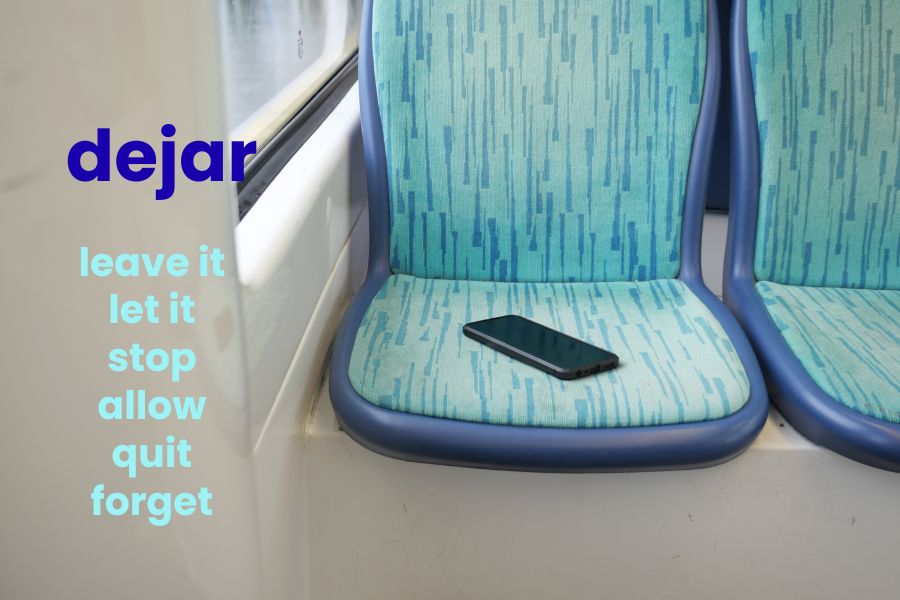
Dejar literally means “to leave,” but in everyday Spanish its reach is much broader. It slips into all kinds of moments where English would split into several verbs — leave it, let it, stop, allow, quit, forget. It’s not always a choice; sometimes it’s just what happens when you don’t interfere.
Dejar isn’t just about what you do; it’s about how you relate to what happens — whether you push, allow, stop, or surrender.
Dejar (algo) → to leave something.
Dejar de (infinitivo) → to stop doing something.
Dejar que (subjuntivo) → to allow/let someone do something.
And because it’s dejar que, the next verb (jueguen) goes into the subjunctive, since it’s about what someone else may do.
Dejar is the hinge between verbs of action and verbs of result.
It’s the space where doing turns into being — where motion stops, or where you stop holding on and something takes its own course.
If you imagine the flow of an event in Spanish grammar terms:
Hacer → Dejar → Quedar
(to do / make → to let / leave → to stay / remain)
The morning that got away
Hice café y traté de trabajar. → I made coffee and tried to get some work done.
Dejé el trabajo por la mitad. → I left the work half-done.
Quedó el café frío y los correos sin responder. → The coffee ended up cold and the emails unanswered.
💬 Dejar is the pivot.
It’s the moment when the subject’s control releases, and the state that follows (quedar) begins.
How it’s used
To leave something or someone (physically or emotionally)
The most literal sense — to not take something/someone with you.
- Dejé las llaves en la mesa. → I left the keys on the table.
- Me dejó por otro. → They left me for someone else.
To let / allow / permit
When followed by another verb in infinitive.
- Déjame hablar. → Let me talk.
- No te dejan entrar. → They don’t let you in.
To stop doing something
Used with de + infinitive → dejar de + [verb].
- Dejé de fumar. → I stopped smoking.
- No dejes de soñar. → Don’t stop dreaming.
- No podía dejar de pensar en eso. → I couldn’t stop thinking about it.
- No podía dejar de leer hasta saber el final. → I couldn’t stop reading until I knew how it ended.
To quit / give up / abandon
More deliberate or permanent.
- Dejó su trabajo. → He quit his job.
- Dejó la carrera. → She dropped out of university.
To leave behind / cause / allow to remain
To leave something in a certain state or condition.
- Dejó la puerta abierta. → He left the door open.
- Me dejó impresionado. → It left me impressed.
To entrust / leave something for someone
Often followed by indirect object pronoun.
- Le dejé una nota. → I left her a note.
- Te dejo mi coche. → I’ll leave you my car.
dejar — its personality, not its grammar.
I was outside having a cigarette when the music I could hear from the house across the street stopped.
You’re the observer at the moment of stopping, not the one causing or explaining it.
That’s why it feels so natural for things like:
Dejó de llover. — It stopped raining.
La música dejó de sonar. — The music stopped playing.
Forum examples
Déjame verlo. → Let me see it.
Déjame pensarlo. → Let me think about it.
Déjalo. → Let it go.
Dejar caer. → To drop.
Dejar a alguien. → To drop someone off somewhere.
Dejé a mi hija en la escuela más temprano. → I dropped (lit. left) my daughter off at school earlier.
Dejé de fumar. → I quit smoking. (Kind of “I left from smoking.”)
Déjalo ir. → Let it go.
¡Déjame saber! → Let me know!
¡Me dejaste plantado! → You stood me up. (Literally “planted.”)
¡Me dejaste tirado! → You left me stranded. (Literally “thrown” or “tossed.”)
Dejarse + infinitivo → permitirse hacer algo; letting or allowing yourself to do something.
Déjate llevar. → Let yourself go. (Literally “Let yourself be carried away.”)
Contexto: En la canción “Suave”, LuisMi canta: “Déjate llevar con la música que te incita.”
Traducción y significado: “Let yourself go with the music that excites you” — an invitation to immerse yourself in a sensory experience.
Dejé tu celular en la mesa esta mañana. → I left your phone on the table this morning.
¡Me dejaste sin palabras! → You left me speechless!
Me dejé fumar un cigarrillo. → I let myself smoke a cigarette.
¡No te dejes enfadar! → Don’t let yourself get mad!
Le eché demasiada tierra a Gabby y me dejé expuesto a una demanda. 😂 → I talked too much smack about Gabby and left myself open to a lawsuit!
I have really only used “dejar” at work, as a physical therapist working on balance, or testing strength for example. “No dejes que te mueva”, as in, don’t let me move you, keep your balance, maintain your position. Or “no dejes que te mueva el brazo” as in, don’t let me move your arm. I feel like it’s one of those words that has a lot of many meanings!
Here’s how you’ll probably use and hear it in real life:
Everyday logistics — leaving or placing things
You’ll say or hear it whenever you put or leave something somewhere:
- ¿Puedo dejar mi mochila aquí? → Can I leave my backpack here?
- Dejé las llaves en la recepción. → I left the keys at reception.
- Te dejo la ropa limpia en tu cuarto. → I’ll leave your clean clothes in your room.
✅ Tip: this is the polite, neutral way to ask if you can set something down — people use it constantly in shops, cafés, and houses.
Polite or practical interactions
- ¿Me deja aquí, por favor? → Can you drop me here, please? (to a taxi driver)
- Lo dejo en la esquina. → I’ll drop you off at the corner.
- Te dejo mi número. → I’ll leave you my number.
✅ These are everyday, friendly, functional uses — you’ll sound natural right away.
Polite exits or transitions
- Bueno, te dejo. → Okay, I’ll let you go (ending a chat or phone call).
- Los dejo para que sigan trabajando. → I’ll leave you so you can keep working.
✅ Used all the time to end a conversation gracefully — sounds considerate, not abrupt.
Emotion & boundaries
- Déjalo así. → Leave it / it’s fine (end a discussion or stop adjusting something).
- Déjame en paz. → Leave me alone (stronger, emotional).
- Déjalo, no te preocupes. → Don’t worry about it, forget it.
✅ These give you emotional control — you can de-escalate, reassure, or set a boundary without sounding harsh.
“Stop doing” something
- Ya deja de tomar tanto café. → Stop drinking so much coffee.
- No dejé de pensar en esa familia. → I couldn’t stop thinking about that family.
- Dejé de estudiar español un tiempo. → I stopped studying Spanish for a while.
✅ You’ll hear this reflexively from locals too — light teasing, caring correction, or storytelling.
Letting things be / trusting
- Déjalo ser. → Let it be.
- Déjate llevar. → Go with the flow / let yourself go.
✅ These turn up in more personal or reflective moments — friendly advice, encouragement, or humor.
Volunteering or community work
You might use dejar when coordinating or offering help:
- ¿Dónde dejo esto? → Where should I put this?
- Te dejo los papeles firmados. → I’ll leave you the signed papers.
- Déjalo aquí, yo me encargo. → Leave it here, I’ll handle it.
✅ That last one — yo me encargo — pairs naturally with dejar, and you’ll hear it a lot in teamwork settings.
In short:
💡 Dejar is your “soft action” verb — it lets you do things, stop things, and move through space and conversation without pushing.
If you get comfortable with ¿Puedo dejar…?, Te dejo…, Déjalo así, and Ya deja de…, you’ll sound relaxed and natural in Mexico.
10-phrase dejar field list
Built for exactly how you’ll move through Mexico as a traveller, student, or volunteer.
Each one’s small, natural, and covers a slightly different real-life function:
¿Puedo dejar esto aquí? Can I leave this here?
¿Me deja aquí, por favor? Can you drop me here, please?
Bueno, te dejo. Alright, I’ll let you go. Everyday way to end a call or conversation kindly. You’ll hear it constantly.
Los dejo para que sigan trabajando. I’ll leave you so you can keep working.
Déjalo así. Leave it like that / it’s fine. Use it for “good enough” moments — someone tidying too much or over-fixing something.
Déjame ver. Let me see. Everyday filler — reaching for your phone, checking directions, reading a form.
Te dejo los papeles / las cosas aquí. I’ll leave the papers / things here for you.
Déjate llevar. Go with the flow.
No dejes de visitar ___ . Don’t miss visiting ___. Locals use this with travellers all the time
Ya deja de ___ . Stop ___ already. Soft scolding or playful tone.
💡 These cover your physical, social, emotional, and conversational movement.
They’re short, flexible, and all sound completely natural in Mexico.