
The accidental se is about the lack of intention or purpose
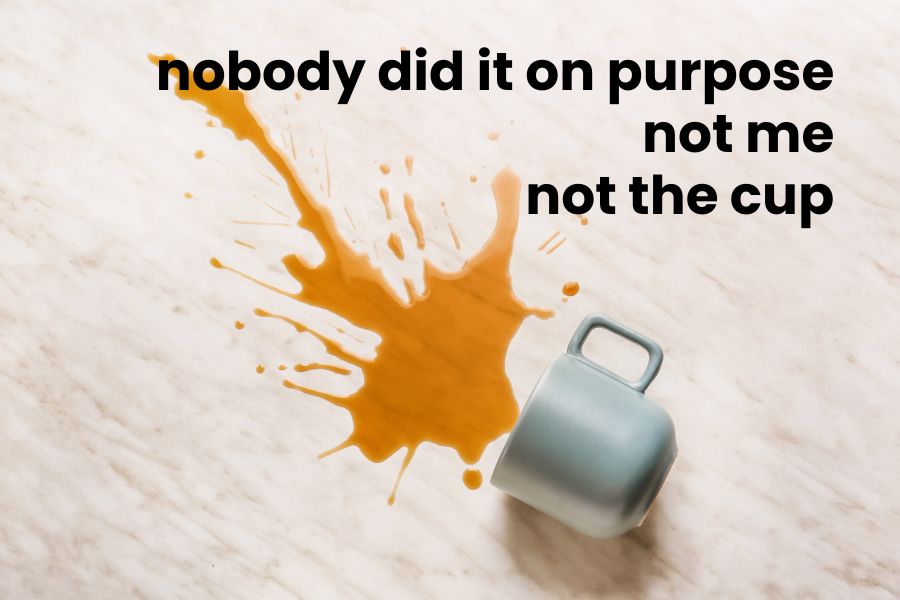
The accidental se is about the lack of intention or purpose.
The majority of verbs are actions of intent and reality, things that are done on purpose – talk, walk, complain, fly, live, grow, change. Even things that are outside of our control like growing and breathing, are by design.
But there are a group of verbs that are used for actions that happen that we don’t do on purpose – fall, break, lose, forget – nobody purposely does these.
I dropped the cup.
If I didn’t drop the cup on purpose then Spanish grammar puts ( I ) to one side – and focuses on the rest of the action in the sentence.
( I was there when ) The cup dropped.
If I didn’t do it on purpose, then the verb/action needs to be allocated to the actual thing that happened.
If I didn’t do it, then what happened?
The cup fell.
La taza cayó.
Note that the verb is conjugated to the cup/object using the third person.
But the cup didn’t do it on purpose either, because it can’t – it has no intention.
This is when you use accidental se.
Spanish acknowledges that there was no will behind the action. Nobody did it. It just happened. Se signals that orphaned action.
Se cayó la taza.
Now I am an Indirect Object
I was there during the action, but I didn’t do the action.
The action affected me as a second order effect.
As a bystander to the action – I automatically become the IDO.
The first order event is the cup falling. That’s the primary action. Se cayó la taza.
I am the second order effect — I didn’t cause it, I didn’t do it, but I was in the blast radius. It affected me. I am the collateral.
And that’s exactly what the IDO marks in Spanish. The person who caught the consequences.
Se me cayó la taza.
It’s important to Return to ‘Intention’
If the cup was purposely dropped, English would use:
She threw it. She knocked it off. She pushed it off. She smashed it down.
Spanish has intentional verbs for these actions as well.
Note the difference:
Se le cayeron las llaves en el mostrador.
- If she placed the keys on the counter — intentional — you’d just say Puso las llaves en el mostrador.
- Intentional needs a specific verb choice: puso
- Intentional needs a specific verb choice: puso
- But se le cayeron las llaves en el mostrador — the keys fell onto the counter. They landed there.
She didn’t place them, they dropped out of her hand and landed on the counter rather than the floor.
- Unintentional uses a different verb choice: fall
this is where verb/vocab choice comes in
For the English speaker, we need to find the verb that would accurately work with the object, during an unintentional action.
Once you remove the human as the doer, you need a verb that actually makes sense when the object is doing it.
(Again note that the verb is conjugated to the object.)
Se cayó la taza. — the cup did the falling
Se olvidó la cita. — the appointment was the thing forgotten
I missed the bus
English makes you the subject who failed. But you didn’t do anything — the bus left.
Now Instead, think: the bus went before I got there
We need the right verb for what the bus did. It stopped at the bus stop and then left for the next stop.
Spanish reaches for irse — the bus went away. Se me fue el autobús. — The bus left (and I was affected).
Spanish looks at what actually moved, what actually ended, what actually disappeared — and gives the verb to that thing.
The English speaker needs to find the verb that would accurately work with the object, during an unintentional action.
10 Accidental Verbs CLICK HERE
Why is me sitting between se and the verb rather than before.
Think about what the sentence is actually saying in layers:
Se cayó la taza — the cup fell (accidentally, no owner, no person)
Now you need to add “and I was there, it happened to me.” You’re inserting yourself into an already complete accidental event.
You’re not the subject — that slot is taken by the cup.
You’re attaching yourself to the action as the affected bystander.
So you slot in between the accident (se) and the action (cayó) — because that’s exactly where you sit in the story.
After the accident is flagged, before the action lands.
Se — (this was accidental)
me — (and I was the one it happened to)
cayó — (the falling)
la taza — (the cup did it)
You’re not before se because you didn’t initiate anything. You arrive after the accident is already flagged.