
Relative Pronouns
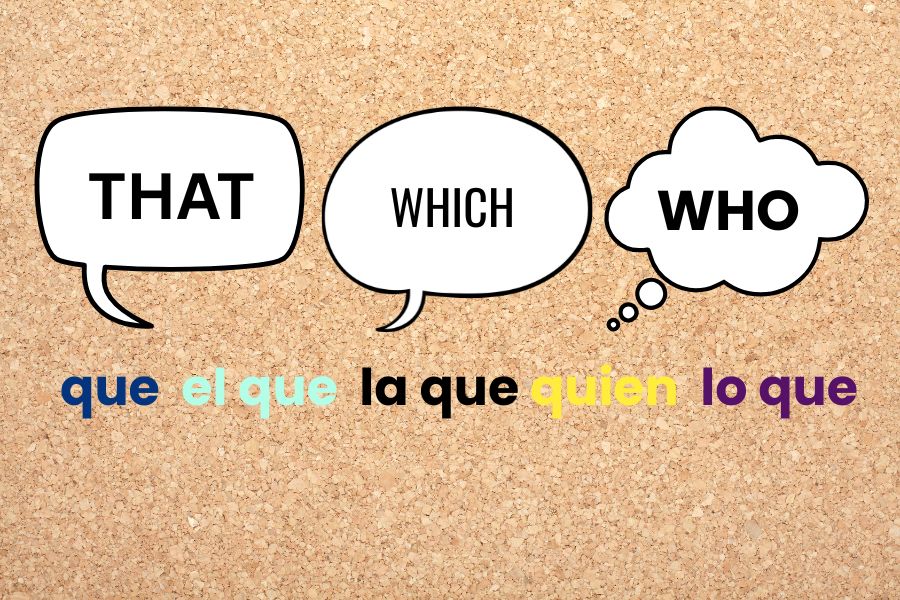
A relative pronoun is a word that links a description (“relative clause”) to a noun, so you can add extra info about which one / what kind / who you mean.
In English, the main relative pronouns are: who / whom , which , that, whose
English has a small kit
Spanish has a bigger kit: que, el que, la que, quien, lo que
Relative Pronouns
QUE for identifying a noun (restrictive clauses)
Use que when the clause tells you which one.
noun + que + verb
Examples
- La persona que vive aquí
- El hombre que trabaja conmigo
- La chica que me llamó ayer
- El libro que compraste
- El lugar que te gusta
Preposition + EL QUE / LA QUE / LOS QUE / LAS QUE
Use this when English ends with a preposition. In English, the preposition gets stranded at the end.
Spanish doesn’t allow that — it pulls the preposition forward and attaches it to el/la/los/las que. (with, about, to, of).
“the woman I spoke with”
“the topic we talked about”
“the place I’m going to”
“the person I fell in love with”
preposition + el/la/los/las que + verb
English ends with a preposition → Spanish pulls it away from the end
WITH
English: The woman (who) I spoke with is nice.
Spanish: La mujer con la que hablé es simpática.
English: The people (that) I go out with are funny.
Spanish: Las personas con las que salgo son graciosas.
ABOUT
English: The topic (that) we talked about is interesting.
Spanish: El tema del que hablamos es interesante.
English: The problem (that) she complained about is real.
Spanish: El problema del que se quejó es real.
TO
English: The city (that) I’m moving to is expensive.
Spanish: La ciudad a la que me mudo es cara.
English: The place (that) we’re going to is far.
Spanish: El lugar al que vamos está lejos.
OF / FROM
English: The topic (that) I’m thinking about is important.
Spanish: El tema en el que pienso es importante.
English: The idea (that) I’m thinking about is interesting.
Spanish: La idea en la que pienso es interesante.
English: The person (that) I’m talking about is my boss.
Spanish: La persona de la que hablo es mi jefa.
Verbs with prepositions force the structure
Some verbs require a preposition like:
- hablar de / con (about / with)
- pensar en (think about)
- depender de (depend on)
- cuidar de (take care of)
- preocuparse por (worry about)
You can’t drop the preposition (because the verb requires it)
You can’t leave it hanging at the end like English does
Examples:
- La persona de la que me enamoré
- El hombre del que me quejé
- La mujer con la que hablé ayer
- El tema del que hablamos
QUIEN / QUIENES (optional, people only)
Use quien/quienes only when the relative clause starts with a preposition (e.g. con, de, a, en, etc).
preposition + quien/quienes + verb
Quien/quienes has the exact same “problem” as el que/la que because it’s used in the same structural situation:
When the English sentence ends with a preposition like with / about / to / from / of, Spanish must pull that preposition forward into the sentence.
So you get:
- The woman I spoke with
→ La mujer con quien hablé
(or con la que) - The person I’m talking about
→ La persona de quien hablo
(or de la que)
Key rule (stupidly simple)
If you’re using quien, it will almost always be:
con quien / de quien / a quien / en quien / por quien / para quien
Treat them like set phrases:
con quien = with whom / who…with
de quien = of/from/about whom
a quien = to whom / whom (as object, esp. people)
en quien = in/on whom (less common, but legit)
por quien = because of whom / by whom
para quien = for whom
LO QUE for ideas, situations, events
Use lo que when English would use “what” (the thing that / what happened / what you said) — not a specific named noun.
It refers to an idea/event, not a named noun like el libro / la mujer / la casa.
Mental rule:
- QUE attaches to a noun: el libro que…
- LO QUE means “what…” (no noun stated)
lo que + verb
Examples that show the meaning (not just grammar)
- No entendí lo que dijiste.
= I didn’t understand what you said. - Lo que pasó ayer fue raro.
= What happened yesterday was weird. - Dime lo que quieres.
= Tell me what you want. - Lo que más me gusta es viajar.
= What I like most is travelling. - Eso es lo que necesito.
= That’s what I need.
Optional formal equivalents (recognition only)
- el cual / la cual / los cuales / las cuales
= just the more formal / more written version of el que / la que / los que / las que.
Same meaning. Same job. Just fancier clothes.
Where you’ll see it:
- news articles
- official documents / government / legal-ish writing
- academic writing
- sometimes novels (especially more formal narrative voice)
In everyday speech in Mexico? Basically:
- “who are you trying to sound like, the constitution?”
1) QUE for identifying a noun (restrictive clauses)
Exercise 1A — Choose QUE only
Translate using QUE only.
(No commas. No el que. No quien.)
- The student who won the prize is happy.
- The woman who lives here works with me.
- The neighbors who complain a lot moved away.
- The book that changed my life is short.
Exercise 1B — Fill in the gap
Complete with que.
- El amigo ___ vive aquí es ingeniero.
- Las personas ___ trabajan conmigo son pacientes.
- La película ___ vimos ayer fue mala.
2) Preposition + EL QUE / LA QUE / LOS QUE / LAS QUE
Exercise 2A — English → Spanish restructuring
Translate.
(Move the preposition forward.)
- The woman I spoke with is here.
- The problem we talked about is serious.
- The place I’m going to is far.
- The people I go out with are friendly.
Exercise 2B — Complete the sentence
Use the correct form of el que / la que / los que / las que.
- La mujer con ___ hablé es doctora.
- El tema del ___ hablamos es importante.
- Las personas con ___ salgo viven cerca.
- El lugar al ___ vamos está cerrado.
3) QUIEN / QUIENES (optional, people only)
Exercise 3A — Rewrite with QUIEN / QUIENES
Rewrite the sentence using quien or quienes.
- La mujer con la que hablé es doctora.
- Los amigos con los que viajé viven lejos.
- Mis padres, que viven lejos, vienen mañana.
Exercise 3B — Decide if QUIEN is possible
Write YES or NO.
- La mujer con ___ hablé ayer.
- La persona de ___ me enamoré.
- Las ciudades en ___ viví eran bonitas.
- Mis amigos, ___ viven en México, vienen mañana.
(Answers: 1 YES, 2 YES, 3 NO, 4 YES)
4) LO QUE for ideas, situations, events
Exercise 4A — QUE or LO QUE
Choose QUE or LO QUE.
- ___ dijiste ayer fue raro.
- La cosa ___ más me molesta es el ruido.
- ___ pasó ayer no fue normal.
- El problema ___ tenemos es el tiempo.
- ___ quiero ahora es dormir.
Exercise 4B — Sentence start
Translate using LO QUE at the beginning.
- What I like most is traveling.
- What happened yesterday doesn’t matter.
- What she said surprised me.
5) Verbs with prepositions force the structure
(enamorarse de / quejarse de / hablar de / con)
Exercise 5A — English → Spanish
Translate.
(Use the verb’s required preposition.)
- The person I fell in love with lives far away.
- The man I complained about just arrived.
- The woman I spoke with yesterday is here.
- The topic we talked about is boring.
Exercise 5B — Complete the sentence
Fill in the missing words.
- La persona ___ la que me enamoré vive lejos.
- El hombre ___ que me quejé se fue.
- La mujer con ___ hablé ayer llegó tarde.
- El tema ___ que hablamos es complicado.
Optional formal equivalents (recognition only)
Exercise 6 — Recognition
Rewrite using el cual / la cual / los cuales / las cuales.
- Las razones por las que me fui son personales.
- La empresa para la que trabajo es pequeña.
“Dangling” prepositions (English → Spanish)
Exercise 7A — Restructure the English
Translate the Spanish way.
- The friend I went to the movies with is here.
- The city I moved to is expensive.
- The problem we argued about is stupid.
Exercise 7B — Spot the error
Mark ✓ correct or ✗ incorrect.
- ✗ La mujer que hablé con es simpática.
- ___ La mujer con la que hablé es simpática.
- ✗ El tema que hablamos de es difícil.
- ___ El tema del que hablamos es difícil.
Clause types (recognition only)
Exercise 8 — Restrictive or Non-restrictive
Write R or NR.
- The students who passed the exam are happy.
- My sister, who lives in Mexico, is visiting.
- The neighbors who make noise moved out.
- My car, which I bought last year, is already broken.