
The Accidental “Se”
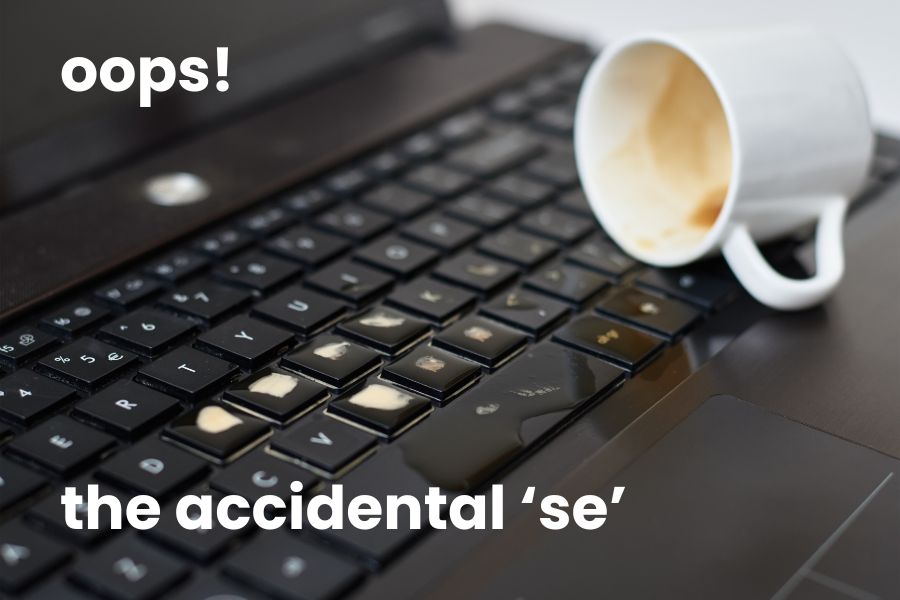
It’s really the “gustar” structure — but for accidents
Gustar sentences are “things happening to a person”
GUSTAR anchor
- A María le gustan las fresas.
- María is not “doing” the verb.
- She’s the affected person.
Accidental “se” uses the same logic
Accidental se works the same way:
the person isn’t doing the action — something happens, and Spanish marks who it happened to.
Accidental SE version
- A María se le cayeron las llaves.
- María is not “doing” the verb.
- She’s the affected person.
Moving from Le Gusta to Le Accidental
A María tiró las fresas (with purpose — drops them from her hands onto the table).
A María se le cayeron las fresas (without purpose — they fall from her hands).
Se le cayeron las fresas.
A él se le cayeron las fresas.
Se le cayeron las fresas.
Se belongs to the verb to show the accidental action.
The verb is conjugated to the thing doing the action — the strawberries are falling.
Le is the standard redundant le from IDO sentences when a person is involved.
If the affected person is named (A María / A él), personal a is required.
You can look at the accidental se like a reflexive verb.
caer → caer(se) → se + le + caer
se + (me/te/le/nos/les) + verb (conjugated)
the pronoun sits in between the ‘reflexive’ and the verb
But only some verbs can be ‘accidental’.
They all describe events that can happen unintentionally or spontaneously:
| Verb | Meaning | Example | Natural “oops” meaning |
| caer(se) | to fall | Se me cayó el vaso. | It fell on me / I dropped it |
| romper(se) | to break | Se le rompió el teléfono. | His phone broke |
| olvidar(se) | to forget | Se me olvidó la cita. | I forgot the appointment |
| perder(se) | to lose | Se nos perdió el gato. | Our cat got lost |
| quedar(se) | to be left / remain | Se me quedó la llave en casa. | I left my key at home |
| quemar(se) | to burn | Se me quemó la comida. | My food burned |
| mojar(se) | to get wet | Se me mojó la ropa. | My clothes got wet |
| acabar(se) | to run out | Se nos acabó la leche. | We ran out of milk |
You add le/me/te/nos/les, to mark who got affected by it.
Se le cayó la taza. → The cup fell on him (he dropped the cup).
Itself (it, the cup) / to him / fell / the cup
Se me rompió el vaso. → The glass broke on me (I broke the glass by accident).
Itself (it, the glass)/ to me / broke / the glass
Se te olvidó la cita. → You forgot the appointment.
Itself (it, the appointment) / to you / forgot / the appointment
Se nos perdió el gato. → Our cat got lost.
Itself (it, the cat) / to us / got lost / the cat
Se les acabó la leche. → Their milk ran out.
Itself (it, the milk) / to them / ran out / the milk
To me these are still unexpected constructions.
If I thought to write or say these things I would never consider either the accidental se or the reflexive IDO.
They feel more like colloquial phrases using not so obvious verbs.
How do I recognise that I will need the accidental se?
🧭 Quick intuition flags — when Spanish wants se + IDO
- Something broke, fell, spilled, burned, disappeared, ran out, got lost, or was forgotten.
- Anytime you’d naturally say in English: “It happened to me / on me / to them / by accident / I ended up…”
How to train your instinct
- When something goes wrong, say it out loud in Spanish using se me / se te / se le / se nos / se les.
→ Drop your pen? Se me cayó.
→ Forget a name? Se me olvidó.
→ Spill your coffee? Se me derramó.
The more you tie real accidents to that phrase pattern, the faster it’ll click.
My keys got left at home → Se me quedaron las llaves en casa.
This is not how you’d say it in English.
English speakers say:
I left my keys at home.
This is where an English speaker gets stuck.
Maybe if you start with oops! Coz you would ‘feel’ it. Oops I left my keys at home.
Then, oh yeah, use ‘se’.
Se me quedaron las llaves en casa
Here are five everyday English sentences that would trigger the accidental se in Spanish:
- I dropped my phone.
- I forgot my wallet.
- The milk went off.
- We ran out of coffee.
- My computer crashed
The Milk Went Off
A perfect anchor sentence — because your brain already gets the logic without needing grammar terms.
“The milk went off.”
You didn’t cause it. You didn’t decide it. It just… happened.
And boy did it happen to you if you poured it into your coffee!
You could say:
1️⃣ acabarse → to run out (finish itself)
Se me acabó la leche.
The milk ran out on me.
(acabar = to finish → reflexive = it finished itself, no more left.)
2️⃣ echarse a perder → to go bad / spoil
Se me echó a perder la leche.
The milk went off on me.
(literally “it threw itself to waste” → means it spoiled.)
“Echarse a perder” doesn’t literally translate to “go bad.” That’s just its meaning in use.
Let’s unpack it straight:
- echar = to throw, toss, put
- perder = to lose
- echar(se) a perder = to throw (oneself) toward losing → metaphorically, “to spoil / to go to waste / to ruin itself.”
I never would have thought to use any combination of these verbs to say the milk went off.
I think there are many everyday accidental se sentences that are more colloquial phrasing than literal translations using the reflexive IDO structures.
And while the majority of the oops-es are probably quite straightforward, I think it would be better to list the 20 most common oops-es in Spanish and learn them as a phrase, not part of a formula.
top-20 “oops” list
Se me cayó el teléfono. → I dropped my phone. (caerse – to fall, drop)
Se me olvidó la cita. → I forgot the appointment. (olvidarse – to forget)
Se me rompieron los lentes. → My glasses broke. (romperse – to break)
Se me acabó la batería. → My battery died. (acabarse – to run out, finish)
Se me quedó la llave en casa. → I left my key at home. (quedarse – to stay, remain)
Se me perdió la cartera. → I lost my wallet. (perderse – to get lost, lose oneself)
Se me mojó la ropa. → My clothes got wet. (mojarse – to get wet)
Se me quemó la comida. → I burned the food. (quemarse – to burn oneself, get burned)
Se me echó a perder la leche. → The milk went bad. (echarse a perder – to spoil, go bad, ruin)
Se me descompuso el coche. → My car broke down. (descomponerse – to break down, stop working)
Se me cayó el café. → I spilled my coffee. (caerse – to fall, drop)
Se me apagó la computadora. → My computer shut off / died. (apagarse – to turn off, shut down)
Se me fue el autobús. → I missed the bus. (irse – to go away, leave)
Se me escapó el gato. → My cat got out. (escaparse – to escape, get away)
Se me cayó Internet. → My Internet went down. (caerse – to fall, drop)
Se nos acabó el pan. → We ran out of bread. (acabarse – to run out, finish)
Se nos pasó la hora. → We lost track of time / we missed it. (pasarse – to pass, go by, slip by)
Se les olvidaron los boletos. → They forgot the tickets. (olvidarse – to forget)
Se le rompió el vaso. → He broke the glass (by accident). (romperse – to break)
Se les dañó el celular. → Their phone got damaged / broke. (dañarse – to get damaged, spoil)
From QRoo
OLVIDAR: 3 versions
1) Olvidar + thing (normal)
Juan olvidó las llaves en la oficina.
2) Olvidarse de + thing (more “I forgot about…”)
Juan se olvidó de las llaves.
3) Accidental se (true “oops”)
A Juan se le olvidaron las llaves.
(se + le + verb agrees with the thing)
Also:
Se nos olvidó apagar la luz.
Se nos olvidó ir a la tienda.
Word list tip: store it as olvidársele = accidental form.
ROMPÉRSELE: accidental version
romperse = to get broken
rompérsele = accidental “oops” version (se + le)
Se te rompió la puerta.
= You broke the door (accidentally).
A ti se te rompió la puerta.
= To you, the door broke (emphasis).
A Juan se le rompió la computadora.
= Juan’s computer broke (on him).
Se me rompieron los vasos.
= I broke the glasses (by accident).
(verb agrees with los vasos → plural → rompieron)
CAÉRSELE
caerse = to fall
caérsele = accidental “to drop something” (se + le)
Se me cayeron las llaves.
= I dropped the keys (by accident).
(verb agrees with las llaves → plural → cayeron)
A mí se me cayeron las llaves.
= Me, I dropped the keys. (emphasis)
A Juan se le cayó el libro.
= Juan dropped the book (accidentally).
A María se le cayó el vaso.
= María dropped the glass (accidentally).
ACABAR
acabarse = to run out / finish
acabársele = to run out of something (se + le)
A María se le acabó el café.
= María ran out of coffee.
A mi profesor se le acabó la paciencia.
= My teacher ran out of patience.
Se acabó.
= It ran out / It’s over / That’s it.
Se me acabó el café.
= I ran out of coffee.
A mí se me acabó el café.
= Me, I ran out of coffee. (emphasis)
Se nos acabaron las opciones.
= We ran out of options.
(verb agrees with las opciones → plural → acabaron)
Word list tip: store it as acabársele.
ANTOJAR: craving (gustar-style)
antojarse = to feel like / to crave
antojársele = craving happens to someone (se + me/te/le/nos/les)
¿Qué se te antoja?
= What are you craving? / What do you feel like?
Se me antoja una hamburguesa.
= I’m craving a hamburger.
OCURRÍRSELE: “it occurred to me” (idea pops in)
ocurrírsele = to occur to someone (se + le)
A Juan nunca se le ocurrió levantarse a las 6 para evitar el tráfico.
= It never occurred to Juan to wake up at 6 to avoid traffic.
Se me ocurrieron tres posibilidades.
= Three possibilities occurred to me.
(verb agrees with tres posibilidades → plural → ocurrieron)
PERDERSE
perdérsele = to lose something (accidentally / it gets lost on you)
literally: “the wallet got lost to Juan”
A Juan se le perdió la cartera.
= Juan lost his wallet. / Juan’s wallet got lost.
Why it’s built like that
- se = accidental / not intentional vibe
- le = affected person (Juan)
- verb agrees with the thing lost: la cartera → perdió (singular)
Also super common without naming the person:
- Se me perdió la cartera. = I lost my wallet.
- Se nos perdieron las llaves. = We lost the keys.