
Verb Stacking – Gerund
Verbs with combo suffixes. I actually like verb stacking, it’s creative.
In the book I’m currently reading I keep coming across verbs ending in -andalo.
El Lápiz Mágico de Sofía by Natalia Núñez.
Gerund Stacking
These words were verbs conjugated for the gerund + a pronoun suffix:
guiñándole
guiñár – to wink
guiñándo – winking (gerund)
guiñándo + le – winking at him/her
Inspeccionándolo
inspeccionar – to inspect
inspeccionando – inspecting
inspeccionando + lo – inspecting it
Note: accent mark is added when needed to maintain the pronunciation of the original infinitive verb.
Not just -andalo
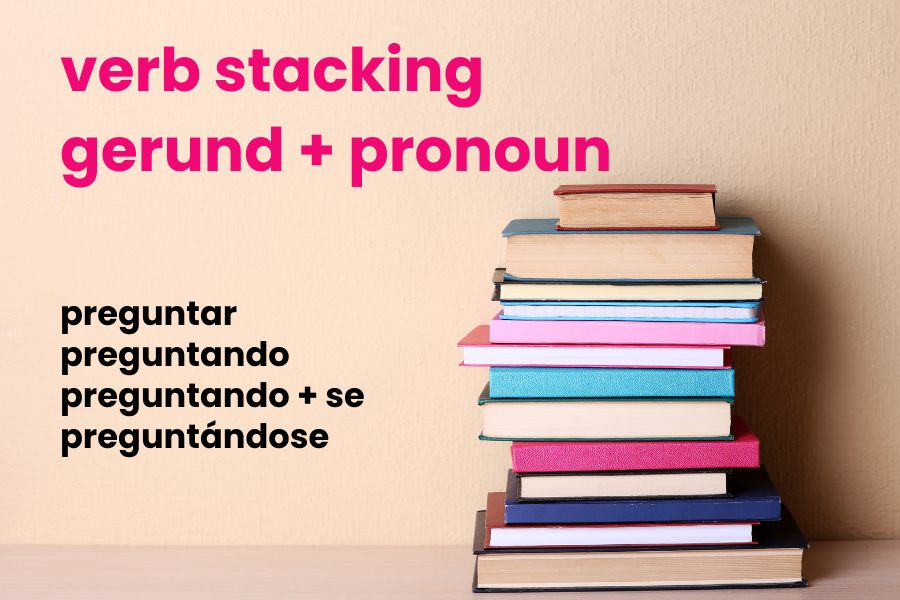
Preguntándose
preguntar – to ask
preguntando – asking
preguntando + se – asking self
(used in the reflexive)
Direct and Indirect Object Pronouns
The pronoun at the end can also be for either the direct or indirect object, depending on what you’re talking about.
I like combo words.
I particularly like this form:
action, in the moment (ing), acting on thing/person
It feels very English to me – “winking at her” all in one word.
Gerund v Present
Remembering rules.
Spanish prefers present tense unless you’re specifically in the middle of something.
Preferred: Trabajo en un nuevo proyecto sobre energías renovables.
Estoy trabajando en un nuevo proyecto sobre energías renovables.
Conversation v Writing
Gerund stacking is more for writing but also shows up in conversation.
In conversation, people almost always split the pronouns off and keep things lighter:
- Books and narration: love gerund stacks (ayudándola) because they sound flowing and elegant.
- Conversation: prefers the pronoun in front of the conjugated verb
(la estaba ayudando).
While conversation may prefer split pronouns, gerund stacking will show up in everyday conversations as well but intention is important.
When you say something like:
Estás enseñándome nuevas cosas.
you’re not just stating “you’re teaching me.”
The gerund pulls the listener into the moment:
→ “you’re in the act of teaching me (right now, and it’s unfolding).”
That’s the nuance of intention and definition and use of the gerund – it’s experiential, not mechanical.
Spanish gerund and English -ing, are both used intentionally when the feeling of simultaneity or immediacy matters.
Rewriting the stacks
I noticed some other things when I looked at rewriting the gerund stacks from the book.
Sofía tomó el lápiz con cuidado, preguntándose si realmente era mágico.|
Sofía tomó el lápiz con cuidado y se preguntó si realmente era mágico.
Ahora no puedo ir al parque con los demás – dijo, cruzándose de brazos.
Ahora no puedo ir al parque con los demás – dijo y se cruzó de brazos.
¿Qué tiene de especial? —preguntó, inspeccionándolo.
¿Qué tiene de especial? —preguntó y lo inspeccionó.
– dijo Sofía con una gran sonrisa, mostrándole la herramienta.
– dijo Sofía con una gran sonrisa y le mostró la herramienta.
Notice “and” + pronoun + verb
The split version tends to separate what’s going on into sequential actions with the use of and / y.
To me, this loses the simultaneous feel.
You can use mientras instead of y if you want it to sound conversational and express actions happening simultaneously.
- ¿Qué tiene de especial? – preguntó mientras lo miraba.
“What’s so special about it?” she asked while she was looking at it.
or
- ¿Qué tiene de especial? – preguntó mientras lo inspeccionaba.
“…as she inspected it.”
In conversation, Spanish speakers describe actions as separate events, even if they’re happening at the same time. The listener easily infers simultaneity from context, tone, and verb choice — so they don’t need the gerund to glue them together the way writing does.
English needs those connectors — while, as, when, -ing — because we usually express simultaneity grammatically, not contextually.
That’s actually quite a difference in worldview/language view…
Accordion: It IS a big difference:
It’s interesting to note that textbook spanish resources reinforces the non stack version.
Gerund Stacking In The Wild
In reality, native speech is a spectrum, not a binary. Gerund-stacking does appear naturally in everyday conversation — just not constantly or unconsciously.
Spanish speech runs on efficiency.
If the meaning’s clear without the gerund, they don’t bother. If the timing, tone, or flow feels better with it, they use it.
Lo estoy viendo and Estoy viéndolo live side by side — the mouth just picks what rolls easier.
The gerund is expressive, not exotic.
It’s used intentionally — not because grammar forces it, but because it shows movement, continuity, emotion, or immediacy.
That’s why you’ll hear it when someone’s narrating, reacting, or describing what’s happening right now:
Te estoy escuchando.
Estoy pensándolo bien.
Vas entendiendo, ¿no?
Context decides
In conversation, a speaker might switch between forms mid-sentence, based purely on rhythm or focus.
No one’s thinking about “split” or “stacked” — it’s just what feels natural.
Te estoy explicando algo — escúchame.
Estoy explicándote algo — escúchame.
Both can come out of the same mouth in the same minute.
Generally, use the gerund with intention.
It’s about continuity, simultaneity, and tone.
If those things matter to the speaker, the gerund appears. If not, the present does the job.
These are kinda the rules underneath everything I’ve been noticing.