
Por vs. Para #4: Direction and Movement
Por v Para: #1 Reaction v Intention
Por vs. Para: #2 Duty vs. Support
Por vs. Para #3: In Order To
Por vs. Para #4: Direction and Movement
Core Distinction
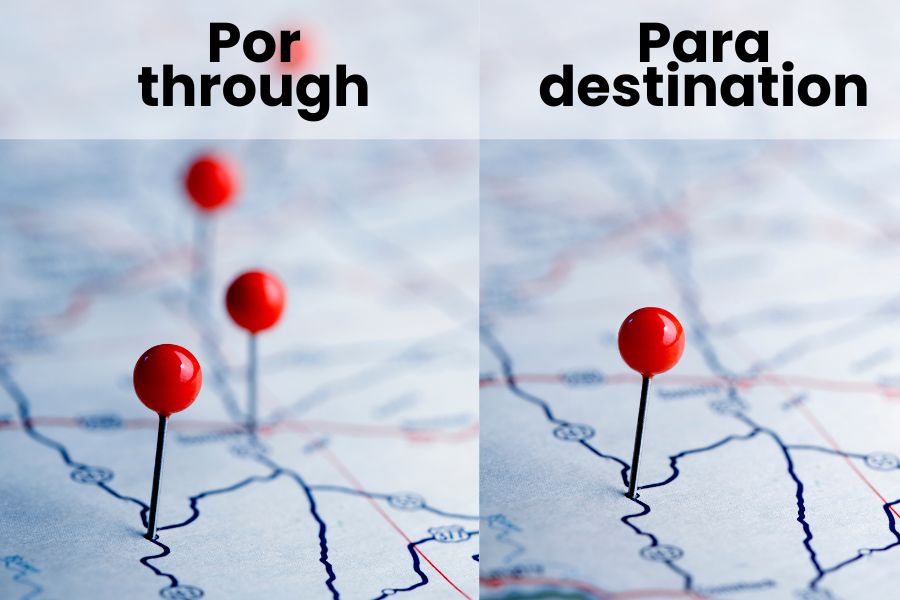
- Use por to describe movement through, along, or around a place.
- Use para to describe movement toward a destination.
Por vs. Para #4: Direction and Movement
- Caminé por el parque.
→ I walked through the park (path) - Voy para el parque.
→ I’m headed to the park (destination)
🔄 Por — Emphasises the Path / Journey
| Function | Description |
|---|---|
| Movement through, along, or around | Describes the actual route or movement across space |
| Emphasises the path | Focus is on how or where the motion travels, not where it ends |
| Passing through | Includes temporary stops, areas touched along the way |
| Journey through abstract ideas | Emotional or metaphorical movement (e.g., going through hard times) |
| Route taken | Specifies which road/path/entry was used |
| General vicinity | Indicates movement in or around a general area (e.g., “por aquí”) |
| Wandering/browsing/drifting | When direction isn’t fixed, just motion within a space |
Pasamos por Puebla.
→ We passed through Puebla.
It wasn’t the destination — just a stop along the way
Viajamos por avión.
→ We traveled by plane
How you made the journey (means)
Pasé por mucho.
→ I went through a lot (emotionally, situationally)
The journey was internal, not geographic — but por still fits
Vamos por la sombra.
→ Let’s walk in the shade.
The route is being chosen intentionally — part of the journey experience.
¿Quieres dar una vuelta por el centro?
→ Want to take a walk around downtown?
Casual meandering — not about destination, just movement through a space.
Vine por la carretera vieja.
→ I came by the old highway.
You’re telling me about the path you took, not where you ended up.
Gracias por venir.
→ Thanks for coming.
Yes, it’s formulaic — but por acknowledges the effort, the movement, the fact that you came through time or space to be there.
Te llamé por error.
→ I called you by mistake.
The journey was unintended — a misroute. Still fits por logic: something happened through a process.
Pasamos por muchas tiendas antes de encontrarlo.
→ We went through a lot of shops before we found it.
Literal journey through options, not just space.
Por aquí no es.
→ It’s not this way.
Someone’s on a path/journey and took a wrong route — por is marking the route being used or questioned.
🎯 Para — Emphasises the Destination / Endpoint
| Function | Description |
| Final destination | The action is aimed at reaching this point |
| Intended direction | The place someone or something is headed toward |
| Target location | Specific goal of movement or delivery |
| Physical goal of transit | Geographical/spatial endpoint |
| Assigned route endpoint | Destination defined by a route or system (e.g., a train’s route) |
| Directional purpose | Movement that has intention and a final aim |
Salió para el trabajo.
→ She left for work.
🧠 Not at work yet — in motion toward a clear destination. In English we might just say “She left” or “She went to work,” skipping the structure that Spanish marks with para.
¿Este camino es para Cuernavaca?
→ Is this road to Cuernavaca?
🧠 English uses “to” — but in Spanish, para marks the intended end point of the road itself, not just your movement.
Ese bus es para el aeropuerto.
→ That bus goes to the airport.
🧠 You’re not on it yet — para expresses what the bus is destined for, not the current action.
Vamos para el norte.
→ We’re heading north.
🧠 In English, “going north” sounds like direction — but para emphasises the intended trajectory, not the general area.
Salimos para allá en cinco minutos.
→ We’re leaving for there in five minutes.
🧠 “Allá” is vague, but para still locks in that it’s the destination we’re aiming at, even if imprecise.
Está caminando para su casa.
→ He’s walking to his house.
🧠 Even if he’s blocks away, para makes it clear that the house is the endpoint, not just a direction.
¿Ese tren es para Monterrey?
→ Is that train headed to Monterrey?
🧠 Para marks the final assigned destination of the train — not who is on it or where it currently is.
¿Vamos para tu barrio o el mío?
→ Are we heading to your neighborhood or mine?
🧠 English doesn’t always mark this directional aim — Spanish does with para to frame movement toward either option.
El camino para la cascada está cerrado.
→ The trail to the waterfall is closed.
🧠 We might say “the trail is closed,” but para clarifies that the purpose and endpoint of the trail is the waterfall.
Toma esta salida para el centro.
→ Take this exit to go downtown.
🧠 English focuses on the exit itself — Spanish emphasises what the exit leads to. Para points to the endpoint of this action.