
Pescando en el lago
Pescando en el lago
Cuando era niña, mi papá era pescador. Pero su trabajo era en barcos de pesca, lejos de la costa, con solamente el mar para ver.
A veces, mi papá iba a pescar desde la playa en su tiempo libre.
Y a veces me llevaba con él.
¡Pero nunca he pescado en un lago!
¡Encuentro esta escena muy interesante!
Conozco algunos peces del mar, pero no conozco los peces de agua dulce. ¿Qué tipo de peces se encuentran en un lago?
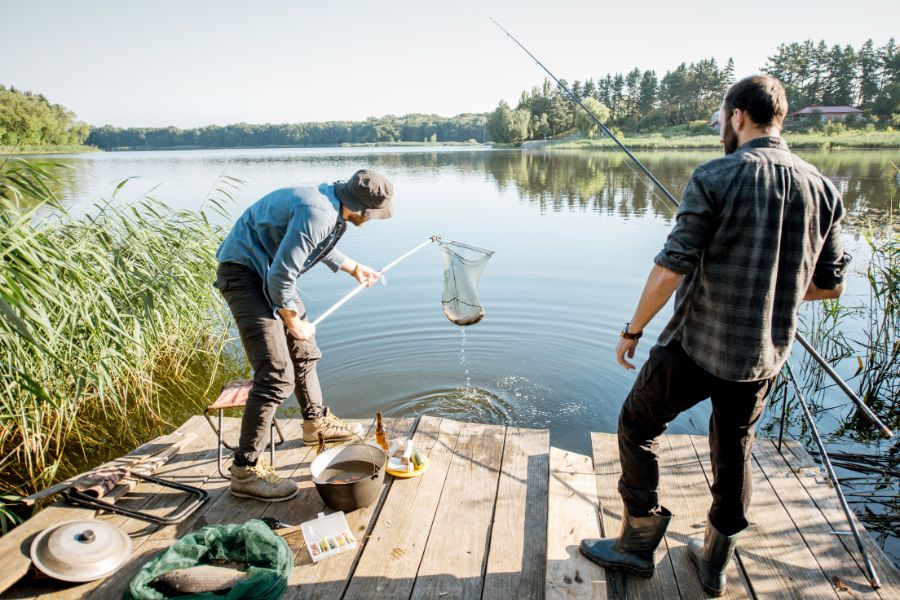
Uno de los hombres tiene un pez en su red… lo suficientemente grande para comer 😉
No puedo ver el tipo de señuelo en la punta de su caña. Y no puedo ver el tipo de carrete que está usando. A lo mejor está pescando trucha?
El lago es muy grande, con muchos árboles que lo rodean.
Nunca he visto un lago tan grande. No tenemos lagos como este donde vivo. Los lagos no son comunes en mi país.
Los pescadores están de pie en un muelle de madera y pequeño. El muelle parece un poco peligroso; desigual, con tablas rotas.
Tienen dos ollas, dos sillas, un plato, un cuchillo de pesca en el muelle con ellos.
Y lo más importante, ¡cerveza! Ningún pescador puede pescar sin cerveza!
🔍 The Role of “Lo” as a Neutral Intensifier
We already saw that “lo” can act as an intensifier when it’s used in expressions like:
- Lo más importante → The most important thing
- Lo mejor → The best thing
- Lo suficiente → Enough (as in “enough to do something”)
In these cases, “lo” isn’t replacing anything concrete. It’s basically pointing at the quality or concept itself. It’s almost like saying the part that is important, the part that is best, the amount that is enough.
🔍 Common Phrases that Use “Lo” as a Neutral Pronoun
- Lo bueno → The good thing
- Lo bueno de vivir aquí es la tranquilidad. → The good thing about living here is the peace and quiet.
- Lo bueno de vivir aquí es la tranquilidad. → The good thing about living here is the peace and quiet.
- Lo malo → The bad thing
- Lo malo de la ciudad es el tráfico. → The bad thing about the city is the traffic.
- Lo malo de la ciudad es el tráfico. → The bad thing about the city is the traffic.
- Lo curioso → The curious/interesting thing
- Lo curioso es que nunca se enferma. → The interesting thing is that he never gets sick.
- Lo curioso es que nunca se enferma. → The interesting thing is that he never gets sick.
- Lo necesario → What is necessary / the necessary amount
- Tienes lo necesario para terminar el proyecto. → You have what you need to finish the project.
- Tienes lo necesario para terminar el proyecto. → You have what you need to finish the project.
- Lo que… → What… / The thing that…
- Lo que más me gusta es el café. → What I like the most is coffee.
- Lo que más me gusta es el café. → What I like the most is coffee.
🔍 Why is “lo” there?
Think of “lo” as a way to abstract the quality or idea. It kind of makes the adjective (bueno, malo, suficiente) into its own noun:
- Lo bueno → “the good stuff”
- Lo malo → “the bad parts”
Lo gives the adjective something to describe, even if it’s abstract.
llevaba – llavar, to take
agua dulce – fresh water
señuelo seh-NYOO-eh-loh – lure
caña – rod
carrete – reel
trucha – trout
muelle – dock, jetty
desigual – uneven
tablas – boards, planks
rota – broken
cuchillo – Cuchilla means “blade” or “cleaver.” For a fishing knife, it’s cuchillo.