
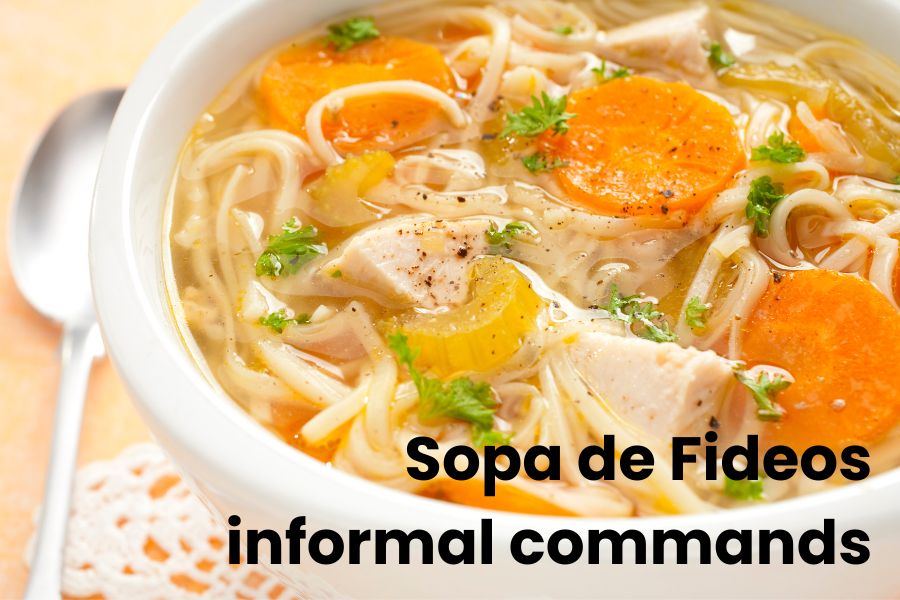
Sopa de Fideos

Practicing the informal command form. In bold italics.

Also noting:

Sopa de Fideos

Estaba lloviendo afuera, y Diego acababa de entrar después de jugar al fútbol con sus amigos.

Estaba mojado y tenía hambre.

Su mamá, Isabel, sonrió cuando lo vio.

“Ve a cambiarte de ropa,” dijo ella.  “Vamos a hacer sopa de fideos.”

🗣️ Everyday conversation in Spanish:

In real, casual speech, people almost never say “dijo ella” unless they’re telling a story or reading aloud. Instead, they’d say:

  • Ella dijo que…
  • Me dijo que…
  • ¿Y qué dijo ella?

So yep — “dijo ella” is narrative Spanish, not conversational Spanish.

Diego regresó con ropa seca, y su mamá ya había sacado los ingredientes: fideos secos, jitomates, ajo, cebolla y caldo de pollo.

“Primero,” dijo ella, “pela el ajo y corta el jitomate en trozos grandes. No te preocupes, no tienes que hacerlo perfecto.”

Mientras Diego cortaba las verduras, Isabel calentaba un poco de aceite en una olla.

“Está bien, ahora agrega los fideos y mézclalos hasta que estén dorado marrón. ¡No los quemes!”

EnglishSpanish (Subjunctive)Why?
Mix them until they are golden brownestén dorado marrónThe noodles aren’t golden yet — you’re aiming for that outcome

This is a negative informal command, and in Spanish:

Command TypeRule
Positive tú commandVerb goes first, pronoun gets attached → quémalos
Negative tú commandUse the subjunctive tú form and put pronoun before → no los quemes

So:

✅ ¡No los quemes! → “Don’t burn them!” (negative command)

✅ ¡Quémalos! → “Burn them!” (positive command)

Los fideos empezaron a oler tostados, y Diego sonrió.

“Ahora pon los jitomates, el ajo y la cebolla en la licuadora,” dijo ella. “Mezcla todo bien. ¡Sin trozos!”

Cuando los fideos estuvieron listos, Isabel bajó la temperatura. “Echa la salsa dentro de la olla — ¡lentamente! Podría salpicar.”

El vapor llenaba la cocina. Diego tosió y se rió.

“Luego, agrega el caldo de pollo y un poco de sal. Cubre la olla y deja cocinar por diez o quince minutos.”

Diego puso la mesa mientras la sopa hervía a fuego lento.

Cuando estuvo lista, Isabel la probó, asintió y le dio un tazón.

“Ahora pruébala y dime si necesita algo más.”

Diego tomó una cucharada y le dio un pulgar hacia arriba. “Perfecto.”

acababa de (imperfect) – had just (done)

🔹 Present tense – acaba de + infinitive

Used to say someone just did something (now)

  • Acabo de comer → I just ate
  • Acabas de llegar → You just arrived
  • Ella acaba de salir → She just left
  • Acabamos de terminar → We just finished
  • Acaban de despertar → They just woke up

✅ Used in everyday situations for something that just happened


🔹 Imperfect tense – acababa de + infinitive

Used to say someone had just done something (in the past)

  • Acababa de comer cuando sonó el teléfono → I had just eaten when the phone rang
  • Ella acababa de llegar cuando llamaste → She had just arrived when you called
  • Acabábamos de salir cuando empezó a llover → We had just left when it started to rain
  • Ellos acababan de acostarse cuando hubo un ruido → They had just gone to bed when there was a noise

✅ Used in storytelling or describing what had just happened before something else

mojado (participle adj) – wet; from mojar

sacado – sacar; to take out. Había sacado (past tense of have done)

caldo de pollo – chicken broth

fideos – thin, short noodles: Think: little strands of pasta, kind of like cut-up spaghetti

trozos – pieces

calentaba (imperfect) – calentar, to heat / to warm up

dorado marrón – golden brown

It’s the past participle of the verb dorar (to brown or to golden something),
but it’s used as an adjective to describe color and doneness, especially in cooking.


🔸 Usage:

  • El pan está dorado.
    → The bread is golden-brown.
  • Fríe las papas hasta que estén doradas.
    → Fry the potatoes until they’re golden.

🔁 “Dorado marrón” is understandable, but not the usual order or phrasing.

In natural Spanish, you’d more likely hear:

  • “…hasta que estén bien dorados.”
    → until they’re nicely golden-brown

Or if you want to keep that color combo vibe:

  • “…hasta que estén dorados, casi marrón.”
    → until they’re golden, almost brown
    (this gives it that toasted visual feel)

So:

  • dorado = adjective ✅
  • estén dorados = subjunctive plural to match fideos ✅

licuadora – blender

Echa (inf c) – echar; throw, add, pour

salpicar – splash, splatter

tosió – coughed

Cubre (inf c) – cubrir; to cover

deja (inf c) – to leave / to let / to allow / to stop doing something

hervía a fuego lento – simmered (literally to boil at slow fire); hervía (imperfect)

la probó – tasted it (la sopa)

asintió – nodded

tazón – bowl

cucharada (noun of quantity) – spoonful; formed from cuchara + –ada (not a participle)

un pulgar hacia arriba – thumbs up

A directional describer, not rooted in a verb or noun; origins in Latin.

  • It tells you where something is pointing, moving, or facing
  • Think of it as the arrow in a sentence → → that way

🔹 Real-life examples with your label:

  • Camina hacia la ventana
    → Walk → that way (to the window)
  • Pulgar hacia arriba
    → Thumb → up
  • Miró hacia mí
    → He looked → toward me