
Informal Command in the Kitchen
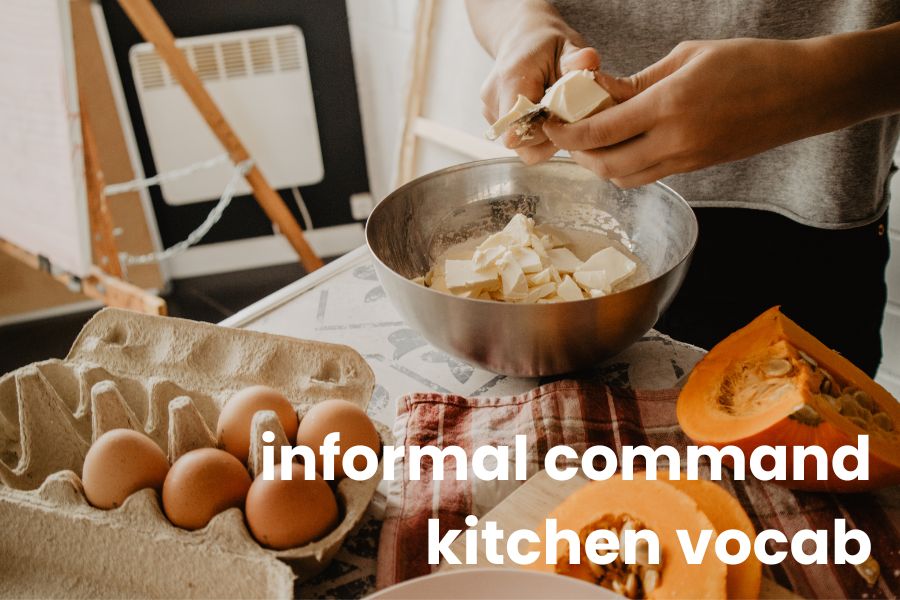
The imperative always has the same core purpose: to give orders, recommendations, instructions, and advice.
Grammatically it is built for politeness but of course in real life, it can depend on tone and intent.
To someone familiar, like a friend or family member you would use the informal form.
To someone you don’t know well, like a stranger, elder, or professional, you would use the formal form.
The forms change depending on whether the command is positive or negative.
Positive Informal (tú) Command Forms
🔹 For -AR verbs:
Drop -ar, add -a
Pelar – Pela dos zanahorias y tres jitomates. To peel – Peel two carrots and three tomatoes.
🔹 For -ER and -IR verbs:
Drop -er/-ir, add -e
Comer – Come un trozo de enchilada para probarla. To eat – Eat a bite (lit. piece) of enchilada to taste it.
Añadir – Añade sal, pimienta y limón.
Servir – Sirve la comida en un plato. (Servir changes its root in the imperative and the -e- becomes -i-: sirve.)
The tú imperative keeps the regular vowel endings, but negative commands swap the vowels.
In The Kitchen
Sigue estos pasos para cocinar esquites.
Corta dos dientes de ajo y media cebolla en trozos finos.
Echa tres cucharadas de mantequilla.
Agrega seis tazas de granos de elote.
Añade agua, sal y limón, y remueve todo para mezclar los ingredientes.
Corta las papas en trozos grandes.
Añade sal, perejil y maíz.
Mezcla las papas con la mayonesa y el queso.
Echa dos cucharadas pequeñas de aceite de oliva.
Sirve la comida en un plato.
Negative Informal (tú) Command Forms
🔹 For -AR verbs:
Drop -ar, add -es
Pelar – No peles las zanahorias todavía.
To peel – Don’t peel the carrots yet.
🔹 For -ER and -IR verbs:
Drop -er/-ir, add -as
Comer – No comas eso si está frío. To eat – Don’t eat that if it’s cold.
No mezcles los ingredientes hasta el último paso. (mezclar) Don’t mix the ingredients until the final step. (to mix)
No comas mucha comida ni muy rápido. (comer) Don’t eat a lot of food or very fast. (to eat)
No añadas demasiado aceite en el sartén. (añadir) Don’t add too much oil in the pan. (to add)
No cortes las zanahorias en trozos muy gruesos. Don’t chop (lit. cut) the carrots into very thick pieces.
No leas las instrucciones muy rápido y sin prestar atención. Don’t read the instructions too quickly and without paying attention.
No sirvas la cena hasta que esté todo listo. Don’t serve dinner until everything is ready.
Muy or Mucho
Muy (very) is used to intensify the meaning of an adjective (like ricas) or adverb (like rápido).
Estas enchiladas están muy ricas. These enchiladas are very tasty.
Tú cocinas muy bien. You cook very well.
Mucho (many, much, a lot of) refers to a big amount or quantity of something. It has to agree in gender and number with the noun it precedes.
Él siempre come muchos tacos. He always eats a lot of tacos.
No añadas mucha mantequilla. Don’t add a lot of butter.
Mucho can also be combined with a verb. In this case, it stays the same and doesn’t change in gender or number.
¡Ellos cocinan mucho! They cook a lot!
Hierve el agua muy rápido y echa sal. Very quickly, boil the water and add salt.
Some verbs, like hervir (to boil) have irregular imperatives (hierve). You’ll learn them progressively as you keep studying Spanish.
No añadas mucho aceite de oliva, solo una cucharada pequeña. Don’t add a lot (of) olive oil, just a teaspoon.
Mezcla los ingredientes muy lentamente. Mix the ingredients very slowly.
Echa suficiente perejil, pero no agregues mucha pimienta, solo una pizca. Throw (in) a good amount (lit. enough) (of) parsley, but don’t throw (in) a lot of pepper, just a pinch.
Corta el queso en trozos muy grandes. Cut the cheese into very big pieces.
No agregues mucha sal en la olla. Don’t add a lot (of) salt in the pot.
Fríe los ingredientes en el sartén y remuévelos muy lentamente. Fry the ingredients in the pan and stir them very slowly.
No me sirvas mucha comida. Don’t serve me too much food.
Pelar – to peel
Añadir – to add
In Spain → añadir is the everyday word; agregar feels technical.
In Mexico → agregar is used in daily speech; añadir sounds bookish or formal.
añadir and agregar are interchangeable in meaning:
Both mean “to add” — whether it’s adding ingredients, information, or objects.
Sigue – seguir → to follow, to continue, to keep doing something
pasos – steps
dientes de ajo – garlic cloves
trozos – pieces
finos – fine (adj)
Fino vs. Delgado in Cooking
Use fino for small or delicate textures (like trozos finos or corte fino), and delgado for flat, thin slices (like rebanadas delgadas or filetes delgados).
Both mean “thin,” but fino feels finer or more precise, while delgado refers to thickness or shape.
In recipes, you’ll see fino for chopping and delgado for slicing.
Echa – echar; to throw, to put in, to pour, to toss in, to add
Very context-based and super common in everyday speech, especially in cooking.
cucharadas – tablespoons
cucharaditas – teaspoons
granos de elote – corn kernels
remueve – remover (infinitive) means to stir (especially to mix gently or keep things moving in a pot or pan).
perejil – parsley
Hierve – hervir; to boil
pizca – pinch; a definition of quantity
Fríe – Fríe (fry) is the irregular imperative of the verb freír (to fry).