
Pone: It Says, It Reads, It Shows
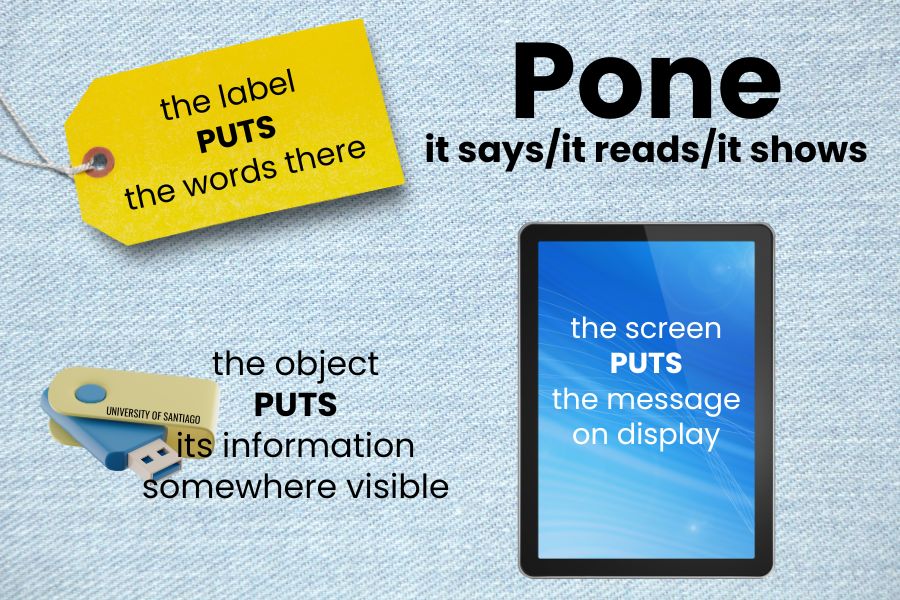
The story read: Hay un lápiz de memoria en la bolsa. ?De quién es? Pone: Universidad de Santiago de Compostela.
What does ‘pone’ mean? Surely not put?
Pone = “It says” / “It reads” / “It shows”
It comes from the verb poner — normally “to put” — but here it’s used like:
Pone: Universidad de Santiago de Compostela
→ It says: University of Santiago de Compostela
🔹 Common uses like this:
- ¿Qué pone en la etiqueta? → What does it say on the label?
- Aquí pone que está prohibido fumar. → It says here that smoking is forbidden.
- ¿Qué pone en el cartel? → What does the sign say?
The root definition of poner is being all about putting or causing a change — like ponerse triste (to become sad), or poner la mesa (to set the table).
Let’s make “say” make sense through that same lens.
🔸 So why does “pone” = “it says”?
Because what it’s really doing is:
“It puts this text in front of you.”
🔹 Think of it like:
- The label puts the words there.
- The screen puts the message on display.
- The object puts its information somewhere visible.
So when we say:
Pone: Universidad de Santiago de Compostela
We’re literally saying: “It puts (these words): Universidad de Santiago…”
And the natural English version becomes:
→ It says: Universidad de Santiago…
But the Spanish logic? Still rooted in poner = to put → to cause something to appear → to display → to say.
🚌 At the bus stop – checking the schedule:
— ¿A qué hora pasa el siguiente camión?
— En el letrero pone: “Cada 20 minutos.”
→ “What time does the next bus come?”
→ “The sign says: ‘Every 20 minutes.’”
🧴 At the store – reading a shampoo label:
— ¿Para qué tipo de cabello es este champú?
— A ver… aquí pone: “Para cabello seco y dañado.”
→ “What type of hair is this shampoo for?”
→ “Let’s see… it says here: ‘For dry and damaged hair.’”
📦 Receiving a package – checking the label:
— ¿Estás segura de que es tuyo?
— Sí, claro. Pone mi nombre aquí: Gabriela Torres.
→ “Are you sure it’s yours?”
→ “Yeah, of course. It says my name here: Gabriela Torres.”
✅ Use pone when you’re referring to written or printed information that appears somewhere.
You’re not quoting a person — you’re talking about what an object, label, screen, or sign “says”.
Think:
- labels
- signs
- boxes
- receipts
- screens
- menus
- forms
- anything that has text on it
💬 You’re answering or asking:
- What does it say here?
- What’s written?
- What’s on the sign?
- What does the label show?
🔄 Natural sentence patterns:
- ¿Qué pone en…? → What does it say on…?
- Aquí pone que… → It says here that…
- Pone: “…” → It says: “…”
- No pone nada. → It doesn’t say anything.
- Pone tu nombre aquí. → Put your name here (different use — imperative form)