
La Granja

La granja

Pienso que crecer en una granja sería genial.

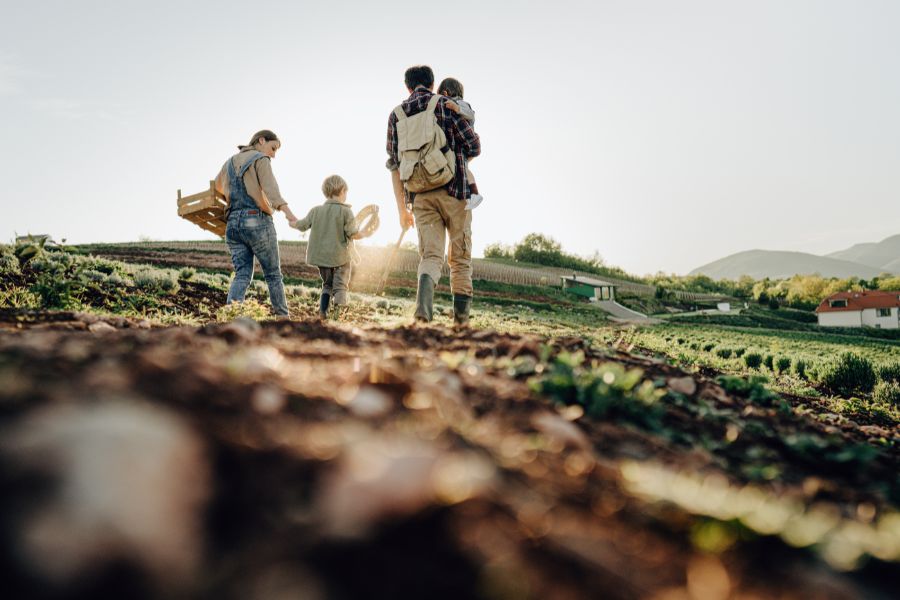
Esta familia vive en una granja y creo que cultivan uvas para hacer vino.

En la pendiente de la colina puedo ver filas de plantas, desnudas por el invierno. Hay más colinas bajas a lo lejos, detrás de la casa.

Parece que es temprano en la mañana porque el cielo está blanco por la luz de un sol temprano.

La familia ha estado trabajando en la granja.

Conjugations (present)

PronombreHaberEjemplo completo
yoheHe estado trabajando en la granja.
túhasHas estado trabajando mucho, ¿no?
él / ella / ustedhaElla ha estado estudiando todo el día.
nosotros/ashemosHemos estado caminando por el campo.
vosotros/ashabéis(not used in Latin America)
ellos / ellas / ustedeshanHan estado cosechando verduras.

A few natural, conversational examples:

  • ¿Qué has estado haciendo últimamente?
    (What have you been doing lately?)
  • He estado aprendiendo español con fotos.
    (I’ve been learning Spanish with photos.)
  • Mis amigos han estado viajando por México.
    (My friends have been traveling through Mexico.)

Here are 7 English sentences for you to translate into Spanish using the [haber en presente] + estado + [gerundio] structure.

  1. I’ve been thinking about that a lot.
  2. They’ve been working since early morning.
  3. Have you been feeling tired lately?
  4. She’s been cooking all afternoon.
  5. We’ve been learning Spanish together.
  6. My friends have been waiting for me.
  7. He’s been talking with his neighbor.
  1. He estado pensando mucho sobre eso.
  2. Han estado trabajando desde temprano en la mañana.
  3. ¿Te has estado sintiendo cansado últimamente?
  4. Ella ha estado cocinando toda la tarde.
  5. Hemos estado aprendiendo juntos.
  6. Mis amigos han estado esperando por mí.
  7. Él ha estado charlando con su vecino.

La madre está llevando una canasta para cosechar verduras; también está sosteniendo la mano de su hijo pequeño.

El padre está llevando a su hijo más pequeño en un brazo y una herramienta en la otra mano.

Tanto el hijo como el padre están usando botas de agua negras para caminar por el lodo.

Use “tanto… como…” when you’re talking about two people or things — and want to say both do something or both have something.

🔹 Think of it like:

“The son as well as the father…”
= Tanto el hijo como el padre…


🔸 Use “ambos / ambas” only when you’re referring directly to both as a group (usually nouns, not full clauses).

Examples to compare:

✔️ Tanto el hijo como el padre están usando botas.
(Both the son and the father are wearing boots.)
→ You’re naming each one and saying they both do something.

✔️ Ambos padres están cansados.
(Both parents are tired.)
→ Here, padres is plural masculine, so ambos works.

✔️ Ambas niñas están felices.
(Both girls are happy.)
→ Feminine plural = ambas is perfect here.

Here are 10 English sentences. Translate them into Spanish using either “tanto… como…” or “ambos / ambas” — your job is to pick which one belongs in each sentence.

  1. Both of my sisters live in Mexico.
  2. The boy and the girl are both holding fruit.
  3. Both cats ran away during the storm.
  4. My dad and my uncle both love working in the garden.
  5. Both hands are dirty.
  6. The teacher and the student are both tired.
  7. Both of the dogs are barking.
  8. She invited both her parents.
  9. The girl and her friend both play the guitar.
  10. Both of my shoes are wet.

Answers:

  1. Ambas
  2. Tanto… como…
  3. Ambos
  4. Tanto… como…
  5. Ambas
  6. Tanto… como…
  7. Ambos
  8. Ambos
  9. Tanto… como…
  10. Ambos

Translate into spanish.

  1. Both of my sisters live in Mexico.
  2. The boy and the girl are both holding fruit.
  3. Both cats ran away during the storm.
  4. My dad and my uncle both love working in the garden.
  5. Both hands are dirty.
  6. The teacher and the student are both tired.
  7. Both of the dogs are barking.
  8. She invited both her parents.
  9. The girl and her friend both play the guitar.
  10. Both of my shoes are wet.

Answers:

  1. Ambos zapatos están mojados.
  2. Ambas mis hermanas viven en México.
  3. Tanto el niño como la niña están sosteniendo fruta.
  4. Ambos gatos se escaparon durante la tormenta.
  5. Tanto mi papá como mi tío aman trabajar en el jardín.
  6. Ambas manos están sucias.
  7. Tanto el maestro como el estudiante están cansados.
  8. Ambos perros están ladrando.
  9. Ella invitó a ambos padres.
  10. Tanto la chica como su amiga tocan la guitarra.

No se les puede ver las caras, pero parece que están felices.

Ellos están caminando hacia su casa para desayunar.

sería – would be

pendiente – slope

filas – rows

canasta – basket (because I didn’t know crate/huacal)

cosechar – harvest

sosteniendo – holding (from sostener = to hold / to support)

herramienta – tool

lodo – mud