
Dónde
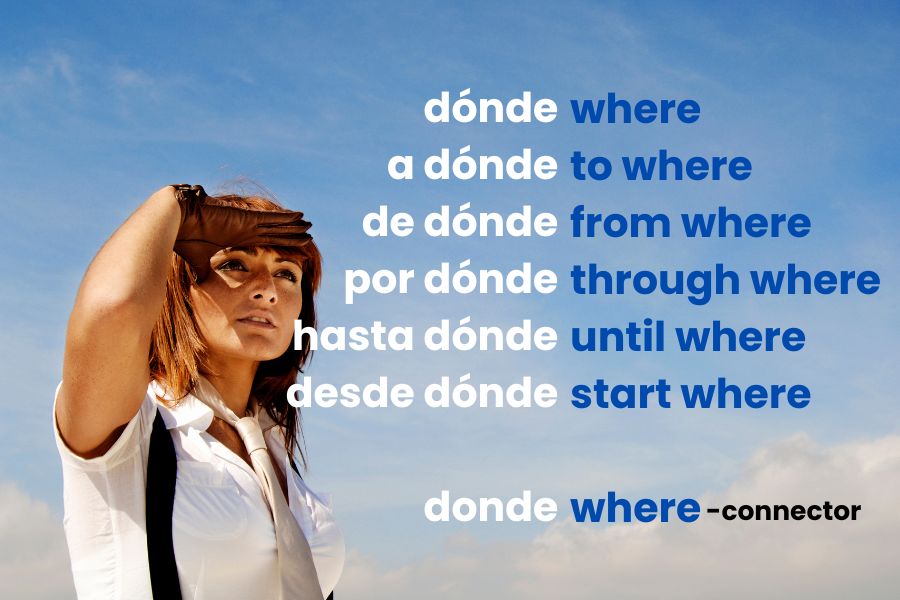
The word “dónde” means “where” and is used to ask or describe locations, destinations, or origins. Depending on how it’s used, it can change slightly in meaning.
- ¿Dónde…? → Asks about location (static position).
- ¿Dónde está el parque? → Where is the park?
- ¿A dónde…? → Asks about movement or destination.
- ¿A dónde vas? → Where are you going?
- ¿De dónde…? → Asks about origin or starting point.
- ¿De dónde eres? → Where are you from?
The word “donde” (without the accent mark) is used in statements rather than questions and functions as a relative adverb, meaning “where.” It introduces a clause that describes a place.
¿Dónde…? → Asking for Location (Static Position)
Used to ask where something or someone is (no movement).
- ¿Dónde estás? → Where are you?
- ¿Dónde vive tu hermano? → Where does your brother live?
- ¿Dónde está el baño? → Where is the bathroom?
“¿A dónde…?” → Asking for Destination (Movement)
Used when asking where someone is going (with movement).
- ¿A dónde vas? → Where are you going?
- ¿A dónde fuiste? → Where did you go?
- ¿A dónde quieres viajar? → Where do you want to travel?
“¿De dónde…?” → Asking for Someone’s Origin
Used to ask where someone or something comes from.
- ¿De dónde eres? → Where are you from?
- ¿De dónde vienes? → Where are you coming from?
- ¿De dónde aprendiste español? → Where did you learn Spanish from?
💡 Difference Between “¿Dónde?” and “¿De dónde?”
- ¿Dónde vives? → Where do you live? (Your current location.)
- ¿De dónde eres? → Where are you from? (Your place of origin.)
Donde With No Accent Mark
Key Differences Between “dónde” and “donde”
| Word | Usage | Example |
|---|---|---|
| Dónde (with an accent) | Used in questions (direct or indirect) | ¿Dónde vives? → Where do you live? (Direct question) |
| No sé dónde está el baño. → I don’t know where the bathroom is. (Indirect question) | ||
| Donde (without an accent) | Used in statements to describe a place | Este es el lugar donde nací. → This is the place where I was born. |
| Voy a la tienda donde venden pan fresco. → I’m going to the store where they sell fresh bread. |
How to Tell if You Need an Accent on “donde”
✅ Use “dónde” (with an accent) when it’s a question (direct or indirect).
✅ Use “donde” (without an accent) when it describes a place in a statement.
- Las llaves están donde las dejaste.
→ The keys are where you left them.
→ (Not a question, just describing a place.)
→ Uses “donde” because it’s a relative adverb.
A relative adverb is a connector word that introduces a clause and describes a place, time, or reason in relation to something mentioned in the sentence. It connects two parts of a sentence by referring to a noun.
In Spanish, the most common relative adverbs are:
- donde (where → refers to a place)
- cuando (when → refers to a time)
- como (how → refers to a manner)
Preposition + Dónde → Other Use Cases
Adding a preposition before “dónde” changes the meaning slightly.
- ¿De dónde eres? → Where are you from? (origin)
- ¿Desde dónde me llamas? → From where are you calling me? (starting point)
- ¿Por dónde se va al parque? → Which way do you go to the park? (route)
- ¿Hasta dónde caminaste? → How far did you walk? (limit)
Un Historia de Dónde
🐱 Mariana vio a su gato y le preguntó:
—¿Dónde estabas, Pancho?
😺 El gato maulló [mah-oo-YÓ] y respondió:
—Estaba en la ventana, donde me gusta dormir. Pero luego fui al techo, a dónde siempre voy a tomar el sol.
🐶 Mariana vio a su perro y le preguntó:
—¿A dónde fuiste, Bruno?
🐕 El perro ladró y dijo:
—Primero fui al jardín, donde corrí todos los días. Luego fui al parque, de donde traje un palo.
🐦 Mariana vio a un pájaro y le preguntó:
—¿De dónde vienes, pajarito?
🕊️ El pájaro trinó y respondió:
—Vengo del árbol, donde cantamos con mis amigos.
🦋 Mariana vio a una mariposa y le preguntó:
—¿Por dónde volaste, mariposa?
🌸 La mariposa revoloteó y contestó:
—Volé por el jardín, donde están las flores más bonitas.
🌞 Mariana miró al sol y le preguntó:
—¿Hasta dónde fuiste, sol?
🌙 El sol bostezó y respondió:
—Fui al horizonte, donde la luna me espera cada noche.
maulló – meowed
techo – roof
ladró – barked
perseguir – chase
trinó – chirped
revoloteó – fluttered
bostezó – yawned