
Location and Movement Palabras
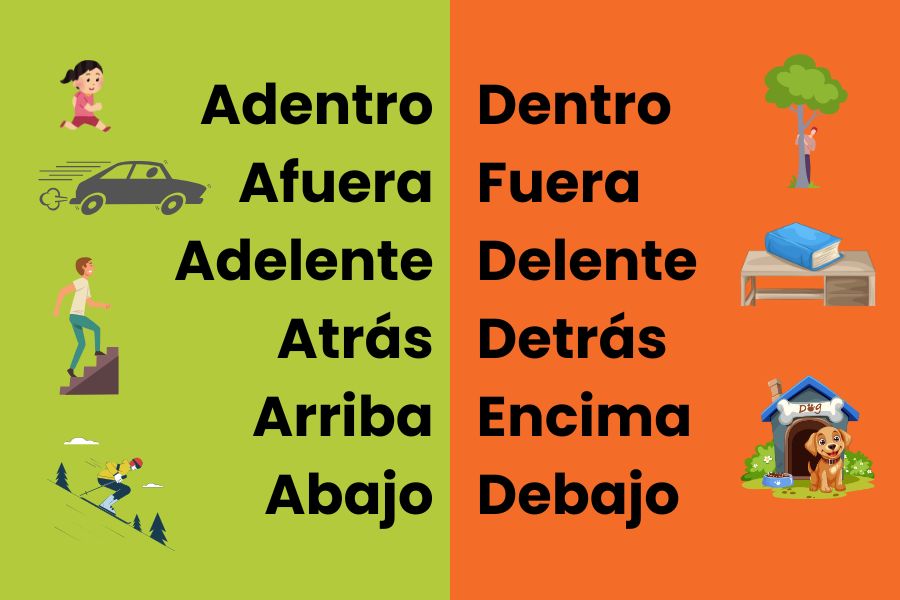
In Spanish, many location words come in two forms: one that implies movement and another that indicates a fixed position. A simple rule of thumb is:
Words that start with “A” (atrás, arriba, abajo, afuera, adelante) indicate movement or direction.
Words without “A” (detrás, encima, debajo, fuera, delante) refer to a fixed location.

IN – Adentro v Dentro
Both “adentro” and “dentro” relate to being “inside,” but they have different uses.
“Adentro” = Movement towards the inside
Think of it like “inward” or “inside” in the sense of direction.
It often appears with verbs of movement (ir, entrar, meter, llevar, etc.).
- Camina adentro de la casa. → Walk inside the house.
- Metí la llave adentro del bolsillo. → I put the key inside the pocket.
- Corre, vamos adentro. → Run, let’s go inside.
“Dentro” = Location (already inside)
It refers to something that is inside a place or container, like “inside” in English.
Often used with “de” to specify location.
- Las llaves están dentro de la mochila. → The keys are inside the backpack.
- Hay mucha gente dentro del restaurante. → There are many people inside the restaurant.
- No puedes fumar dentro de la oficina. → You can’t smoke inside the office.
Begins With “A”
Movement or general direction.
“A” is a prepostion that also means ‘to’ eg Voy a ir a México. I am going to Mexico.
“To” is another way to remember ‘movement‘ and also ‘direction‘.
“To look up” is a kind of directional movement.
Connecting the idea that:
- the directional words in these notes that begin with “A” often indicate movement or direction
- AND that the preposition “a” means “to” (implying motion toward something)
- you can see a pattern that the words beginning with ‘a’ are the movement words, while the directional words not starting with ‘a’ are about position.
Recognising that “movement” isn’t just physical like walking inside (adentro) but it can also be a shift in attention—like looking up (mirar arriba), which still involves movement but in a not-so-physical sense.
“A” moves you—physically, visually, or mentally.
OUT: Afuera v Fuera
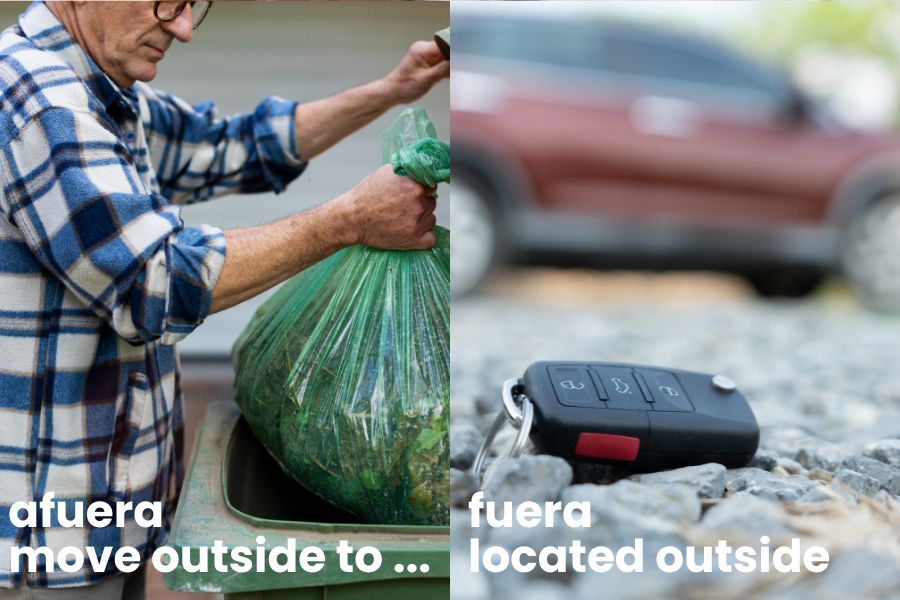
“Afueura” = Movement (going outside) OR emphasis on being outside.
Think of it like “outward” or “outside” in the sense of direction.
It often appears with verbs of movement (salir, ir, llevar, poner, etc.).
- Sal afuera a tomar aire. → Go outside to get some air.
- Saca la basura afuera. → Take the trash outside.
- Vamos afuera, hace calor aquí. → Let’s go outside, it’s hot in here.
“Fuera” = Location (already outside) or figurative use
It refers to something that is outside a place or container, like “outside” in English.
Often used with “de” to specify location.
- Las llaves están fuera, en la mesa. → The keys are outside, on the table.
- Dejé el coche fuera del garaje. → I left the car outside the garage.
- ¡Eso está fuera de lugar! → That is out of place! (Figurative use)
FORWARD – Adelante vs Delante
Both “adelante” and “delante” relate to being “in front” or “forward,” but they have different uses.
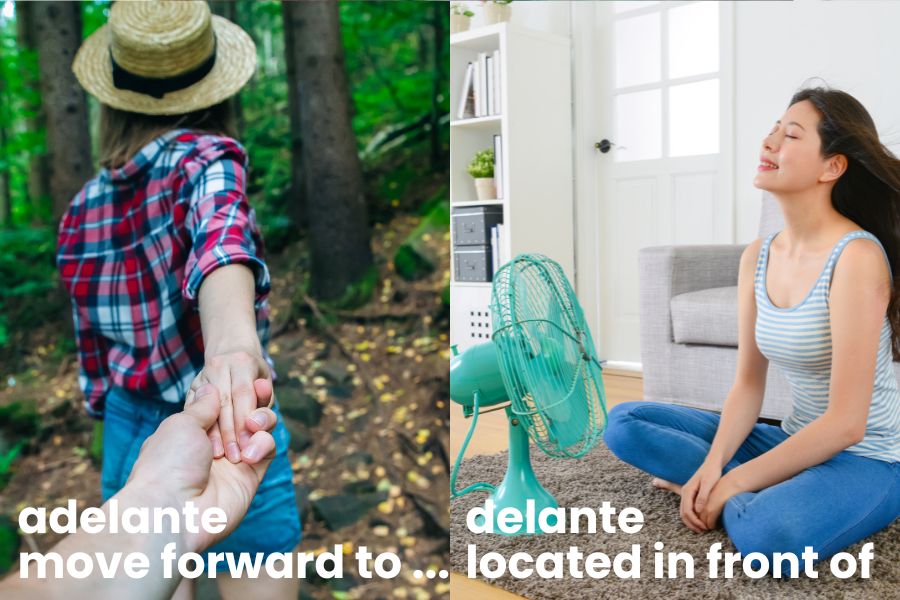
“Adelante” = Movement forward or permission to go forward
Think of it like “go ahead” or “move forward.”
It often appears with verbs of movement (seguir, ir, pasar, avanzar, etc.).
- Sigue adelante, casi llegamos. → Keep going forward, we’re almost there.
- Pasa adelante y toma asiento. → Go ahead and take a seat.
- Voy adelante, tú sígueme. → I’m going ahead, follow me.
It can also be used figuratively:
- Tienes que seguir adelante con tu vida. → You have to move forward with your life.
“Delante” = Location (already in front of something)
It refers to something that is positioned in front of a specific point.
Often used with “de” to specify location.
- El coche está delante de la casa. → The car is in front of the house.
- Tienes algo delante de ti. → You have something in front of you.
- Se sentó delante de mí en el cine. → He sat in front of me at the movies.

BACK – Atrás vs Detrás
Both “atrás” and “detrás” relate to being “behind” or “back,” but they have different uses.
“Atrás” = Movement backward or general direction
Think of it like “backward” or “to the back.”
It often appears with verbs of movement (ir, mirar, volver, dar, echar, etc.).
- Da un paso atrás. → Take a step back.
- Miré atrás y vi a mi amigo. → I looked back and saw my friend.
- Echa la silla más atrás. → Push the chair further back.
It can also refer to a past time:
- Hace años, atrás todo era diferente. → Years ago, everything was different.
“Detrás” = Location (already behind something)
It refers to something that is positioned behind a specific point.
Often used with “de” to specify location.
- El coche está detrás de la casa. → The car is behind the house.
- Puse la llave detrás de la puerta. → I put the key behind the door.
- Hay un parque detrás del supermercado. → There is a park behind the supermarket.

ABOVE – Arriba vs Encima
Both “arriba” and “encima” relate to being “above,” but they have different uses.
“Arriba” = Movement upward or general position
Think of it like “up” or “upstairs.”
It often appears with verbs of movement (subir, ir, mirar, levantar, etc.).
- Mira arriba, hay un pájaro. → Look up, there’s a bird.
- Voy arriba a mi cuarto. → I’m going upstairs to my room.
- Levanta la cabeza arriba. → Lift your head up.
It can also be used figuratively:
- ¡Ánimo! Siempre hacia arriba. → Cheer up! Always moving forward/up.
“Encima” = Location (already on top of something, touching it)
It refers to something that is positioned on top of a specific point.
Often used with “de” to specify location.
- El libro está encima de la mesa. → The book is on top of the table.
- No pongas los pies encima de la silla. → Don’t put your feet on top of the chair.
- Se cayó y se golpeó encima del ojo. → He fell and hit himself above his eye.
BELOW – Abajo vs Debajo
Both “abajo” and “debajo” relate to being “below,” but they have different uses.
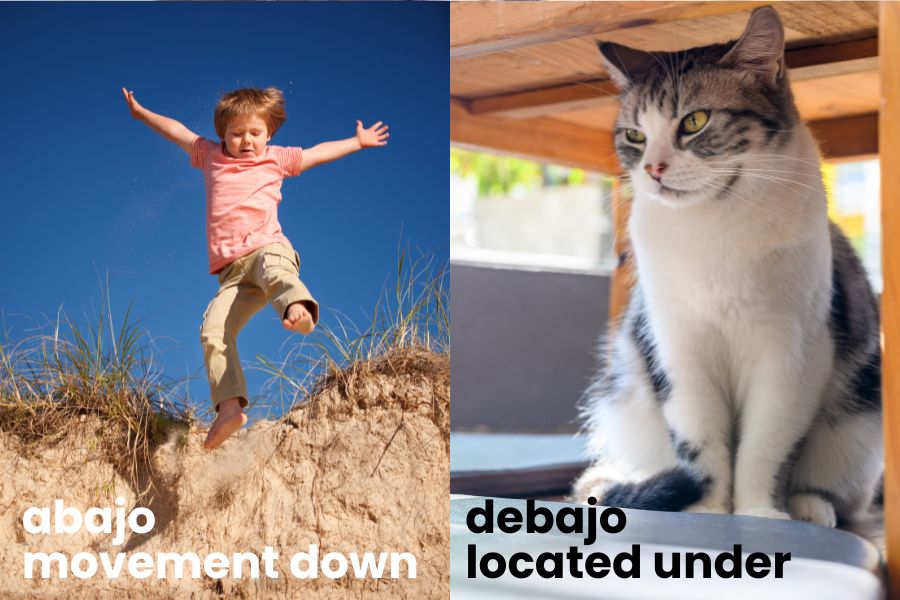
“Abajo” = Movement downward or general direction
Think of it like “down” or “downstairs.”
It often appears with verbs of movement (bajar, caer, ir, mirar, etc.).
- Mira abajo, hay una moneda. → Look down, there’s a coin.
- Voy abajo a comprar algo. → I’m going downstairs to buy something.
- Las hojas cayeron abajo del árbol. → The leaves fell down from the tree.
It can also be used figuratively:
- ¡Abajo el estrés! → Down with stress! (Expressing opposition)
“Debajo” = Location (already under something, touching or covered by it)
It refers to something that is positioned underneath a specific point.
Often used with “de” to specify location.
- El gato está debajo de la cama. → The cat is under the bed.
- Las llaves están debajo de los papeles. → The keys are under the papers.
- Hace frío debajo del puente. → It’s cold under the bridge.