
El Mapa del Tesoro
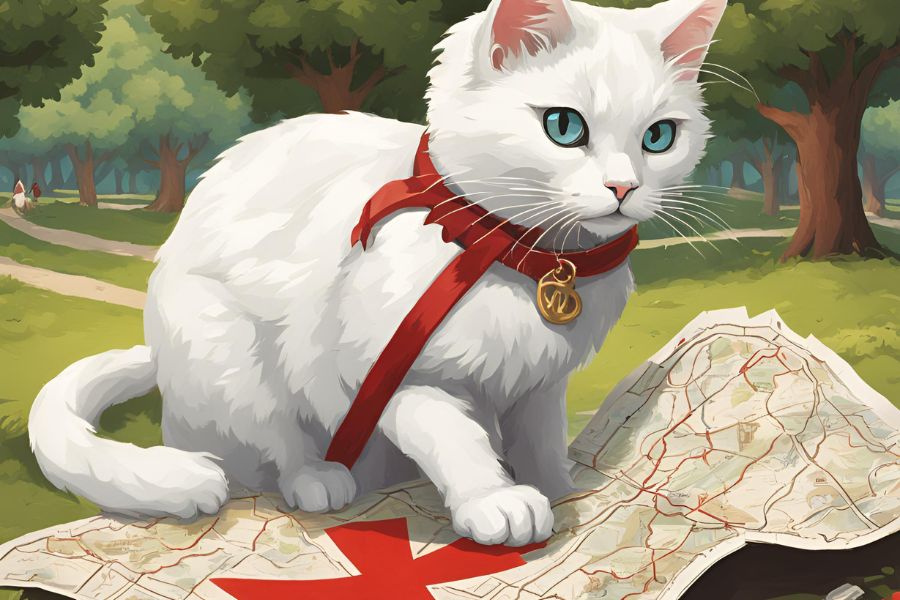
An exercise in directions and the informal command form.
The informal command form (tú) is used when addressing someone you know well (family and friends), and to yourself when muttering instructions to remember!
It’s also common in written instructions for general audiences, such as manuals for furniture assembly, appliance setup, recipes, or personal care items (and treasure maps!).
There are three main types of conjugations in this story:
- the past tense (p) is used for completed actions that continue the storyline. Generally past tense is used with the actions of the main character, but can also be used with other people the main character interacts with, eg the woman nodded
- the imperfect tense (i) for past actions that are part of the background story
- and informal command (inf c) for the instructions
El Mapa del Tesoro
Tom el gato encontró un mapa viejo en el parque. (p)
El mapa tenía una “X” roja y un mensaje: (i)
“Sigue las instrucciones y encuentra el tesoro.” (inf c)
Tom estaba emocionado. (i)
Miró el mapa y leyó la primera instrucción: (p)
“Sigue (inf c) derecho por la calle principal hasta que llegues (s) a la plaza grande.”
Tom fue derecho por la calle principal.
Caminó y caminó hasta que llegó a la plaza. (p)
Allí, miró el mapa otra vez. (p)
La segunda instrucción decía (i):
“Gira a la derecha en la fuente y cruza el puente pequeño.” (inf c)
Tom giró en la fuente y cruzó el puente pequeño. (p)
Ahora estaba cerca de un mercado lleno (adj) de frutas y flores.
La tercera instrucción decía (i):
“Toma la segunda calle a la izquierda y camina hasta que veas la panadería.” (inf c)
Tom tomó la segunda calle a la izquierda. (p)
Caminó hasta que vio la panadería. (p)
El olor de pan fresco llenó el aire. (p)
La cuarta instrucción decía (i):
“Cruza la calle delante de la panadería y busca la librería.” (inf c)
Tom cruzó la calle delante de la panadería y buscó la librería. (p)
¡Ahí estaba! (i)
La última instrucción decía: (i)
“Entra en la librería, sube las escaleras y mira detrás de los libros.” (inf c)
Tom entró en la librería, subió las escaleras y miró detrás de los libros. (p)
¡Encontró el tesoro! (p)
Era una foto vieja de un gato pirata con un collar dorado.
La nota en la parte posterior de la foto decía: (i)
“¡Felicitaciones, Tom! Has descubierto el tesoro del Capitán Bigotes.” (present perfect, irregular)
The informal command is used only with tú, not with other pronouns, as it’s reserved for informal contexts like family, kids, or friends. Commands can be positive or negative:
Positive commands: Change -ar → -a, -er/-ir → -e (present tense), e.g., Espera! (Wait!).
Negative commands: Use the subjunctive form with -ar → -es, -er/-ir → -as, e.g., ¡No esperes! (Don’t wait!).
The preposition “en” (at/in) is used to indicate movement to or around a specific point, such as in the phrase “Gira en la fuente” (Turn at the fountain).
seguir – means “to follow” or “to continue.”
fuente – fountain
cruzar – to cross
puente – bridge
delante de – in front of
subir – to go up
detrás de – behind
bigotes – whiskers
1st, 2nd, 3rd, 4th
“Instrucción” is feminine, so the adjective must agree in gender: “cuarta.”
“hasta que llegues”:
The phrase “hasta que” (until) triggers the subjunctive mood because it refers to an action that hasn’t happened yet.
Use “llegues” (subjunctive tú form of llegar) for grammatical accuracy.