
Using Present Tense For The Future
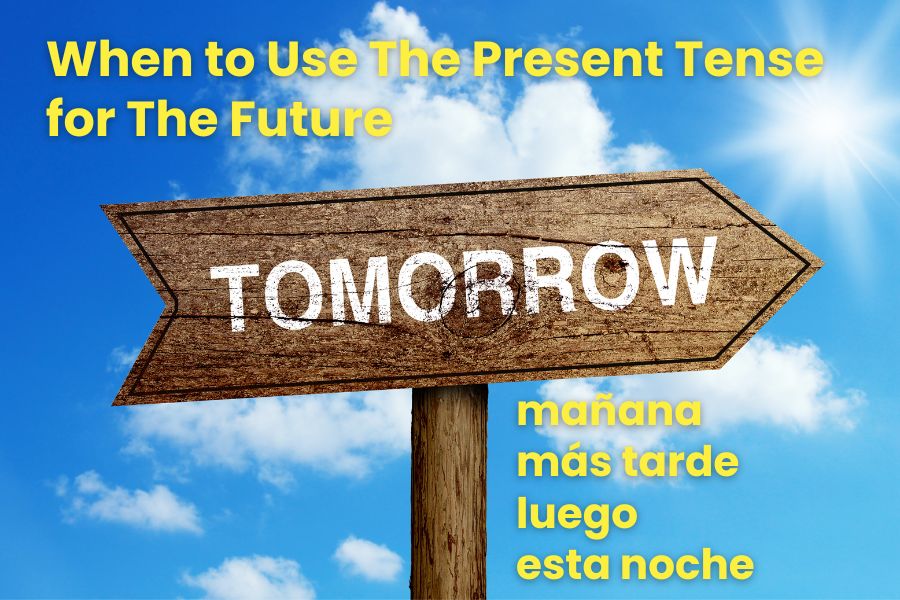
When we think “future,” we usually expect a future tense.
But in everyday Spanish, a lot of future talk actually uses the present tense — especially when the timing is clear or near.
This is why phrases like Te llamo mañana or Nos vemos luego sound perfectly natural in Spanish, even though they literally say “I call you tomorrow” or “We see each other later.”
I used to translate these literally —
To you / I call / later
— without realising that llamo was a present tense being used for a future meaning.
If I tried to pull “I will call you later” out of my head, I would have reached for a future tense.
Now I understand there are three ways Spanish talks about the future, each with a different sense of timing and intention.
When to Use The Present Tense for The Future
1️⃣ Present Tense → for immediate or scheduled future
Used when the timing is understood or soon.
It feels casual, certain, and already in motion.
Te llamo mañana. → I’ll call you tomorrow.
Nos vemos luego. → See you later.
Salgo a las ocho. → I leave at eight.
Logic: real plan → context supplies the future meaning.
No “will,” no auxiliary — just present form + time clue.
2️⃣ Ir + a + infinitive → “gonna / going to”
Used when there’s intention or near action, like something you’re about to do or have decided to do.
Voy a estudiar esta noche. → I’m going to study tonight.
Vamos a comer en un rato. → We’re gonna eat in a bit.
Logic: expresses intention or imminence.
It’s more dynamic — “I’m heading toward doing this.”
3️⃣ Future Tense → “will” with emphasis
Used when there’s distance, uncertainty, formality, or emphasis — something you predict, promise, or declare.
Te prometo que lo haré mañana. → I promise I’ll do it tomorrow.
Algún día entenderás. → Someday you’ll understand.
Firmaré el documento después de que hagas esa llamada. → I’ll sign the document after you make that call.
Logic: marks commitment, intention, or prediction — not just timing.
So when Paul says Spanish has “three ways to talk about the future,” he’s pointing to three levels of psychological distance:
| Form | Used when | Feels like |
|---|---|---|
| Present tense | certain / planned | “it’s basically happening” |
| Ir + a + infinitive | intended / soon | “I’m about to” |
| Future tense | distant / formal / emphatic | “I will (for sure / promise / predict)” |
Present Tense For the Future
If you think of the stereotypical Mexican immigrant on American TV, you can hear how Spanish speakers often do a literal translation from Spanish to English. They’ll say things like:
“I call you tomorrow.”
It sounds like poor English, but what they’re actually doing is mapping the Spanish present-for-future pattern directly into English.
In Spanish, you’d naturally say:
Te llamo mañana. → literally “I call you tomorrow.”
So their English reflects Spanish logic: present tense verb + future time marker — perfectly correct in Spanish, just mismatched in English.
But you can’t do this for every situation. “Lavo el carro” (I wash the car) sounds like a habit, not a future plan.
The present tense can only point to the future when the context itself anchors the timing:
mañana, luego, esta noche, en un rato (in a while)
Super Comon present-for-future Phrases
- Nos vemos mañana.
→ See you tomorrow.
(Literally “We see each other tomorrow.” Most common of all.) - Te llamo más tarde.
→ I’ll call you later.
(Context gives the future; “later” anchors it.) - Voy al súper después.
→ I’m going to the supermarket later.
(Ir here is present tense, not voy a ir — you’ll hear both, but this simple one’s quick and casual.) - Comemos en un rato.
→ We’ll eat in a bit. - Salgo a las ocho.
→ I’m leaving at eight.
(Used all the time for schedules, departures, appointments.) - Nos vemos allá.
→ See you there.
(Short, fixed formula. Again: “we see each other” literally, but meaning “we’ll meet there.”) - Te escribo cuando llegue.
→ I’ll text you when I arrive.
(“I write you when I arrive.” This one is huge in messages.) - Te aviso si puedo.
→ I’ll let you know if I can.
(Present tense “I let you know” + future-dependent clause.) - Paso por ti mañana.
→ I’ll pick you up tomorrow.
(Common, natural, no voy a needed.) - Te cuento luego.
→ I’ll tell you later.
(Literally “I tell you later.” Perfect example of contextual future.)
You can see the same pattern marker in all of them:
present verb + clear time marker or implicit near-future context