
Personal Reaction Verbs: A Soft Lead Into IDO
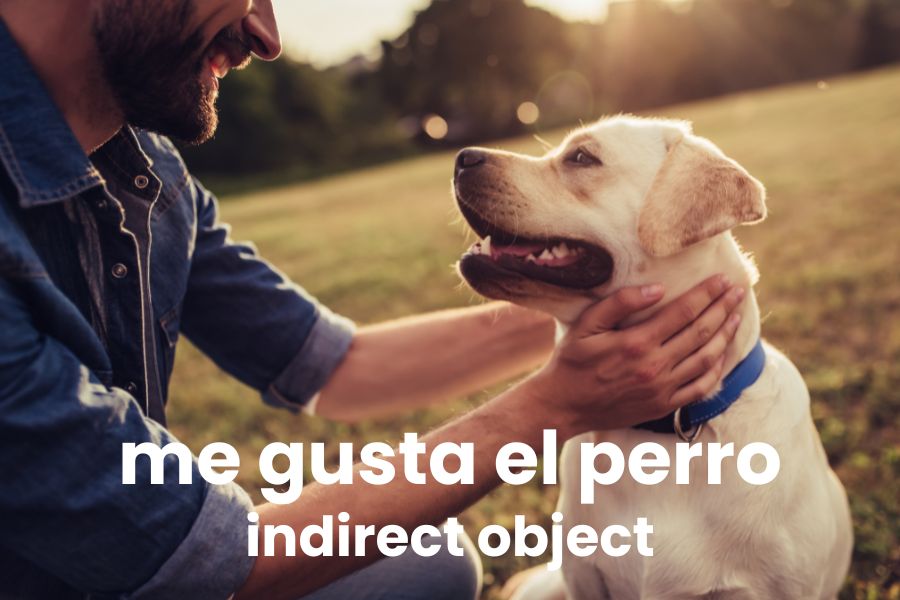
In English, emotion is internal.
In Spanish, emotion is triggered externally.
Is it psychologically true that feelings happen to us rather than come from within?
There are two schools of thought — and the answer is: both.
But in Spanish, feelings are consistently treated as something that happens to us. This holds true because:
- Even complex emotions like embarrassment, fear, or desire are often evoked by context, not chosen.
- Many emotions are reactions to external stimuli — someone says something hurtful, the sun comes out, a loud noise startles you.
- The nervous system responds automatically, before the conscious mind has time to interpret.
📌 Why this matters for grammar:
Understanding this perspective makes personal reaction verbs in Spanish feel less weird. You stop expecting them to behave like English, because the emotion isn’t “yours” — it’s given to you by something outside you.
👉 Does this help explain indirect objects too? Yes. Absolutely.
Indirect objects in Spanish mark the recipient of something — not just physical things like gifts, but also feelings, pain, opinions, and experiences.
If you think of emotions (or impressions) as things that are given, triggered, or land on someone, then it makes total sense that we use indirect object pronouns: me, te, le, nos, les.
You’re not just describing how you feel —
You’re describing what was given to you, who gave it, and how it landed.
Personal Reaction Verbs
💬 English: Emotion is internal.
“I like the dog.”
→ I am the subject.
→ The feeling is coming from me.
💬 Spanish: Emotion is triggered externally.
“Me gusta el perro.”
→ The dog is the subject.
→ The feeling is coming from the dog (as a trigger), and I am reacting.
→ Literally: The dog is pleasing to me.
So what’s happening?
- In English, we own the emotion.
- In Spanish, the world acts on us, and we react.
This explains why:
- The verb agrees with the thing causing the reaction (el perro → gusta).
- The person experiencing the reaction is in the indirect object role (me → to me).
This structure shifts the focus away from the individual as the emotional source.
Instead, something outside us triggers a response.
It’s a more externalized, observational perspective, where feelings happen to us rather than come from within us.
🩺 And this same logic carries over to the body:
Spanish often uses definite articles (la mano, la cabeza) instead of possessives (mi mano) — because the body part is framed as something that affects us, not something we fully own or control.
There’s a subtle distance between the self and the body, reinforcing the idea that pain, illness, or sensation is something we receive, not something we create.
All personal reaction verbs in Spanish follow this same logic:
External trigger → internal reaction
Verb agrees with the thing causing the reaction
Person reacting is the indirect object (beneficiary)
Personal Reaction Verbs: The Core Set
These verbs treat emotion, opinion, or sensation as something that happens to you, not something you actively do:
| Verb | What It Expresses | Who Reacts | What Triggers It | Example |
|---|---|---|---|---|
| me gusta | liking / pleasure | me (to me) | el café | Me gusta el café. → Coffee pleases me. |
| me encanta | strong liking / delight | me | la música | Me encanta la música. |
| me duele | physical pain | me | la cabeza | Me duele la cabeza. |
| me queda bien | fit / appearance | me | la camisa | Me queda bien la camisa. |
| me parece bien | positive impression / approval | me | la idea | Me parece bien la idea. |
| me interesa | interest | me | el tema | Me interesa el tema. |
| me molesta | annoyance / bother | me | el ruido | Me molesta el ruido. |
| me da miedo | fear | me | la oscuridad | Me da miedo la oscuridad. |
| me parece | opinion / impression | me | el precio | Me parece caro. |
| me falta | lack / something missing | me | tiempo | Me falta tiempo. |
Framing it as Indirect Objects (IDO)
Indirect Objects are classified by actions being performed for a beneficiary.
“Me gusta su perro.”
= To me, his dog is pleasing.
🧠 The dog is giving me good feelings.
→ I’m receiving something — not a gift, not a favor, but a reaction.
✅ So we treat my emotional response as the thing being given, and me as the beneficiary.
| Structure | What’s Happening | Why It Helps |
|---|---|---|
| Me gusta su perro | “To me, it is pleasing” → I receive pleasure | Emotional reaction treated as a “benefit” |
| Me encanta la música | “To me, music enchants” → I receive joy | Stronger feeling = stronger “gift” vibe |
| Me interesa el tema | “To me, the topic is interesting” → I gain interest | “Interest” becomes the “thing” I’m given |
| Me da miedo | “It gives me fear” | Now we’re sliding into real IDO territory |
Transition to Action Verbs
Once this emotional reaction structure feels familiar, it’s easier to recognise how real-world actions also use indirect objects.
Now we’re moving from feelings to actual things being done or given — but the logic is the same:
Someone receives something = beneficiary = indirect object.
By the time you’re saying me duele la cabeza or me falta tiempo, you’re already using indirect objects — you just don’t know it yet.
What’s being “given” is a feeling, a state, a need.
Now we shift to verbs where the thing received is more physical or concrete — like a message, money, or coffee.
The logic stays the same: someone receives something = beneficiary = indirect object.
Indirect Objects pronouns:
- I = me
- you = te
- he/she =le
- us = nos
- them = les
| Personal Reaction Verbs | Action Verbs |
|---|---|
| Me gusta el café.(I like coffee.) → To me, coffee is pleasing. → IDO = me | Le doy el dinero.(I give him/her the money.) → He/She receives the money. → IDO = le |
| Te encanta la playa.(You love the beach.) → To you, the beach enchants. → IDO = te | Te traigo un café.(I bring you a coffee.) → You receive the coffee. → IDO = te |
| Le interesa el libro.(He/She is interested in the book.) → To him/her, the book is interesting. → IDO = le | Nos escribe una carta.(He/She writes us a letter.) → We receive the letter. → IDO = nos |
| Nos da miedo la oscuridad.(We are afraid of the dark.) → The dark gives us fear. → IDO = nos | Me compras un helado.(You buy me an ice cream.) → I receive the ice cream. → IDO = me |
| Les molesta el ruido.(The noise bothers them.) → To them, the noise is bothersome. → IDO = les | Les mando un mensaje.(I send them a message.) → They receive the message. → IDO = les |
A soft lead into IDO structure.