
Le with Objects
Personal a → the verb goes straight into the person (DO)
Dative a (+ le) → the verb does something else, and that person/thing ends up involved because of it (IDO):
le / les + action + what you moved/changed + a + who/what ends up in a new situation because of it
Le puse gasolina al carro.
This is the English struggle with Spanish:
How do I know when the action lands on something else?
These 2 examples seem no different to each other:
I (cleaned) the car
I (put gas in) the car
“Clean the car” is a state-change that terminates on the object itself.
You act on the surface of the car. The verb’s job is done.
There is no internal reconfiguration implied by the verb limpiar.
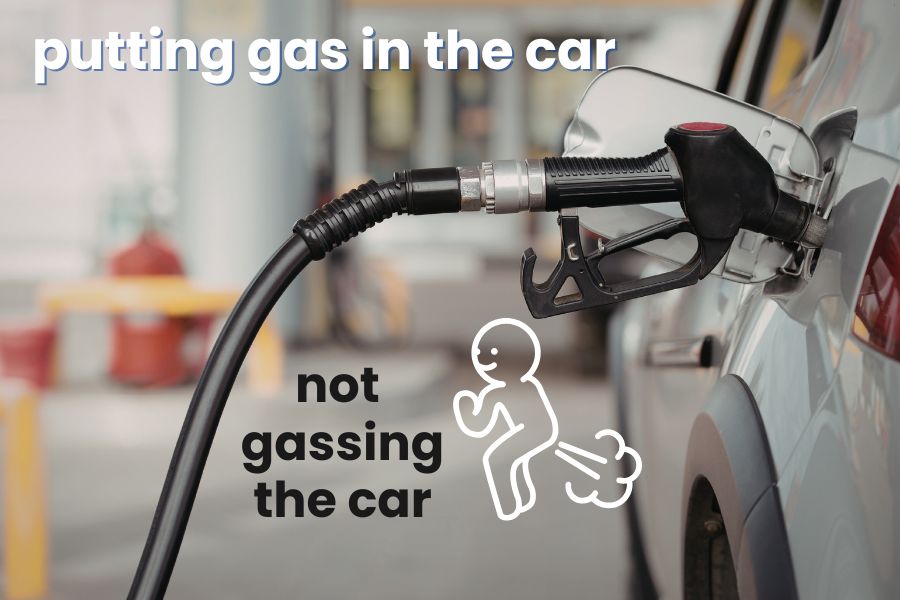
In contrast, poner gasolina is not about acting on the car directly..
You are not “gassing the car” in Spanish.
You are introducing a substance into a system.
The moment a verb implies relocation + internal effect, Spanish treats the target as an indirect endpoint.
That’s how you know the action “lands elsewhere” and when to use ‘le’.
- Le eché azúcar al café porque estaba muy amargo.
→ I added sugar to the coffee because it was really bitter.
English treats “add sugar” as a single action. Spanish splits it: sugar moves, coffee changes.
- Le metí las llaves a la mochila y salí corriendo.
→ I put the keys in the backpack and ran out.
English collapses the movement and the endpoint into “put in”.
- Le saqué el chip al celular viejo.
→ I took the chip out of the old phone.
Again, English focuses on removal. Spanish tracks where that removal lands.
- Le puse una cobija al perro porque hacía frío.
→ I put a blanket on the dog because it was cold.
English makes “put on” feel like acting on the dog. Spanish keeps the blanket as the moved element.
- Le cambié la contraseña a la compu.
→ I changed the computer’s password.
This one really shows the mismatch. English treats the computer as the direct object. Spanish treats the password as the manipulated thing and the computer as the affected system.
Think of it like this:
Some verbs describe contact.
Other verbs describe involvement.
Contact verbs just touch something and stop.
Involvement verbs leave something caught up in the consequence of what happened.
That’s why:
Limpié el carro.
You touched the car. The action ended at the surface. No relationship was formed beyond contact.
Le puse gasolina al carro.
Now the car is implicated in what happened. Its condition, role, and future behavior are altered. A relationship between gasoline and car was created, and the car is the participant that has to live with that outcome.
Le puse una cobija al perro.
You didn’t just touch the dog. You changed the dog’s situational state. The dog is now in a new condition relative to the world (warmer, covered). The verb created a temporary relationship between dog and blanket, and the dog is the one carrying that consequence.
Same with people:
Le conté el chisme a Marta.
Now Marta is involved in the social ripple of that information.
Le enseñé a manejar a mi hijo.
Now your son is implicated in a new ability that changes how he interacts with the world.
So the common thread isn’t “benefit” or “inside vs outside”.
It’s that the verb causes one participant to become entangled in a new state, possession, condition, or circumstance.
Spanish marks the participant that becomes relationally altered.
That makes a lot of sense — and it’s a powerful way to look at it.
A lot of traditional grammar explanations treat sentences like mechanical diagrams: subject does X to object, arrows everywhere, labels slapped on parts. That works, but it often misses what language is really built to track: how participants are connected through what happens.
Spanish in particular is very sensitive to relationships between participants. Not just who did what, but who ends up involved, affected, included, burdened, benefited, stuck with the result, brought into the situation. That’s exactly the territory where le lives.
When you use a relationship lens, things like this stop being random:
Le conté el problema.
You’re not just “telling”. You’re bringing someone into the circle of that problem.
Le puse gasolina al carro.
You’re not just performing an action. You’re changing the car’s situation in relation to fuel, movement, use.
Le rompieron el celular.
The phone broke, but Spanish zooms in on the person whose world is now different because of it.
What ties these together isn’t “indirect object” as a grammar label. It’s that the verb creates a new relational state, and Spanish marks the participant who now has to live in that new setup.
Verbs aren’t just actions, they’re relationship events.
This same lens helps with things like reflexive verbs, accidental se, gustar-type verbs, even parts of the subjunctive.
There is the social and situational geometry underneath the grammar.