
Le, Lo and La Pronouns
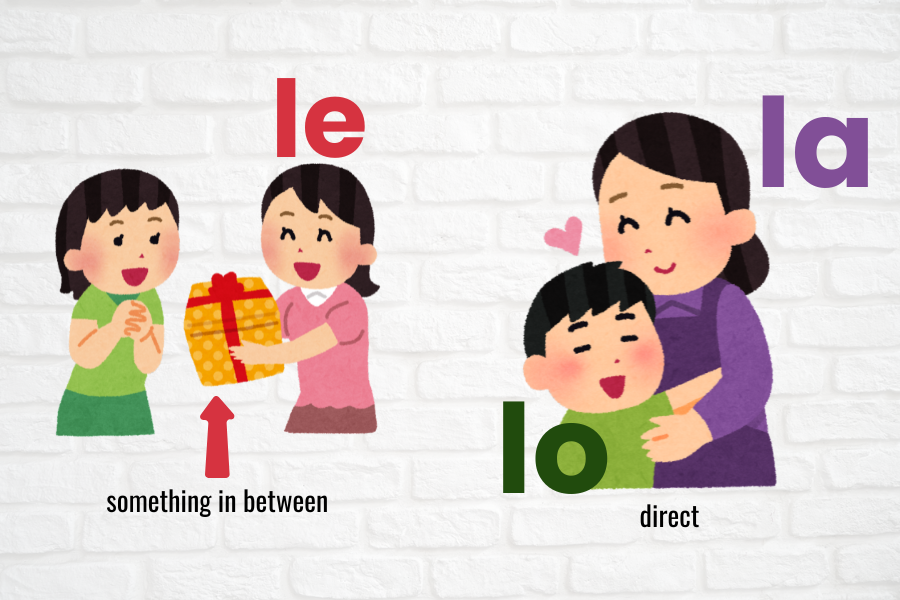
The properties of an Indirect Object that uses the pronoun le:
- there is a beneficiary (person or object)
- there is an ‘in-between’ action for the beneficiary
The properties of an Direct Object that uses the pronoun lo or la:
- the verb is acting directly upon the object or person
- some verbs are inherently direct actions (see right column)
Simple Rule for Everyday Speaking:
- Context: What is the sentence talking about?
- The ‘what’ is the receiver of the verb—the direct or indirect object.
- Then let the verb guide you:
- If the verb is taking direct action (direct object) on the thing (or person), use lo or la.
- If the person (or thing) is benefiting from the verb, use le.
Watch for the Verb
Some verbs inherently act directly on the ‘what’: These verbs naturally involve no beneficiary—just the action and its target.
- Yo abrazo a mi mamá. (Who do I hug? My mum – direct object.)
- Mi hermano vio la película. (What did he see? The movie – direct object.)
- El camarero limpió la mesa. (What did he clean? The table – direct object.)
- Ella tiene la pelota en la mano. (What does she have? The ball – direct object.)
BUT most verbs can act directly on the ‘what’ OR involve an in-between action for a beneficiary.
- Direct action:
The verb acts directly on the object, with no in-between element or beneficiary.- Ayer escribí una carta.
(The verb “escribí” is acting directly on the letter—no beneficiary involved.) - Dimos un regalo.
(The verb “dimos” is focused entirely on giving the gift—no beneficiary.)
- Ayer escribí una carta.
- In-between action (indirect):
The verb involves an in-between action (like giving, writing, or sending) for the benefit of a recipient.- Ayer le escribí una carta a mi amiga.
(The verb “escribí” is writing the letter for the benefit of my friend—the beneficiary.) - Le dimos un regalo a nuestra mamá.
(The verb “dimos” involves giving the gift to our mum as the beneficiary.)
- Ayer le escribí una carta a mi amiga.
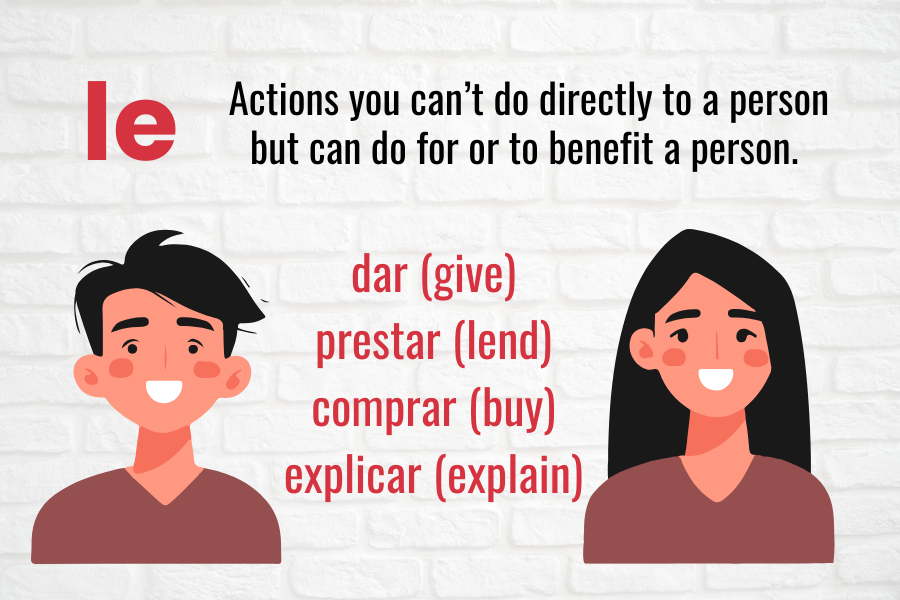
“Le” for the Beneficiary
You use “le” when the person (formal or informal, tú or usted) is benefiting from the action—something is being done for them or for their benefit.
“le/les” is indirect because there’s often an “in-between” element like a message, action, or object being exchanged between the subject and the beneficiary, like the giving of a gift.
- Le doy el libro. “I give him the book.”
- Le escribimos una carta.
- Le compré un regalo.
- ¿Ya le hablaste?
- Le compré tacos a mi hermano. “I bought tacos for my brother.”
- Le presté mi bicicleta. “I lent my bike to him/her.”
Why “Le” Is Used for “Talking” (Hablar)
In Spanish, verbs like hablar inherently view the listener as the beneficiary of the action (i.e., ‘the words are directed toward them’), which is why le is used.
“Le” and Sentence Structure:
In general, “le” typically appears before the conjugated verb, but there are exceptions where something can show up in between depending on the sentence structure.
Implied Beneficiary at the Start (dropping the yo/tú etc)
- (yo) Le di el libro. → “I gave him the book.”
Stated Beneficiary at the Start
- A mi hermano le compré tacos. → “I bought tacos for my brother.”
Question Structure
- ¿Ya le hablaste? → “Did you already talk to him/her?”
When there’s a conjugated verb followed by an infinitive or gerund, “le” can appear before the conjugated verb or attach to the infinitive/gerund.
- Le quiero escribir una carta. → “I want to write him a letter.”
- Quiero escribirle una carta. → “I want to write him a letter.”
- Le estoy hablando. → “I am talking to him/her.”
- Estoy hablándole. → “I am talking to him/her.”
Lo / La for the Direct Target
“Lo” or “La” refers to the direct target of the action—the person or object the verb directly affects. There is no ‘in-between’ element.
“La/las”: Feminine nouns.
“Lo/los”: Masculine nouns or general ideas.
The action/verb is entirely focused on the person.
- La visito. (“I visit her.”)
- Lo vi ayer. “I saw him yesterday.”
- La llamé por teléfono. “I called her on the phone.”
- ¿Dónde está el cuaderno? Lo necesito. “Where’s the notebook? I need it.”
- “I saw her at the store.” → La vi en la tienda.
Lo and La Sentence Structure:
Before the Conjugated Verb:
- Lo llamé esta mañana. → “I called him this morning.”
- La vi ayer. → “I saw her yesterday.”
In the Second Clause:
- Vi a María en la tienda, pero no la saludé. → “I saw María in the store, but I didn’t greet her.”
- Compré un libro, pero no lo leí. → “I bought a book, but I didn’t read it.”
“Lo/La” as a Suffix
When a conjugated verb is followed by an infinitive or a gerund, “lo/la” can attach to the end of the infinitive or gerund, or it can appear before the conjugated verb.
With an Infinitive:
- Lo quiero ver. → “I want to see him.”
- Quiero verlo. → “I want to see him.”
With a Gerund (-ing):
- Lo estoy viendo. → “I’m seeing him.”
- Estoy viéndolo. → “I’m seeing him.”
With Two Verbs (Conjugated + Infinitive):
- Voy a hacerlo. → “I’m going to do it.”
- Lo voy a hacer. → “I’m going to do it.”
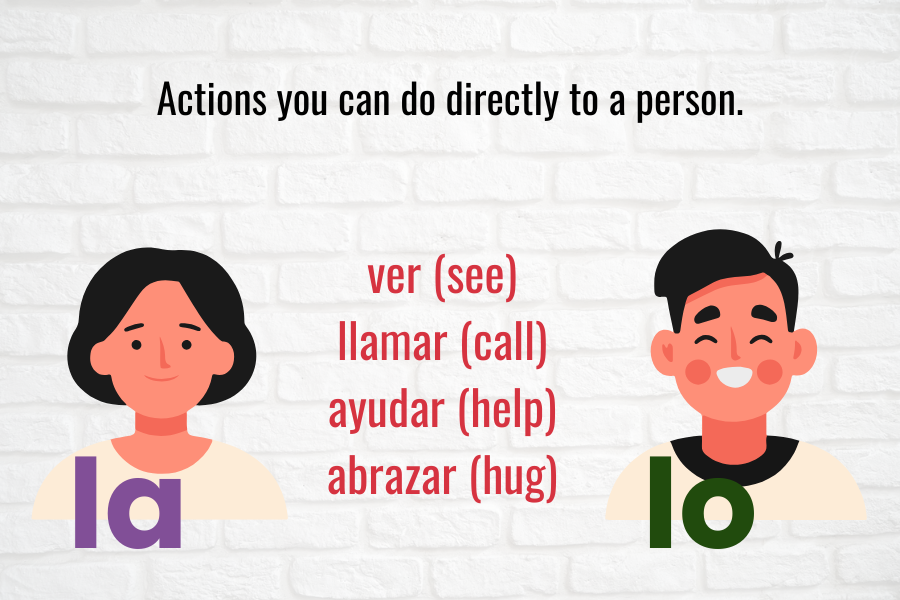
Most common verbs that are inherently direct actions. Direct Object – LO/LA
- Ver → to see
- Llamar → to call
- Buscar → to look for
- Encontrar → to find
- Oír → to hear
- Esperar → to wait for
- Ayudar → to help
- Invitar → to invite
- Conocer → to meet / to know
- Seguir → to follow
- Amar → to love
- Abrazar → to hug
- Besar → to kiss