
Estaba – Not What I was Expecting
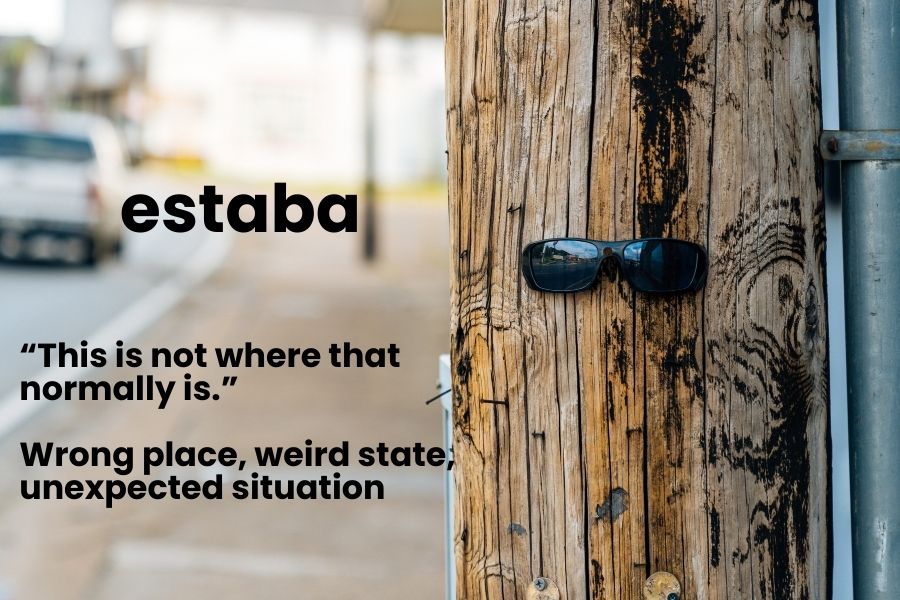
From Jerome’s post.
You can often use estaba it when a characteristic isn’t what you’d expect.
For example: you see a book on your table, you would expect it to be in Spanish … but ..El manual estaba en inglés.
And Sonny’s phone. You’d expect it be in English … but it was in Spanish – estaba.
So a thing can take:
- SER = identity/category (what it is)
- ESTAR = state/encounter (how it showed up / what it was like in that moment)
And you can choose to use estar/estaba to highlight a different state than you expected.
Ser vs Estar (the “scene report” idea)
Ser vs estar isn’t only “permanent vs temporary.”
In real Spanish, it’s often more like:
- SER = label / identity / category
- ESTAR = scene report / state encountered / what showed up in front of you
So your choice of ser or estar communicates what kind of information you’re giving the listener.
Two camera modes (storytelling lens)
Think of Spanish like switching camera modes:
1) SER = “what it is” (definition / category)
You’re describing the kind of thing it is.
- Es francés. (identity/origin)
- Es de metal. (material)
- Es alto. (defining trait)
- Era un libro en español. (a book in Spanish — category/type)
This is “labeling” information.
2) ESTAR = “what it was like / what I found” (scene report)
You’re describing the state it was in when you encountered it.
- Estaba en la mesa. (location)
- Estaba sucio. (condition)
- Estaba cerrado. (status)
- Estaba en inglés / en español. (what language it appeared in / was set in)
This is “pointing at reality”: look at this, here’s what it was like.
Key insight: ESTAR can be used even if the thing is “permanently” that way
Example that triggered the whole conversation:
✅ El manual estaba en inglés.
Even though the manual is obviously written in English (a stable characteristic), estar works because:
- the speaker is reporting what they encountered in that moment
- it has a “discovery / scene report” vibe
- it’s almost like: “Turns out… it was in English.”
So it’s not claiming the manual temporarily changed languages.
It’s describing the state it presented to you when you found/opened it.
Schrödinger’s Cat Spanish 😄
Before you open the manual / press play on the song / check your phone…
You don’t know what language it’s in.
Then you check → reality collapses:
- La canción estaba en español.
- El manual estaba en inglés.
- Mi celular estaba todo en español.
This framing is extremely estar-friendly, because you’re reporting your experience of the situation.
“Not what I expected” = a strong ESTAR detector
Surprise isn’t a rule, but it’s a great signal.
If your sentence feels like:
- “I expected X… but I found Y”
- “I looked and it was…”
- “It turned out to be…”
…Spanish often wants estar.
Example:
- Me sorprendió que estuviera tan sucia. (I was surprised it was so dirty)
Eiffel Tower logic (your example)
SER = expected / defining facts
- La Torre Eiffel es francesa.
- Es alta.
- Es de metal.
ESTAR = condition / how it was that day
- Está sucia.
- Está llena de gente.
- Está cerrada.
- Está iluminada.
So estar lets you narrate the situation you encountered.
The “pointing at it” function of ESTAR
ESTAR often feels like the speaker is gesturing at reality.
English:
- “The phone was all in Spanish.”
Spanish: - Mi celular estaba en español.
= pointing at the scene: this is what I saw when I looked.
This is similar to how preterite vs imperfect reveals your framing choice:
your word choice isn’t random — it signals what you want the listener to notice.
Quick meaning map
- SER → “this is what it is”
- ESTAR → “this is what it was like (when I saw it)”
Or:
- SER = label
- ESTAR = report