
Descripciones, Perspectivas y Narraciones

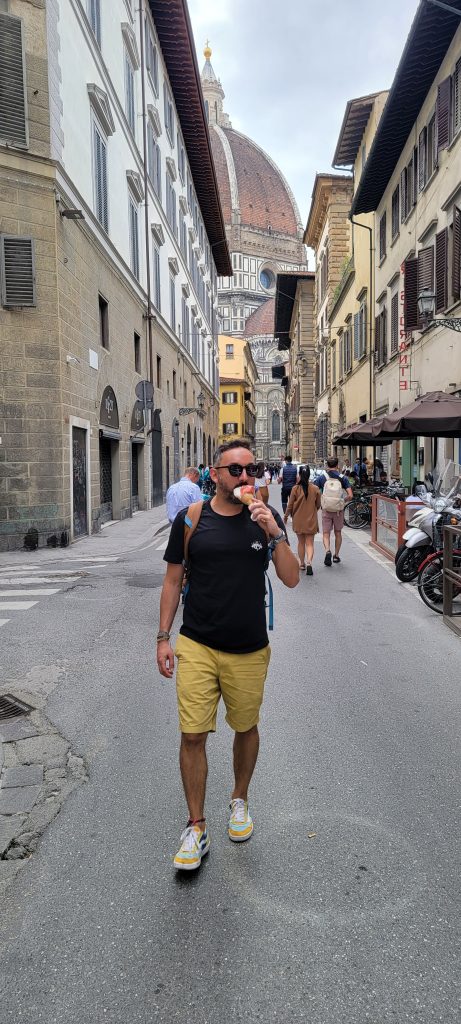
The class was asked to describe a photo. Each student saw something different—some recognised landmarks, others talked about topics that interested them, and some focused on details like the way colors matched or ‘feelings’.

For this exercise, I’m practicing descriptions by also exploring how each person perceived the same image in different ways.

And to practice storytelling tenses by recounting what classmates said.

Mi descripción:

No sé dónde está este lugar pero es muy interesante.

Me encantan las calles que están para la gente y no los autos; donde se puede caminar seguro por el medio y comer un helado.

Muchas personas están caminando y parecen relajados.

Hay motos y bicis estacionadas a lo largo de la calle ancha entre los restaurantes y las tiendas.

Este tipo de calle es parte del urbanismo, un tema que me encanta.

También, este lugar tiene dos tipos de edificios. Muchos son modernos, pero en el fondo hay un edificio muy grande y antiguo. ¿Es una catedral o una mezquita?

Observation 1: When both nouns in a sentence share the same definite article (los/las), you can drop the second one because the article applies to both equally. eg Los perros y gatos necesitan agua.

Observation 2. Descriptions in Spanish like to use nouns as adjectives – eg: eg shirt of stripes. I talk about this more here.

Observation 3. If you drop the second ‘una’ from – ¿Es una catedral o una mezquita? – it could make “mezquita” sound like it’s modifying “catedral,” almost like saying “a cathedral-type mosque” instead of listing two separate things.

Since “catedral” and “mezquita” are both standalone nouns, keeping “una” before each one makes it clear that they are distinct options.

Fue interesante que vi algunas cosas mientras mis compañeros vieron otras cosas.

Una compañera de clase reconoció la arquitectura de Florencia. También, ella comentó sobre la comida de Italia. Parece que esta foto le recordó su comida favorita.

Me encanta cómo las fotos conectan a las personas con recuerdos específicos!

También, ella se dio cuenta de que un edificio en el fondo es amarillo y que el hombre en la foto está usando shorts amarillos. ¡Y que partes de sus zapatos tienen el color amarillo! Tiene buen ojo!

“Buen ojo” (singular) is the most common way to say someone has a good eye for details.

“Buenos ojos” (plural) would literally mean “good eyes” (physically), but in this context, we’re talking about perception.

💡 Alternative:

“Es muy observadora” (She’s very observant.)

“¡Qué buen ojo tiene!” (What a good eye they have!)

Algunos compañeros de clase usaron palabras y frases informales para describir esta foto. ?Aprendieron estas palabras informales por hablar mucho con amigos españoles?

Otro compañero describió cómo se sentía el hombre:
Seguro usted estaba pensando en el sabor del helado que estaba comiendo y en cuánto te gusta este sitio.
A lo mejor va al parque y come su helado mientras está sentado en una banca.

Neither “probablemente” nor “a lo mejor” triggered the subjunctive here because of the way certainty vs. uncertainty plays out in these specific cases.

“Probablemente” → Can take either indicative or subjunctive

✅ “Probablemente usted estaba pensando en el sabor del helado…” (Indicative)

  • Here, you’re stating something as a likely fact (You were probably thinking about…), so it feels like a normal description, not speculation.
  • Since the main verb “estaba pensando” is in the past imperfect, it follows a descriptive/narrative tone rather than introducing doubt.

💡 When would “probablemente” take the subjunctive?

  • If the sentence were more hypothetical or uncertain, you could use the subjunctive:
    ✅ “Probablemente usted haya pensado en el sabor del helado.” (You have probably thought about the flavor of the ice cream.)
  • But in casual speech, the indicative is more common with “probablemente” when simply expressing a probable action.

“A lo mejor” → Always takes the indicative

✅ “A lo mejor va al parque y come su helado…” (Indicative)

  • “A lo mejor” (maybe, perhaps) is different from “quizás” or “tal vez” because it expresses stronger probability (closer to probably than maybe).
  • It always takes the indicative, so using “va” and “come” (present indicative) is correct.

💡 Example where “quizás” could take the subjunctive:
✅ “Quizás vaya al parque y coma su helado.” (Maybe they’ll go to the park and eat their ice cream.)
👉 Here, “quizás” introduces uncertainty, so the subjunctive fits better.

Es importante reconocer que otras personas ven el mundo con ojos diferentes. Cuando leo los descripciones de mis compañeros, me dan más español. Recibo nuevas formas de pensar en español y muchas palabras nuevas!
estacionadas – parked

a lo largo de – along

el fondo – background

ancha – wide

se dio cuenta de que – she noticed

pensar en algo – to think about something

Seguro – probablemente

Seguro is more confident and conversational.

“Seguro estabas pensando en el sabor del helado.”
(You were probably thinking about the flavor of the ice cream.)

  • Sounds more certain—like “I’m sure you were” rather than just guessing.
  • Very casual and conversational in spoken Spanish.
  • Used without subjunctive because it expresses confidence.

Probablemente is more nuetral and slightly formal.

“Probablemente estabas pensando en el sabor del helado.”
(You were probably thinking about the flavor of the ice cream.)

Can take either indicative or subjunctive, depending on how certain you are.

Sounds a bit less certain, like a neutral guess.

Used in both written and spoken Spanish but feels slightly more formal than “seguro.”

cuánto – how much (of a thing)