
Pronominal Verbs Have a Different “little Story”
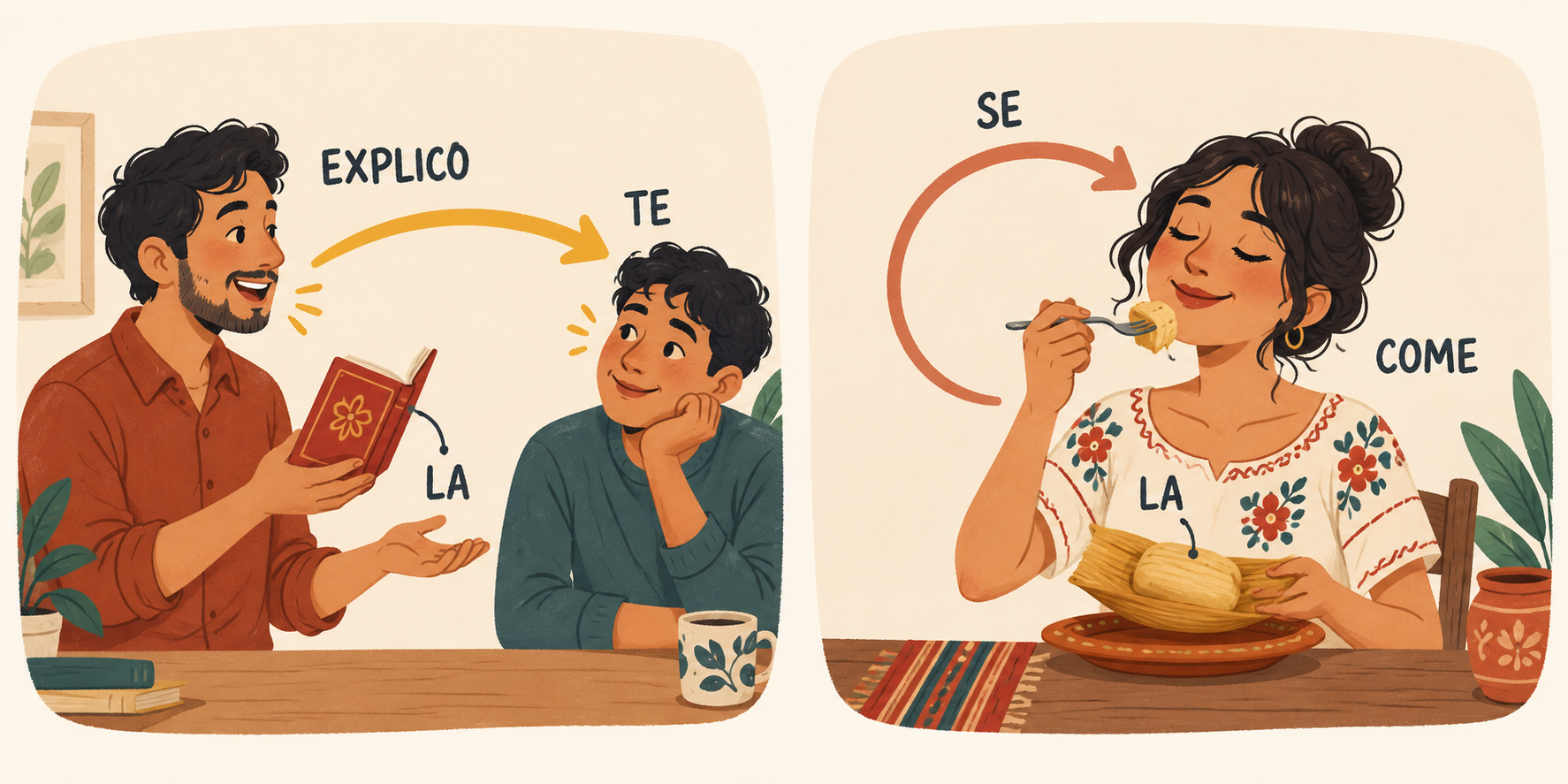
Pronominal Verbs Have a Different “little Story”
I have been struggling with understanding what pronominal verbs actually do and how they fit into my theory of ‘little pronoun stories’.
My theory goes like this:
[pronouns + conjugated verb]
tell a little story
- who it lands on
- who or what is involved
- what the action is and who did it
Sentences generally follow the above order.
pronouns like me, te, se, le – are who the action lands on
pronouns like la, lo – are about who or what is involved
conjugates verbs – explain what the action is and who did (he,she / you / I / they – did it)
And generally more than one person is involved:
La vendedora puso unos mangos en una bolsa y me la dio (she gave it to me).
me la dio – she gave it to me
Getting to know pronominal verbs
Pronominal verbs are verbs that have ‘se’ on the end, and the definition of the original verb changes.
Sometimes the change in meaning is a lot and sometimes it’s subtle.
For now, I am putting pronominal verbs and reflexive verbs together in their own group.
Both of them speak to the actions of only one person.
The action of the verb involves only one person.
Reflexive: the action is done to that person.
me lavo — I wash myself.
Pronominal verbs: the pronoun marks the action as that person’s own experience or personal act.
me voy — I leave (irse)
Common pronominals in action.
Comerse – to eat it
Abra la hoja del tamal, pero no se la coma.
Reírse – to laugh
Su hermana se rió.
Llevarse – to take with you
El perro se llevó su pelota en la boca.
El perro se la llevó.
Going back to my theory
- who it lands on
- who or what is involved
- what the action is and who did it
Te expliqué la situación
Te la expliqué
te – who it lands on (you)
la – who or what is involved (la situación)
expliqué – what the action is and who did it (I explained)
It’s clear that there are two people in this interaction.
But now look at a sentence that uses a pronominal verb.
Abra la hoja del tamal, pero no te la comes.
No te la comes – don’t (you) eat it
comerse
te – informal tú
la – who or what is involved (fem noun – una hoja del tamal)
no comes – the action and who does it (don’t you eat)
There is only one person involved in the interaction.
comerse → the personal act of consuming something
Comí manzana. → I ate some apple. (comer)
Me comí una manzana. → I ate an apple—the complete, specific apple. (comerse)
Se comió todo el pastel. → She ate the entire cake. (comerse)
Ana se llevó la bolsa.
Se la llevó. — She took it away with her.
llevarse
se – points back to Ana, the person taking it
la – the thing she took (la bolsa)
llevó – the action and who did it (she took)
There is one person in this little story. Here, se is referring to the third person she/Ana, the same as the conjugated verb is referring to the third person she/Ana.
Context is everything.
Sometimes se is actually replacing ‘le’.
Ana le dio la bolsa a Luis. — Ana gave the bag to Luis.
Ana se la dio. — Ana gave it to him.
Personal act
My biggest takeaway for pronominal verbs is that the pronominal pronoun ‘se’ lands on the same person that is doing the action.
It’s a ‘personal act’.
In a pronominal verb, me/te/se/nos identifies whose personal act it is.
irse → a personal act of leaving → leave/go away
quedarse → a personal act of remaining → stay
dormirse → a personal experience of sleeping → fall asleep
acordarse → a personal experience of remembering → remember
olvidarse → a personal experience of forgetting → forget
sentirse → a personal experience of feeling → feel
darse cuenta → a personal experience of realising → realise
equivocarse → a personal act/experience of making a mistake
quejarse → a personal act of complaining
arrepentirse → a personal experience of regretting