
Prounoun Stacking
You cannot put pronouns on the end of just any kind of verb.
You can only put pronouns on the end of:
– Infinitive
– Gerund
– Affirmative imperative and
– Reflexive verbs
These are the ONLY verb forms where the pronoun can attach like a suffix.
Suffix Stacking
Suffix stacking is when you add one or more pronouns on the end of a verb.
This is the first place I saw pronouns on the end of a more complex type of verb:
These are the only Times You can add a Pronoun on the end of a verb
– AKA suffix Stacking
| Form | Examples |
| Infinitives | decirme, contarme, explicarme |
| Gerunds | diciéndome, contándome, preguntándose |
| Affirmative imperatives | dime, cuéntame, cállate |
| Reflexive verbs | llamarse, sentarse, preguntarse |
A pronoun can attach to the end of a verb in only the above situations.
If the verb is conjugated — the pronoun has to float in front: Me puedes
The Three types of pronouns that can suffix stack
- IDO pronouns: me, te, le, nos, les
- DO pronouns: me, te, lo, la, nos, los, las
- Reflexive: me, te, se, nos, se
Any of the verb forms (infinitive, gerund, imperative, reflexive) can take just an IDO pronoun or just a DO pronoun.
But when the verb has both pronouns on the end they have to be in this order:
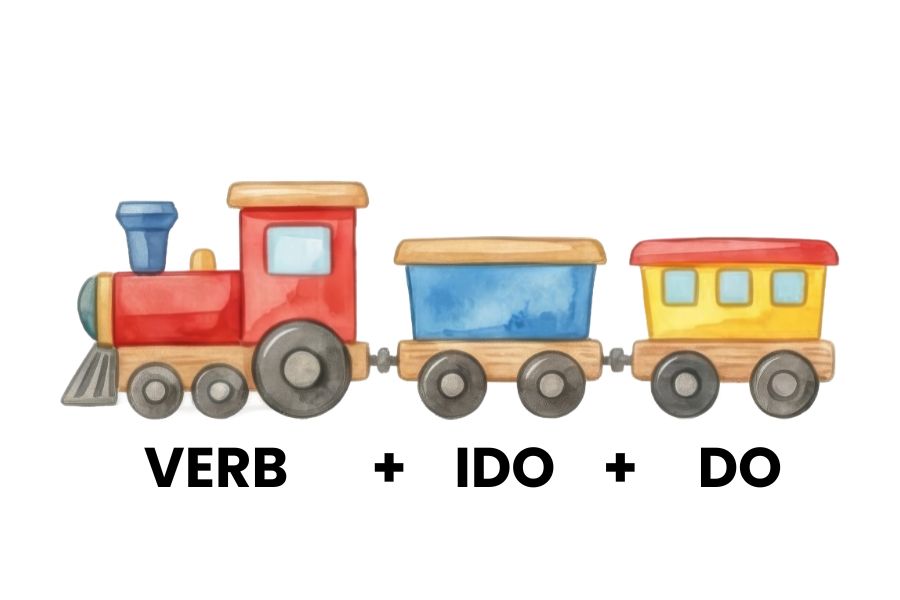
The Formula: Verb + IDO + DO
It’s also important to remember that the le→se rule applies here too: le and les always convert to se before lo, la, los, las — never lelo, lela etc.
1. Infinitive Stacking
decirme, examinarlo, explicártelo
Do you have to stack? No — free choice, both are correct and mean the same thing:
- Voy a llamarte = Te voy a llamar
- Voy a hacerlo = Lo voy a hacer
What makes you choose? Mostly rhythm and feel — there’s no grammar rule forcing one over the other. The mouth picks what rolls easier. Tendency only: stacking sounds more flowing, splitting is lighter and faster in casual speech. With double pronouns, splitting is easier because the stacked version gets unwieldy (explicármelo vs me lo vas a explicar).
Single pronoun:
- ¿Puedes ayudarme? / ¿Me puedes ayudar? — Can you help me?
- Voy a llamarte / Te voy a llamar — I’m going to call you
- Quiero decirte algo / Te quiero decir algo — I want to tell you something
- Voy a hacerlo / Lo voy a hacer — I’m going to do it
- Necesito explicarte esto / Te necesito explicar esto — I need to explain this to you
Double stacking:
Double stacking shows up whenever:
the action has involved two people/things – IDO
AND
when an action has landed on a thing (without changing it)- DO
SIMULTANEOUSLY.
1. Voy a explicártelo
- explicar — to explain
- te — to you (involvement — you’ll be changed by receiving it)
- lo — it (contact — the thing being explained)
2. Quiero presentárselo
- presentar — to present/introduce
- se — to him/her (involvement — le becomes se because lo follows)
- lo — it/him (contact — the thing or person being introduced)
3. Necesito mandártela
- mandar — to send
- te — to you (involvement — you’re the receiver)
- la — it (contact — the thing being sent, feminine — la carta)
2. Gerund Stacking
diciéndome, explicándolo, guiñándole
Do you have to stack? No — free choice, but the feel shifts:
- Estoy explicándotelo — stacked, flowing, more literary
- Te lo estoy explicando — split, lighter, more conversational
What makes you choose? Same as infinitive — rhythm and feel. In writing and narration, stacking sounds elegant and simultaneous. In fast casual conversation, splitting is more natural. Double pronoun stacks (diciéndomelo, explicándotelo) are genuinely hard to say at speed, so splitting wins there almost always.
Note the gerund verb looks like it has a lot going on compared to an infinitive verb with two pronouns on the end.
It changes from the infinitive to the gerund and then stacks the pronouns.
explicar
explicando
explicándote
explicándotelo
Single pronoun:
- Estoy pensándolo / Lo estoy pensando — I’m thinking about it
- Estoy escuchándote / Te estoy escuchando — I’m listening to you
- Estoy haciéndolo / Lo estoy haciendo — I’m doing it
- Está mirándola / La está mirando — he’s looking at her
- Estoy diciéndote la verdad / Te estoy diciendo la verdad — I’m telling you the truth
Double stacking:
Same principle — involvement pronoun first, contact pronoun second:
1. Estoy explicándotelo
- explicando — explaining
- te — to you (involvement — you’re being brought into it)
- lo — it (contact — the thing being explained)
2. Está contándoselo
- contando — telling/recounting
- se — to him/her (involvement — le becomes se because lo follows)
- lo — it (contact — the story or thing being told)
3. Estoy mandándotela
- mandando — sending
- te — to you (involvement — you’re the receiver)
- la — it (contact — the thing being sent, feminine — la carta)
The stacked versions are genuinely hard to say at speed, which is why conversation tends to split them: te lo estoy explicando
3. Imperative Stacking
dime, llámame, háblame
Do you have to stack? YES — no choice. The affirmative imperative requires suffix stacking.
Negative imperative flips it — pronoun goes in front, stacking not allowed ❌
Single pronoun:
- Dime — tell me
- Llámame — call me
- Ayúdame — help me
- Escúchame — listen to me
- Háblame — talk to me
Double stacking:
With imperatives, stacking is obligatory — so double stacking is also obligatory. Involvement pronoun first, contact pronoun second:
1. Dímelo
- di — tell (imperative of decir)
- me — to me (involvement — I’m being brought into it)
- lo — it (contact — the thing being told)
2. Mándamela
- manda — send (imperative of mandar)
- me — to me (involvement — I’m the receiver)
- la — it (contact — the thing being sent, feminine — la carta)
3. Dáselo
- da — give (imperative of dar)
- se — to him/her (involvement — le becomes se because lo follows)
- lo — it (contact — the thing being given)
4. Reflexive Stacking
llamarse, preguntándose, cállate
Reflexive verbs follow exactly the same suffix stacking rules as the others.
A reflexive means the action loops back to the subject — the doer and the receiver are the same person. So the two slots in a reflexive double stack are for the person and the thing. It is never about two people, due to the nature of reflexive being about a single person.
(Because in reflexive stacks the person slot is already taken by se. There’s simply no scenario where lo/la would need to refer to another person — that person would need their own involvement pronoun instead, which immediately makes it non-reflexive.)
Do you have to stack? Depends on the verb form — reflexive in the infinitive, gerund or imperative:
- Infinitive and gerund: free choice
- Imperative: must stack
The reflexive imperative is some of the most common everyday Spanish — and notice how splitting creates a completely different sentence:
- cállate ✅ – be quiet
- te calla ❌ means “it suits you”
- siéntate ✅ – sit down
- te sienta ❌ means “it suits you” (again)
Single pronoun:
- llamarse / se llama — to be called
- preguntarse / se pregunta — to wonder
- cállate — be quiet
- siéntate — sit down
- levántate — get up
Double stacking — reflexive + contact pronoun:
A reflexive means the action loops back to the subject — the doer and the receiver are the same person.
So the two slots in a reflexive double stack are for the person doing the action IDO and the thing DO.
There’s never a second person involved in the meaning of the double stack.
1. Preguntárselo
- preguntar — to ask
- se — himself/herself (reflexive)
- lo — it (contact — the thing being wondered about)
2. Está preguntándoselo
- preguntando — wondering
- se — himself (reflexive)
- lo — it (contact — the thing being wondered about)
3. Voy a decírmelo
- decir — to tell
- me — myself (reflexive)
- lo — it (contact — the thing being told)
Little Stories
The whole VERB + IDO + DO construction is a little story: a story between two parties where something happened.
There’s even a story between just the two parties (without the action involved). I looked at this more closely, as mini stories, as a way to wrap my mind around ‘who’s involved and how’ rather than grammar rules you have to memorise:
The Accent Rule — applies to all forms
Attaching a pronoun adds a syllable and shifts the stress. A written accent pins the stress back to where it originally fell:
- explicando → explicándome
- examina → examínalo
- di → dime (short enough, no accent needed)
- decír → decírmelo (double stack, accent essential)
The One Underlying Rule
| Form | Pronoun placement | Choice? |
| Infinitive | attach or split | free choice |
| Gerund | attach or split | free choice |
| Affirmative imperative | must attach | no choice |
| Reflexive verb | follows the rule of its verb form | same as above |
| Any conjugated verb | must go in front | no choice |