
Why is Aunque a Subjunctive Trigger?
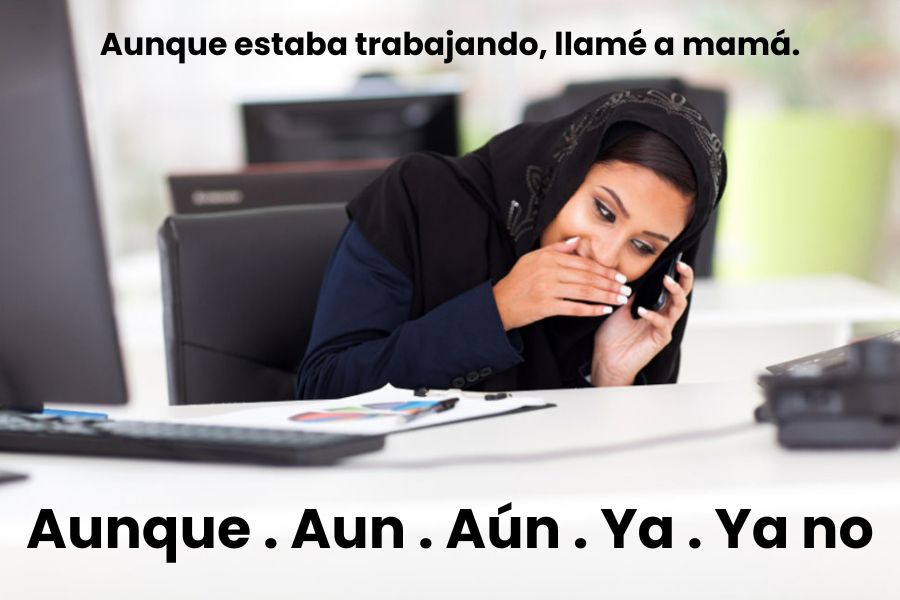
aunque = even if (subjunctive follows)
aunque = even though (indicative follows)
aun = even (emphasiser, more often hasta yo or incluso yo in conversations)
aún = still/yet — very close to todavía
ya = already / now – this is the condition
ya no = not anymore – this is the new condition
Why is Aunque a Subjunctive Trigger?
The core reason: aunque means “even if / even though” and it can introduce either a known fact or a hypothetical/conceded possibility — and Spanish uses the mood to signal which one you mean.
Indicative — you’re presenting it as a known reality:
- Aunque está lloviendo, voy a salir —
Even though it is raining (I can see it, it’s a fact),
I’m going out.
Subjunctive — you’re conceding a possibility, or it doesn’t matter either way:
- Aunque esté lloviendo, voy a salir —
Even if it happens to be raining (I don’t know, or it doesn’t change anything),
I’m going out.
Indicative — known fact:
Aunque estaba cansada, salí con mis amigas.
Even though I was tired, I still went out with my friends.
Fact / indicative
Aunque estaba trabajando, llamé a mamá.
Even though I was working I still had time to call my mum.
Fact / indicative
Subjunctive — conceded possibility:
Aunque esté cansada mañana, voy a salir.
Even if I’m tired tomorrow, I’m going out anyway.
I don’t know yet if I’ll be tired / subjunctive
Aunque no te guste, tienes que comerlo.
Even if you don’t like it, you have to eat it.
We don’t know if you like it or not / subjunctive
You use the subjunctive with aunque when:
You don’t know if it’s true — aunque esté lloviendo (I haven’t checked outside)
It doesn’t matter whether it’s true — the “regardless” meaning
Future/hypothetical — aunque llueva mañana, voy a salir — even if it rains tomorrow
You use the indicative when:
You know it’s true and you’re stating it as fact — aunque está lloviendo (I can see the rain)
Variations
Aunque doens’t need to be just at the beginning of a sentence.
Flip the clauses:
Llamé a mamá aunque estaba trabajando. I called mum even though I was working.
Same sentence as before, just flipped. Works perfectly naturally either way.
And aunque can sit in the middle of a sentence joining two independent clauses — it’s not locked to the front. The only difference is emphasis:
- Aunque estaba cansada, salí — the concession is foregrounded, you lead with it
- Salí aunque estaba cansada — the main fact is foregrounded, the concession comes second
Same meaning, different weight. In conversation you’d naturally put whichever part you want to emphasise first.
Aunque is a conjunction and conjunctions can sit wherever the join needs to happen. It’s not position-locked, it just goes where the two clauses meet.
What’s the difference between aun and aunque?
They look related and they are, but they work differently.
aunque — conjunction, introduces a clause (needs a verb after it)
- Aunque llueva, voy a salir — Even if it rains, I’m going out
- always followed by a full clause (, I’m going out)
aun — has two distinct lives depending on accent
aún (with accent) = todavía — “still” / “yet”
- Aún no he comido — I still haven’t eaten
- ¿Aún estás aquí? — Are you still here?
aun (no accent) = “even” — a scale of something surprising or extreme on a range, compared to
- Aun yo lo sé — Even I know that
- Aun así — Even so
- Aun cuando — Even when
Aun (no accent, “even”) is more written and formal — you’d see it in literature, journalism, speeches. In everyday Mexican Spanish conversation you’d more likely hear:
hasta yo lo sé— even I know that
up to even me, I know it
Hasta literally means “until” / “up to” / “as far as” — it’s a limit word, marking the furthest point on a scale.
So literally: up to even me, I know it — meaning “it reaches as far as me on the scale” — even someone as unlikely as me is included.
You can see the scalar logic directly in the literal meaning — hasta is pointing to the far end of a range. It’s the same word in:
- hasta luego — until later
- hasta la frontera — as far as the border
- hasta yo — as far as even me
Mexican Spanish extended it into this “even” meaning because the underlying logic is identical — marking an extreme point on a scale.
incluso yo — even I
included me
Incluso comes from incluir — to include. So literally: included, me — I am included in the set of people who know this, surprisingly.
Your instinct was exactly right. It’s a past participle of incluir that fossilised into an adverb meaning “even / including.”
Same thing happened in English — “even” originally meant something like “level/equal” — it drifted into this scalar emphasiser meaning over time.
Both words show the same underlying thought: this person is included, surprisingly, at the extreme end of the scale.
How Are Aun and Aunque Related?
So the family connection is:
- aun = even
- aunque = aun + que = “even that” → “even if / even though”
aunque — a conditional in disguise whether X or not, Y still happens
- always has two clauses, always has that “regardless” logic underneath
- can start a sentence or connect clauses (eg whether X or not aunque Y still happens)
- If you can see que inside the word, you know a clause is coming.
que as a clause-opener is consistent across the whole conjunction family:
porque — por + que → clause coming
aunque — aun + que → clause coming
para que — para + que → clause coming
a menos que — a menos + que → clause coming
con tal que — con tal + que → clause coming
aun (no accent) — a modifier sits next to a word and intensifies it, pushes it to an extreme point on a scale
- aun yo — even me (modifying the pronoun)
- aun así — even so (modifying the situation)
- It works like an adverb (modifies verbs, adjectives, other adverbs)
aún (accent) — a state marker it remains true / it continues / not yet changed
- aún está aquí — it’s still the case that she’s here
- todavía
Aún – todavía – ya
These three form a little system:
| aún / todavía | still/yet (ongoing, not finished) |
| aún no / todavía no | not yet |
| ya | already / now (it has happened) |
| ya no | not anymore |
Aún – it’s still a thing
- ¿Aún estás aquí? = ¿Todavía estás aquí? — Are you still here?
- Ya llegó — She’s already arrived
- Ya no vive aquí — She doesn’t live here anymore
Aún and todavía are interchangeable — todavía is just more conversational.
ya no – it was a thing but it’s not anymore – cuts off something that was previously true:
- Ya no vive aquí — She used to live here, but not anymore
- Ya no me gusta — I used to like it, but not anymore
- Ya no somos amigos — We were friends, but not anymore
The ya is carrying a sense of a change having occurred — a before and after. Whatever was true before has now shifted.
So ya and todavía are almost opposites on the axis of change:
Using vivir aquí as an example — living here, a state that can start and stop:
- ¿Todavía vive aquí? — Does she still live here? (no change yet?)
- Sí, ya vive aquí — Yes, she’s living here now (change happened, she moved in)
- No, ya no vive aquí — No, she doesn’t live here anymore (change happened, she left)
Now you can see the full axis:
todavía — the state is continuing, no change
ya — the change into the state has happened
ya no — the change out of the state has happened