
HACER: Making someone do it vs causing it to happen
HACER = “MAKE” (English)
English uses make for a bunch of meanings (cause, force, influence, create results).
Spanish splits this into two main constructions, depending on what kind of “make” you mean.
Spanish has two engines for “make”:
Engine 1: Push
Someone pushes someone into doing something (made them do it)
➡️ hacer + pronoun + infinitive
Engine 2: Cause
Something causes a result / reaction (made it happen)
➡️ hacer que + subj
HACER – push
X makes Y do something (directly)
This is the “I’m making you / they made him / the boss makes us…” type of make.
Subject + DO/IDO pronoun + hacer + infinitive
This is the easier construction.
No subjunctive is needed.
Pronoun reference
DO: me, te, nos, se (+ lo, la, los, las)
IDO: me, te, nos, se (+ le, les)
💡 Note: me / te / nos / se can be DO or IDO — they look the same either way.
Examples (no subjunctive)
Present
- El jefe me hace trabajar los sábados.
- La lluvia hace que las plantas crezcan más rápido.
Past
- El jefe me hizo trabajar…
- La lluvia hizo que las plantas crecieran…
Future
- El jefe me hará trabajar…
- La situación hará que ellos cambien…
Conditional
- El jefe me haría trabajar…
- Eso haría que ellos cambiaran…
present tense: hago, haces, hace, hacemos, hacen
Preterite: hice, hiciste, hizo, hicimos, hicieron
Conditional: haría, harías, haría, haríamos, harían
DO / IDO choice note
They made him quit.
- Lo hicieron renunciar. (DO)
- Le hicieron renunciar. (IDO — very common in Mexico)
In this construction, the person can sometimes be shown with either:
- lo/la (DO) OR
- le/les (IDO)
Both show up, depending on region + sentence style.
When the sentence is long, people often choose le to help refer back to the person clearly.
Other verbs to consider for English “make”
Sometimes “make” in English is better translated with a different verb (so you don’t force everything into hacer).
Common options:
- obligar a + infinitive = force / require
- forzar a + infinitive = force (stronger)
- dejar que + subjunctive = allow / let
- lograr que + subjunctive = manage to get / succeed in getting
- conseguir que + subjunctive = manage to get / obtain that
(These are useful because English “make” is a shape-shifter.)
HACER QUE (cause → result)
This is the cause/result version of make:
- “This makes it happen that…”
- “This causes X to occur…”
- “This leads to…”
You can think of it as: explanation / causation / outcome
Sub 1 + hacer que + Sub 2 + subjunctive
- 2 clauses / 2 subjects
- Clause 1 + trigger + Clause 2
- hacer que = subj trigger
- This construction is clearer when a third party is involved.
Which verb takes the subjunctive?
✅ The verb in clause 2 is in the subjunctive.
✅ It is conjugated to Subject 2.
Examples (subjunctive in clause 2)
The rain makes the plants grow faster.
- La lluvia hace que las plantas crezcan más rápido.
Her dedication makes everyone trust her.
- Su dedicación hace que todos confíen en ella.
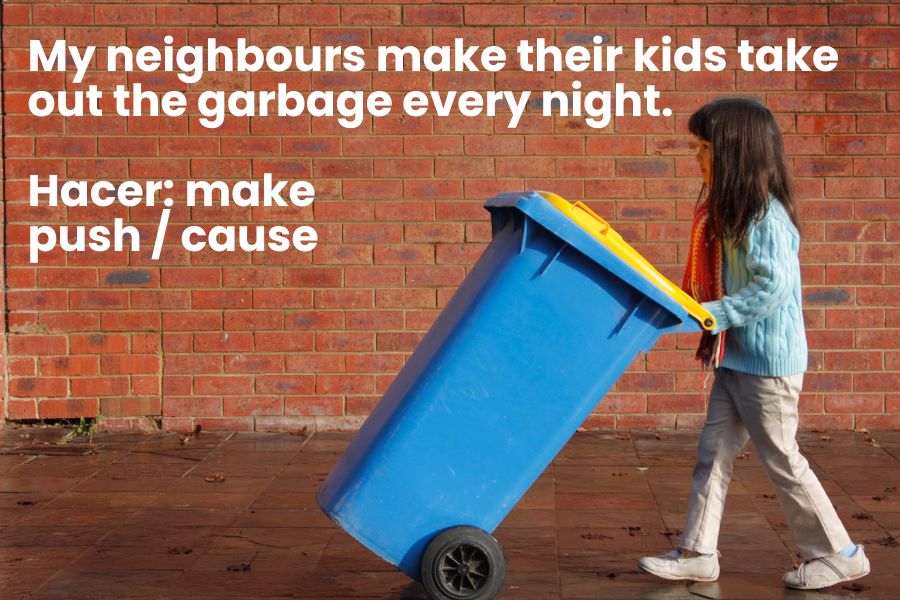
My neighbours make their kids take out the garbage every night.
- Mis vecinos hacen que sus niños/hijos saquen la basura todas las noches.
The boss makes us work Saturdays. (harder way / subj version)
- El jefe hace que trabajemos los sábados.
The boss makes Juan and María work Saturdays.
- El jefe hace que Juan y María trabajen los sábados.
The professor makes the students learn something new every day.
- El profesor hace que los estudiantes aprendan algo nuevo todos los días.
Same meaning shown both ways (important comparison)
My friend made me go to the store.
Two valid Spanish engines:
- Harder way (cause – made it that I went): Mi amigo hizo que (yo) fuera a la tienda.
- Easier way (push – made me go): Mi amigo me hizo ir a la tienda.
How common are these in everyday conversation?
Very common. Both show up all the time, but in different situations.
- Hacer + pronoun + infinitive (PUSH engine)
Super common in daily speech because people constantly talk about:
“it made me think / made me laugh / made me do X / made me go” - Hacer que + subjunctive (RESULT engine)
Also common, but slightly more “explaining consequences” / “reasoning out loud” / “cause-effect” — you hear it a lot in:
opinions, complaints, news, arguments, advice, business talk
So: PUSH = more casual conversational. RESULT = more explanatory.
What’s the local workaround?
When people want to avoid hacer que + subj (or just don’t feel like building two clauses), they often use:
A) Just say the result directly
- La lluvia hace que las plantas crezcan más rápido
→ Con la lluvia, las plantas crecen más rápido.
B) “Por eso / entonces / así que…”
- Eso hace que me preocupe
→ Por eso me preocupo.
C) “Me da…” (super common workaround for feelings/reactions)
- Eso me hace sentir mal
→ Eso me da cosa / me da pena / me da miedo / me da risa.
D) “Me pone…”
- Me hace feliz
→ Me pone feliz / me pone contenta.
So yeah: Spanish often avoids the clause structure by switching to a reaction verb.
Top 10 most common everyday phrases
Here are the ones you’ll hear constantly. I’ll label them:
PUSH engine (hacer + pronoun + infinitive)
- Me hizo reír. (It made me laugh / He made me laugh)
- Me hace pensar. (It makes me think)
- Me hizo llorar. (It made me cry)
- Me hizo esperar. (It made me wait / they made me wait)
- Me hizo cambiar de opinión. (It made me change my mind)
RESULT engine (hacer que + subjunctive)
- Eso hace que me preocupe más.
That makes me worry more. - Esto hace que sea más fácil entenderlo.
This makes it easier to understand. - Hace que todo sea más fácil.
It makes everything easier - Hace que la gente piense que no me importa.
It makes people think I don’t care. - Eso hizo que cambiara de opinión.
That made me change my mind.