
Five senses and the direct object
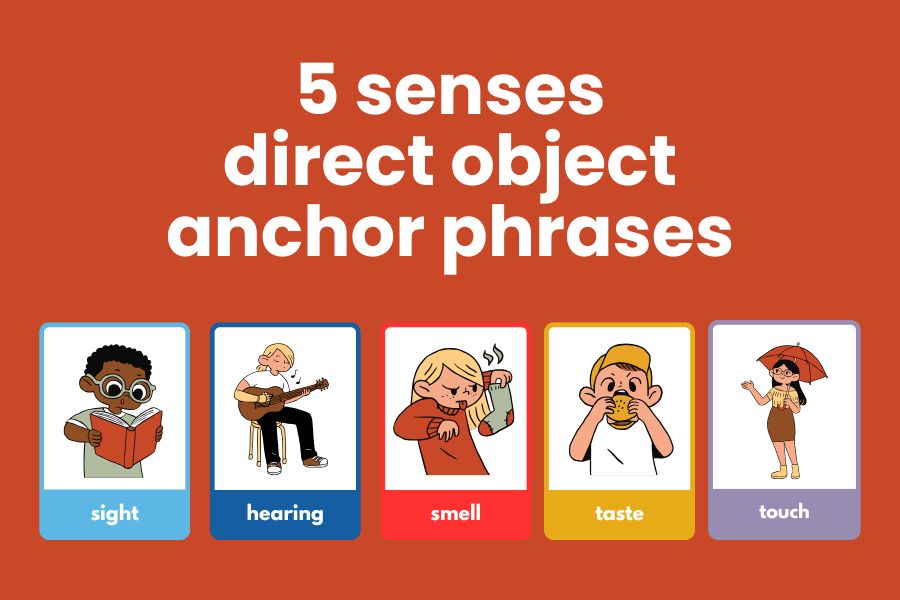
With the five senses (seeing, hearing, touching/feeling, tasting, smelling), Spanish commonly uses DO
lo / la / los / las.
Example:
Muchas veces lo he visto pasar por mi casa.
I was working with the 5 senses for sentence practice and discovered a nice little easy-to-memorise pattern.
The direct object is wrapped up in a bunch of grammar rules that take a while for an English brain to get used to.
So it’s nice when something pops up that isn’t strictly a grammar rule, just a pattern, for something that you’d commonly use.
Five senses and the direct object
The verbs for the five senses (seeing, hearing, touching/feeling, tasting, smelling) are high-frequency in usage, AND they also commonly use Direct Object pronouns – lo / la / los / las.
If I can remember “5 senses + lo/la” I get things like:
Muchas veces lo he visto pasar por mi casa.
Lo vi salir corriendo. – I saw him run out.
La escuché llorar. – I heard her crying.
Los sentí pasar cerca de mí. – I felt them walk past me.
La huelo quemándose. – I smell it burning.
Lo probé y estaba salado. – I tasted it and it was salty.
What is true
- lo / la / los / las are NOT limited to the five senses
- They appear with:
- perception verbs (ver, oír/escuchar)
- mental verbs (entender, saber)
- actions (hacer, ver, tomar)
- speech (decir, explicar)
- The large group of DO verbs where the action doesn’t have a beneficiary.
- perception verbs (ver, oír/escuchar)
Direct object action means there is no exchange of ‘something’ in between. If there is no exchange, there is no beneficiary. This is my framing, not textbook framing.
See notes here.
The 5 senses make great anchor phrases.
The 5 senses + DO combo in everyday conversation is very common — and very natural — in everyday spoken Spanish.
These verbs are basic, high-frequency:
You use them constantly in real life:
- ver (see)
- oír / escuchar (hear/listen)
- sentir (feel)
- oler (smell)
- probar / saborear (taste)
They’re not fancy. They’re not academic.
They’re in daily life — buses, food, dogs, weather, people, music, pain, etc.
It’s not only with people
The “5 senses + lo/la/los/las + infinitive” structure is used with both people and things — any direct object you can perceive doing something.
The “+ infinitive” part is a key piece of that 5 senses + DO structure. Here’s exactly what it means and how it fits:
In these sentences, you’re not just noticing someone or something — you’re perceiving what they’re doing.
So the structure looks like:
lo / la / los / las + [perception verb] + [infinitive]
Abstract ideas
Me gusta cuando hay tiempo para mirar los árboles. Lo encontraba muy pacífico.
Yes — encontrar is a direct object (DO) verb.
In “Lo encontraba muy pacífico”, the “lo” often refers back to an idea or situation previously mentioned — not a specific noun. That makes it a neutral direct object standing in for something abstract.
Add a Recipient
But — when you add a recipient, you might end up layering in an IDO. The DO stays tied to the person or thing you’re perceiving. The IDO tags along if there’s a second participant receiving something in that perceived action.
🧠 Prompts to Try
- You hear your neighbour playing music.
- You saw your cat jump up on the table.
- You smelled something burning in the oven.
- You felt the breeze on your face.
- You tasted the soup and noticed it was too salty. Lo
- You heard your friend laugh behind you.
- You saw two birds fly over the house.
- You smelled flowers at the market.
- You felt someone touch your arm.
- You heard someone knock at the door.
To taste is a bit tangled
in Spanish because there are multiple verbs, and they each carry different nuances depending on who’s doing the tasting, how, and what you’re trying to say.
Let’s untangle it clearly — and keep it practical.
Probar = to taste / to try
→ Yes, it fits the 5-senses pattern.
→ Needs lo / la / los / las when referring to the thing tasted.
- La probé. – I tasted it (feminine item, e.g. la sopa)
- Lo probé. – I tried it (masculine item, e.g. el café)
Saborear = to savour
→ Yes, it’s an intentional 5-senses verb.
→ Takes lo / la, just like probar.
- Lo saboreé. – I savoured it.
- La saboreé lentamente. – I savoured it slowly.
🟡 Saber (a) = to taste like
→ No, this one is describing a property, not sensing it directly.
→ It’s not 5-senses + lo/la — instead:
You say:
- La sopa sabe a ajo. – The soup tastes like garlic.
- ¿A qué sabe esto? – What does this taste like?