
tortillero: Tortilla-Loving
I came across a sentence in a street interview:
“México es un país muy tortillero.” Mexico is a tortilla-loving country.
What does the -ero/-era suffix do?
tortillero: Tortilla-Loving
–ero / –era
This suffix adds extra definition to a noun around “related to / full of / heavy on / a lot of / someone who deals with X.”
In tortillero it basically means: a place where tortillas are everywhere / super common.
Other super normal –ero words (same vibe)
Comida / cosas:
- frijolero → bean-heavy / full of beans
- carbonero → charcoal-heavy
- cebollero → onion-heavy
- taquero → taco-maker guy (job)
Places:
- ranchero → from a rancho / ranch-style
- carnicero → butcher
- panadero → baker
- tortillero → person who makes tortillas or tortilla-heavy (context decides)
Objects:
- basurero → trash can / dump
- sombrerero → hat seller
- salero → salt shaker
Personality quirks / habits (very Mexican):
- fiestero → party person
- noviero → someone who always has a new boyfriend/girlfriend
- platicero → chatty
- comelón is another vibe, but comelón—comelona works similarly.
So “tortillero” means tortilla-heavy.
It can turn a noun into an adjective
or a different type of noun
✅ It can turn a noun into a noun for a person
Usually “someone who works with / sells / makes X.”
- pan → panadero (baker)
- carne → carnicero (butcher)
- taco → taquero (taco vendor)
- tortilla → tortillero (person who makes/sells tortillas)
✅ It can turn a noun into a noun for an object/container/location
“Place where X goes” or “container for X.”
- basura → basurero (trash can / dump)
- sal → salero (salt shaker)
- pan → panero (bread box — old-school word)
- dinero → monedero (coin purse)
✅ It can turn a noun into an adjective-ish noun
“Full of / heavy on / characterized by X.”
- tortillero → tortilla-heavy / very tortilla-based
- frijolero → bean-heavy
- cebollero → onion-heavy
- fiestero → party-prone / likes partying
- noviero → someone who always has a partner
It’s not always a pure adjective, but it behaves like one because it describes a characteristic.
–ero is a creative, productive suffix
Meaning: you can slap –ero on the end of a word and, if the context is right, Spanish speakers will understand you — even if it’s not an “official” dictionary word.
This is super true in Mexican Spanish, where people play with language all the time. Some of them are softly pejorative.
⭐ Real-world examples of creative, unofficial –ero words people say:
- cafecero → someone who drinks a lot of coffee
- dulcero → someone who loves sweets
- memero → someone obsessed with memes
- perrero → dog person
- plantanero → someone who loves plants / a plant-heavy vibe
- sueñero (rare, poetic) → dreamy person
- playero → beachy vibe / someone always at the beach
- tiktoker…ero (joking remix) → someone glued to TikTok
None of these need to be in the dictionary.
They work because –ero carries a flexible “person/place/thing associated with X” meaning.
Spanish speakers instantly “get” the pattern:
X + ero = something/someone related to X
It’s one of the most playful, easy-to-invent suffixes in the language.
Very similar vibe to diminutives, but with its own flavour.
Warning
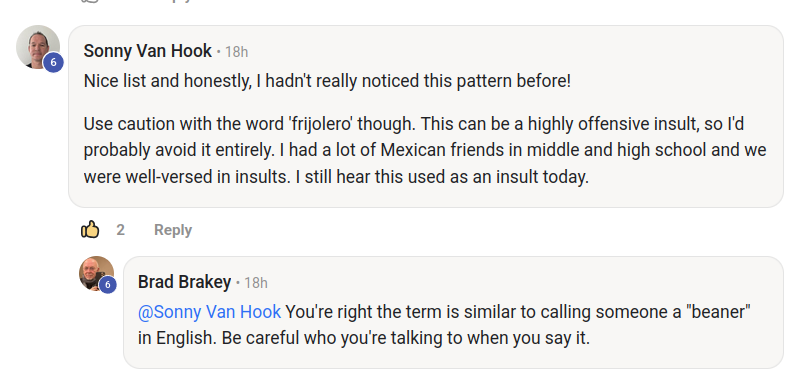
“frijolero” only gets loaded in the U.S. context.
In Mexico itself, the word isn’t automatically an insult.
It can be playful, descriptive, or neutral depending on tone.
But in the U.S.–Mexico cultural and political context, it got weaponised as a slur, so Americans hear it differently.
So your “I didn’t get it because I’m not American” is not surprising.
Outside the U.S. and outside Mexico?
Most people won’t even know the word unless they study Spanish.
It won’t automatically read as offensive.
It’ll just look like a silly –ero formation (frijol → frijolero).
The core use of –ero / –era:
- the agentive/job pattern
It’s the most stable, least dialect-dependent version of the suffix, and everything he listed fits the long-established rule:
noun + –ero/a = person who works with / is associated with that noun
Almost any trade can have the ero/era added “-ero/a” (a person who does something) to describe the tradesman/woman.:
Zapatero / Zapatera – Shoemaker / Cobbler Zapato (shoe)
Panadero / Panadera – Baker Pan (bread)
Carnicero / Carnicera – Butcher Carne (meat)
Pescadero / Pescadera – Fishmonger Pescado (fish)
Camionero / Camionera – Truck driver Camión (truck)
Cartero / Cartera – Mail carrier / Postman Carta (letter)
Jardinero / Jardinera – GardenerJardín (garden)
Cocinero / Cocinera – Cook / Chef Cocina (kitchen/cooking)
Bibliotecario / Bibliotecaria – Librarian Biblioteca (library) – doesn’t fit exactly, close though
Joyero / Joyera – Jeweler Joya (jewel)
Relojero / Relojera – Watchmaker / Watch repairer Reloj (watch/clock)
Granjero / Granjera – Farmer Granja (farm)
Tendero / Tendera – Shopkeeper Tienda (shop/store)
Mesero / Mesera – Mesa + ‘ero/a’ (a person who does something) – a person who waits on tables.