
Como: Like “Like”
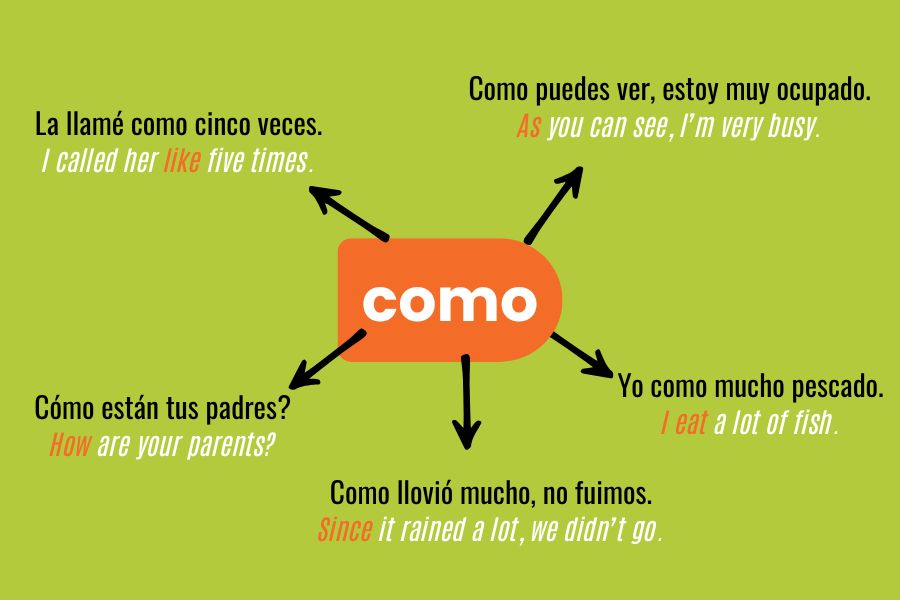
Como is one of the most alive words in Spanish because it flexes the same way like does in English.
You’ll hear it constantly in everyday talk.
It has some great uses outside of “I eat” and asking “how?”
Like “Like” in English
Como (comparison or manner = “as / like / the way”)
Used to compare or describe how something is done.
- Como puedes ver, estoy muy ocupado. → As (like) you can see, I’m very busy.
- Hazlo como te dije. → Do it (like) the way I told you.
- Corre como un loco. → He runs like a madman.
👉 Often means “as” or “like,” depending on whether it’s describing a manner or introducing a comparison.
Como (approximation = “about / like”)
Used informally for rough quantities or comparisons.
- La llamé como cinco veces. → I called her like five times.
- Tengo como veinte pesos. → I’ve got about twenty pesos.
- Llegaron como a las ocho. → They arrived around eight.
👉 This “como” = “más o menos / aproximadamente.”
Como (cause = “since / because”)
When it starts a sentence, it means “since” or “given that.”
- Como llovió mucho, no fuimos. → Since it rained a lot, we didn’t go.
- Como no tengo coche, tomo el autobús. → Since I don’t have a car, I take the bus.
- Como ya sabes, me voy a mudar. → As you already know, I’m moving.
👉 Equivalent to “because,” but only when before the main clause.
Como si (as if / as though)
Always followed by subjunctive.
- Habla como si supiera todo. → He talks as if he knew everything.
- Me mira como si fuera culpable. → She looks at me as if I were guilty.
👉 Great for hypothetical comparisons.
Tan… como / tanto… como (comparison of equality)
Structure for “as… as.”
- Tan alto como su hermano. → As tall as his brother.
- Trabajo tanto como tú. → I work as much as you.
- No canta tan bien como antes. → She doesn’t sing as well as before.
Como que / Es como que (colloquial filler)
Super common in speech — adds tone or hesitation.
- Es como que no quiere hablar. → It’s like he doesn’t want to talk.
- Yo, como que no entiendo. → Me, like, I don’t get it.
- Fue como que me ignoró. → It was like he ignored me.
👉 Sounds casual — used like “it’s like…” in English.
Looking at Como from a Different Angle
💬 Soft filler or approximation
- Tiene como veinte años. → He’s like twenty.
- Estoy como cansada. → I’m kinda tired.
- Fue como raro. → It was like weird.
👉 Mirrors how English speakers use like to blur edges or make speech sound natural, not precise.
💬 Manner / vibe
- Lo dijo como en broma. → He said it like as a joke.
- Me miró como con tristeza. → She looked at me like with sadness.
- Está como distraído hoy. → He’s kinda out of it today.
💬 Colloquial softening
- Es como que no le importa. → It’s like he doesn’t care.
- Yo como que no entiendo. → I’m like, I don’t get it.
- Fue como que se enojó. → It’s like she got mad.
👉 These como que phrases are pure everyday tone — you’ll hear them everywhere in Mexico and Latin America, especially when people are trying not to sound too blunt.
💬 Emotional emphasis
- ¡Cómo me gusta ese lugar! → How I love that place!
- ¡Cómo llueve! → Man, it’s really raining!
- ¡Cómo te extraño! → How I miss you!
👉 The accent cómo here gives it feeling — like our “God, I love that place!” or “Man, it’s pouring!”
The reason it still carries the accent mark is because in Spanish, cómo (with accent) is used in both questions and exclamations — basically, anytime it has a special or emphatic meaning.
Testing
Could i have used como in this sentence: Hay dos mujeres en el carro, y quizá tienen veintitantos años. Es difícil saberlo.
Let’s look at it closely:
Hay dos mujeres en el carro, y quizá tienen veintitantos años. Es difícil saberlo.
✅ Perfectly natural and neutral. “There are two women in the car, and maybe they’re in their twenties.”
Now, with como:
Hay dos mujeres en el carro, y tienen como veintitantos años. Es difícil saberlo.
👉 This one sounds more offhand, like you’re estimating visually:
“There are two women in the car, they look like they’re in their twenties.”
It softens quizá out of the equation — como already carries that “roughly / around” vibe.
You could still use both together (quizá tienen como veintitantos años) — that would just double the uncertainty, like “maybe around their twenties.” Totally fine in spoken Spanish.
Here’s why neither quizá nor como triggers the subjunctive automatically in this sentence. The verb tienen (they have / they’re) still refers to a real, observable situation — you’re just uncertain about the detail (their age), not the reality of their having an age.