
When You Know Where It Is, It’s No Longer Estar, It’s Quedar
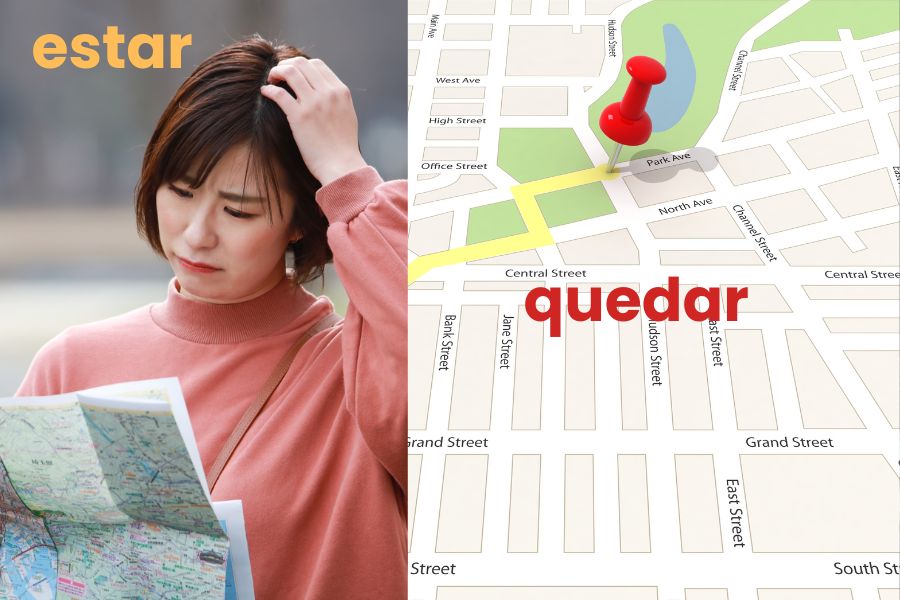
When You Know Where It Is, It’s No Longer Estar, It’s Quedar
Estar
The way Spanish handles location fascinates me, especially the difference between estar and quedar.
When we’re first taught Spanish, we learn estar for location. It’s the verb we associate with movement, travel, and asking for directions — ¿Dónde está la tienda? or ¿Dónde está el baño?
But that’s really only half the story.
In everyday conversation, especially in Mexico, quedar often replaces estar when talking about where things are. The shift isn’t about grammar — it’s about perspective.
Where is the shop? — Estar, because someone is being asked and the location is relative to where that person is. The person could be anywhere, so the directions will always change and are therefore temporary.
Quedar – to stay, remain
Where is the shop? — At 15 Rosa Calle, on the next corner, in X barrio.
It’s not about who’s looking for it — it’s about the shop itself, a fixed fact about where it’s located. And here, quedar really does “stay” put.
If you don’t know where something is, you use estar. You’re asking from your own position, trying to locate it relative to yourself.
(You can use quedar without being incorrect, but these notes are to show the difference)
¿Dónde está la plaza? — “Where is the plaza (for me)?”
But once you know the area — once that place already “exists” on your mental map — estar transitions to quedar.
La plaza queda a 2 minutos a pie por esa calle. — The plaza is 2 minutes walk down that street.
The answer is using an internal map and explaining where the plaza is situated. You’re orienting and placing the plaza in context with other familiar landmarks.
That’s also why locals often use quedar automatically. For them, most places already have defined spots within a shared geography. So when a foreigner says ¿Dónde queda…?, they sound like someone who already knows the terrain. That’s why locals suddenly speak a mile a minute — they assume you’re an insider.
It’s a subtle shift, but it changes everything.
When you know where it is, it’s no longer estar, it’s quedar.
Estar v Quedar
Estar for existence-in-space, quedar for fixed address.
“There IS a postbox in the neighbourhood” — estar.
It exists somewhere relative to you.
“The postbox IS on the corner of X and Y, near the library” — quedar.
It has a fixed address in a shared geography. It ‘stays’ there.
Questions and Answers
In Mexico especially, quedar is used for location naturally in conversation, particularly when you’re talking about distance or directions. It’s not incorrect to reach for estar either in the question or the answer but there seems to be a preference in Mexico for:
Question → estar. You’re searching, you don’t have the map yet.
Answer → quedar. You’re placing it on a shared map.