
Para Que Subjunctive Trigger
Subjunctive trigger reminders:
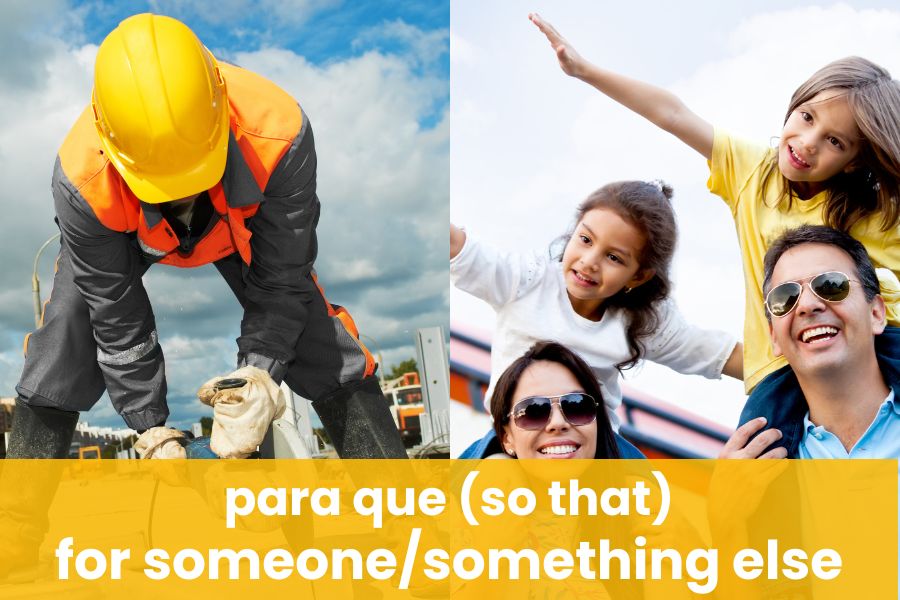
Para → one subject: “I do this for myself.”
Para que → two subjects/clauses: “I do this so that someone else can…”
Para Que Subjunctive Trigger
“Para que’ is a set phrase that triggers the subjunctive.
The verb can show the subject shift:
Hago videos como este para ayudarte a mejorar tu español.
– ayudarte; I am helping you
– Reminder infinitive comes after ‘para’
Hago videos como este para que puedas mejorar tu español.
– puedas; you can; subject change
| Compré pintura para arreglar la pared. (I bought paint to fix the wall.) – arreglar → I fix; same subject. – When it’s the same subject for both actions, Spanish uses the infinitive for the second action, even if the subject is explicitly you in meaning – Reminder infinitive comes after ‘para’ | Compré pintura para que tú arreglaras la pared. (I bought paint for you to fix the wall.) – arreglaras → you fix; subject change. |
The subjects don’t need to be people
Compro ropa de buena calidad para que dure más tiempo.
Compro → subject = yo
dure → subject = la ropa
Te presto mi chamarra para que no te dé frío.
(I’m lending you my jacket so you don’t get cold.)
Subject 1 – Yo
Subject 2 – el frío (or “it” as an impersonal force)
Para que no te dé frío literally = so that not to you (it) gives cold
Voy a dejar la ventana abierta para que entre aire.
(I’m going to leave the window open so air comes in.)
Subject 1 – yo
Subject 2 – el aire
Ponle tapa al café para que no se derrame.
(Put a lid on the coffee so it doesn’t spill.)
Subject 1 – tú (implied command)
Subject 2 – el café. se derrame is one of those “the coffee spills itself” constructions (reflexive/passive se), and the way you pin down the second subject is by asking “Who or what is doing the verb’s action?”
The subjunctive can be in clause one and clause two
Quiero que pintes la casa para que podamos venderla más rápido.
- Quiero que pintes la casa → subjunctive (pintes) triggered by quiero que (desire + subject change).
- para que podamos venderla más rápido → subjunctive (podamos) triggered by para que (purpose + subject change).
Espero que llegues temprano para que podamos ir juntos.
(I hope you arrive early so we can go together.)
1. Espero que (trigger) llegues (subjunctive) temprano / 2. para que (trigger) podamos (subjunctive) ir juntos.
Necesito que me ayudes para que terminemos antes de la cena.
(I need you to help me so we finish before dinner.)
1. Necesito que (trigger) me ayudes (subjunctive) / 2. para que (trigger) terminemos (subjunctive) antes de la cena
Quiero que me llames para que no me preocupe.
(I want you to call me so I don’t worry.)
1. Quiero que (trigger) me llames (subjunctive) / 2. para que (trigger) no me preocupe (subjunctive).
The subjunctive can be in the past tense (imperfect)
- I painted the house / so it would sell faster
- I turned off the music / so you could sleep
Something happens in the past / para que (so that) something could/would follow.
There’s no “preterite subjunctive” in Spanish. When you want a past subjunctive, the simplest past tense you can use is the imperfect subjunctive.
Pinté la casa para que se vendiera más rápido.
(I painted the house so it would sell faster.)
1. Pinté la casa / 2. para que (trigger) se vendiera (imperfect subjunctive) más rápido.
Apagué la música para que pudieras dormir.
(I turned off the music so you could sleep.)
1. Apagué la música / 2. para que (trigger) pudieras (imperfect subjunctive) dormir.
Guardé un poco de pastel para que probaras.
(I saved some cake so you could try it.)
1. Guardé un poco de pastel / 2. para que (trigger) probaras (imperfect subjunctive).
Le di mi número para que me llamara después.
(I gave them my number so they’d call me later.)
1. Le di mi número / 2. para que (trigger) me llamara (imperfect subjunctive) después.
The subjunctive trigger para que can be used at the beginning of an answer
?Por qué pintaste la casa?
Para que se venda más rápido.
- the answer does not have 2 clauses or 2 subjects
- the answer implied the first clause
- the question is basically holding the first clause and subject, even though you’re not repeating it in your answer.
Note: If you answered with “Para venderla más rápido”, then you’d be saying the same subject (“I” paint, “I” sell) → no subjunctive.
Wait what? Is this an option?
Yep — totally an option, and it changes the meaning slightly.
- Para que se venda más rápido = “so that it sells faster” (focus is on the house selling faster — different subject from you) → subjunctive.
- Para venderla más rápido = “to sell it faster” (focus is on you doing the selling — same subject) → infinitive, no subjunctive.
Which style of answer is more common?
In everyday conversation, the infinitive version (“para venderla más rápido”) is more common — because people tend to default to keeping the subject as themselves if it’s their own action.