
The Person Who…
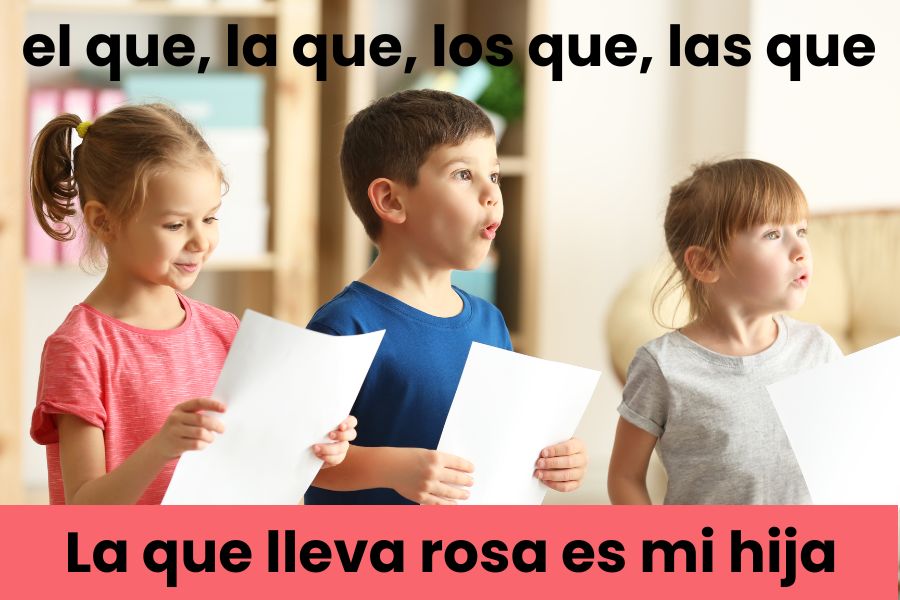
el que / la que / los que / las que function as relative pronouns, but with a twist:
they are compound relative pronouns made from an article (el, la, los, las) + que.
They work just like “que” (who/that/which), but with more clarity or emphasis — especially:
- when referring back to a specific person or thing
- when gender or number matters
- el que = the one (masculine) who / that
→ e.g. the man who… / the book that… - la que = the one (feminine) who / that
→ e.g. the woman who… / the house that… - los que = the ones (masculine or mixed group) who / that
→ e.g. the men who… / the things that… - las que = the ones (feminine) who / that
→ e.g. the women who… / the shoes that…
How Are They Used?
El que, la que, los que, las que are everywhere — not because they’re fancy grammar, but because they’re how people refer to other people.
They show up all across the Spanish-speaking world because they do something plain que can’t always do: point clearly to real people — known or unknown, singular or plural.
When you’re interacting with people — telling stories, talking about what someone did, describing someone without naming them — these forms come up constantly.
They’re everyday, conversational, and completely natural. You’ll hear them on the street, with friends, in families, at work — everywhere real Spanish is spoken.
👉 To point to someone/something specific:
- Hay algunas personas en la cocina. El que está revisando el horno es mi tío.
→ There’s some people in the kitchen. The one checking the oven is my uncle.
(el que = el señor) - Ese ruido viene de uno de los relojes. El que está en la sala suena cada hora.
→ That noise is coming from one of the clocks. The one in the living room chimes every hour.
(el que = el reloj)
👉 To describe who or what you’re talking about:
- La que canta es mi tía.
→ The lady/person who is singing is my aunt. (la) - Mi recomendación personal es llevar en todo tiempo una pequeña libreta en la que puedes ir recolectando o registrando todas las nuevas palabras para ti.
👉 To talk about a group:
- Los que llegaron tarde son mis amigos.
→ The people who arrived late are my friends. (los mixed gender group) - Las que están en oferta son las camisas de lino.
→ The ones that are on sale are the linen shirts.
(las que = las camisas)
👉 To answer with just a phrase:
- ¿Cuál prefieres?
— La que tiene chocolate. (la galleta)
→ The one with chocolate.
What it Looks Like In English
English tends to compress ideas into adjective phrases or short descriptors.
English doesn’t usually say “the one who” unless it’s really specific. We just say:
- He lives in Mexico.
- The guy who lives in Mexico. (identifying which guy)
- The girls I met yesterday…
- It’s broken.
- The phone that’s broken. (identifying which phone)
- The broken phone.
- They’re in the drawer.
- The scissors that are in the drawer. (identifying which scissors)
- The scissors in the drawer.
- I bought them yesterday.
- The shoes that I bought yesterday. (identifying which shoes)
- The shoes I bought yesterday.
But in Spanish, you need to use el que, la que, los que, las que to point clearly to the person or thing you’re talking about — especially when identifying which one.
✅ Referring back to someone already mentioned
- “The guy who fixed it did a great job.”
→ El que lo arregló hizo un gran trabajo. - “That woman you saw? She’s the one who started it.”
→ La que lo empezó. - “The people you were sitting with left early.”
→ Los que estaban contigo se fueron temprano.
✅ Talking about someone unknown but specific in context
- “Whoever left this bag might come back later.”
→ El que dejó esta bolsa podría (conditional) regresar más tarde. - “Someone brought empanadas — whoever it was, bless them.”
→ El que trajo las empanadas, bendiciones.
Use ‘el’ as a default masculine singular “unknown someone” - Anyone who arrives late won’t be allowed in.
Los que llegen tarde no podrán entrar.
Use masculine ‘los’ as a default for unknown mixed group plural for those/anyone
✅ Answering a question with just a phrase
- “Which shoes do you want?”
“The ones with red laces.”
→ Las que tienen agujetas rojas. (las agujetas) - “Who do you trust?”
“The guy with the weird tattoo.”
→ El que tiene el tatuaje raro.
✅ Describing someone by action or trait
- “That girl who always wears glitter? Yeah, she’s here.”
→ La que siempre usa brillantina ya llegó. - “The guy who always pays in coins? He came back again.”
→ El que siempre paga con monedas volvió.
✅ Summing up a known group
- “The people who helped us last year are volunteering again.”
→ Los que nos ayudaron el año pasado están ayudando otra vez. - “The women who organize the festival are amazing.”
→ Las que organizan el festival son increíbles.
✅ Making a general statement
- “People who lie usually get caught.”
→ Los que mienten, normalmente se descubren. - “Whoever made this mess better clean it up.”
→ El que hizo este desastre, que lo limpie.
✅ Pointing or clarifying in dialogue
- “That guy?” — “No, the one (who is) standing behind him.”
→ No, el que está detrás de él.
Adding In Prepositions
This comes up all the time in real conversations.
When you’re talking about who you did something with,
what you used
or where something happened —
and there’s a preposition involved (like with, for, in, about)
Preposition + article + que
→ con la que, para los que, en el que, etc.
You can’t just say “the girl I talked to” — in Spanish, you have to build it like:
“the girl with whom I talked” → la chica con la que hablé
It sounds formal in English, but in Spanish it’s totally normal — it’s how people actually talk.
In English, we drop the preposition at the end — it’s casual and sounds natural:
- The girl I talked to
- The people I work for
- The house we stayed in
If you make them more formal, you can pull the preposition forward:
- The girl who I spoke to
- The people whom I work for
- The house that we stayed in
And while English doesn’t usually say:
- The girl with whom I spoke
- The people for whom I work
- The house in which we stayed
… Spanish does. Always.
How is Lo Que Different?
lo que = floating idea, abstract thing, not referring back to a previously mentioned noun
(What happened was strange. → Lo que pasó fue raro.)
Notes