
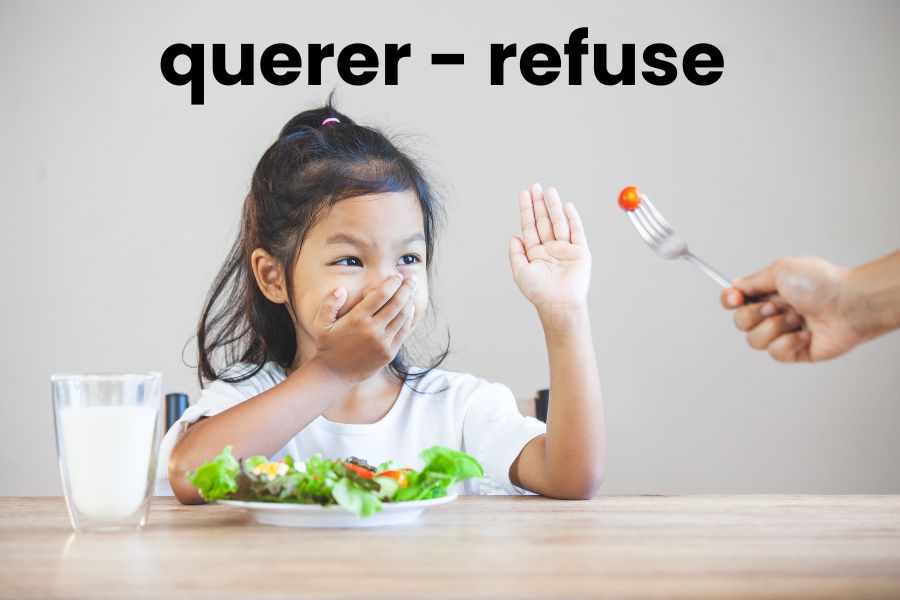
Querer: To Refuse
English Definition of “if” (in grammar)
The lesson said: Some verbs take on different meanings depending on whether they are in the preterite or the imperfect tense.
Querer – to want
– Preterite: to want to do something – Al escuchar la noticia quise gritar. (Upon hearing the news, I wanted to scream.)
– Preterite (Negative): to refuse – No quise decirle mi nombre. (I refused to tell him/her my name.)
– Imperfect: to want (ongoing) or to love – Nunca me dijiste que querías comprar una casa. (You never told me that you wanted to buy a house.)
Querer – Refuse
A question came up on the spanish forum:
Querer in the preterite, in the negativeI’ve learned that querer, when negative in the preterit, means to “refuse” to do something. Not just you didn’t want to do something, but you refused to do it. However today, I was watching an episode of a series in English, with Spanish subtitles on. One of the characters said, “That’s not what I meant.” Spanish subtitle read, No quise decir eso.
Bad translation? Or is this one of those cases where the general rule doesn’t apply?
When I look at something like this, I go back to definitions.
Querer means to want.
And preterite means a done-and-dusted action.
Example 1:
No quise decir eso
No / I wanted / to say / that
I didn’t want to say that
Here it’s quite straight forward that the person is saying ‘that’s not what I meant’.
But it doesn’t explain the preterite/refuse aspect of the forum question.
Example 2:
No quisieron ayudar
No / they wanted / to help
They didn’t want to help
With quisieron in the preterite (done-and-dusted) form:
Not wanting to became a decision (completed action)- and they didn’t help.
Which means: the help was refused.
So that’s where the “refusal” meaning comes from.
– it’s in the decision of “they didn’t want to” (and so they didn’t)
– the decision is the preterite/done-and-dusted action
So the idea of refusal is not actually a different definition of the word querer when it’s used in the preterite.
Querer in the preterite
Here are some other examples of querer used in the imperfect and the preterite to contrast the differences in meaning.
No quería salir.
→ I didn’t want to go out. (no reference to starting or ending something)
No quise salir.
→ I refused to go out. (I didn’t want to, made the decision, and didn’t go)
Quería ayudarte.
→ I wanted to help you. (that was my intention)
Quise ayudarte.
→ I tried to help you. (I made the effort — the action started)
Ellos no querían hablar del tema.
→ They didn’t want to talk about it. (no reference to starting or ending something)
Ellos no quisieron hablar del tema.
→ They refused to talk about it. (they decided they didn’t want to, effectively shutting it down)
Quería decirte algo.
→ I wanted to tell you something. (maybe I didn’t get to it)
Quise decirte algo.
→ I tried to tell you something. (I made the effort, there was a beginning of an action)
Mi papá no quería vender la casa.
→ My dad didn’t want to sell the house. (but maybe he did in the end)
Mi papá no quiso vender la casa.
→ My dad refused to sell the house. (he made the decision not to)
So it’s not always about refusal.
It’s about whether you made a decision — and whether that decision had a clear outcome.
When Do You Use Querer in the Preterite?
How do you decide when to querer in the preterite?
Ask – Did I make a decision?
Yes → Use preterite
No → Use imperfect
It’s the core logic for choosing between preterite and imperfect forms of querer, whether it’s positive or negative.
Also querer in the preterite negative does not always mean “to refuse.”
But it often does, when the context supports that interpretation.
When does no querer in the preterite mean “refused”?
It means refused when:
- The speaker made a clear decision not to do something
- And that decision led to the thing not happening
there’s a pattern of expressions where querer in the negative preterite communicates regret, clarification, or unintended consequence, not refusal.
Here are some more real, natural examples that fall into that category:
When does no querer in the preterite NOT mean “refused”?
1. No quise hacerte sentir mal.
→ I didn’t mean to make you feel bad.
✅ The person did something, and the listener did feel bad — but the intent wasn’t there.
👉 Not refusal — this is regret.
2. No quise interrumpirte.
→ I didn’t mean to interrupt you.
✅ They did interrupt — but it wasn’t deliberate.
👉 Not refusal — it’s clarification after the fact.
3. No quise meterme.
→ I didn’t mean to get involved / butt in.
✅ Usually said after someone has already inserted themselves in a conversation or situation.
👉 The action happened, but not intentionally = no refusal.
4. No quise causarte problemas.
→ I didn’t mean to cause you any trouble.
✅ Something caused a problem, but the speaker is disclaiming intent.
👉 Again: outcome happened, but not refusal.
5. No quise ofenderte.
→ I didn’t mean to offend you.
✅ Speaker said/did something offensive, but that’s not what they meant.
👉 No refusal — pure damage control.
In all these cases:
- The action did happen
- No querer = “that wasn’t my intention”
- The preterite reflects a decision or moment of intent
- Negation is clarifying what the decision was NOT
So these aren’t refusals — they’re more like “I did it, but not on purpose.”
takeaway:
The mistake would be to equate “no querer” in the preterite = refusal automatically.
Instead, always ask:
✅ Did the thing not happen because I decided against it? → Refusal
✅ Did the thing happen, but I didn’t intend it? → Regret / Unintended Outcome