
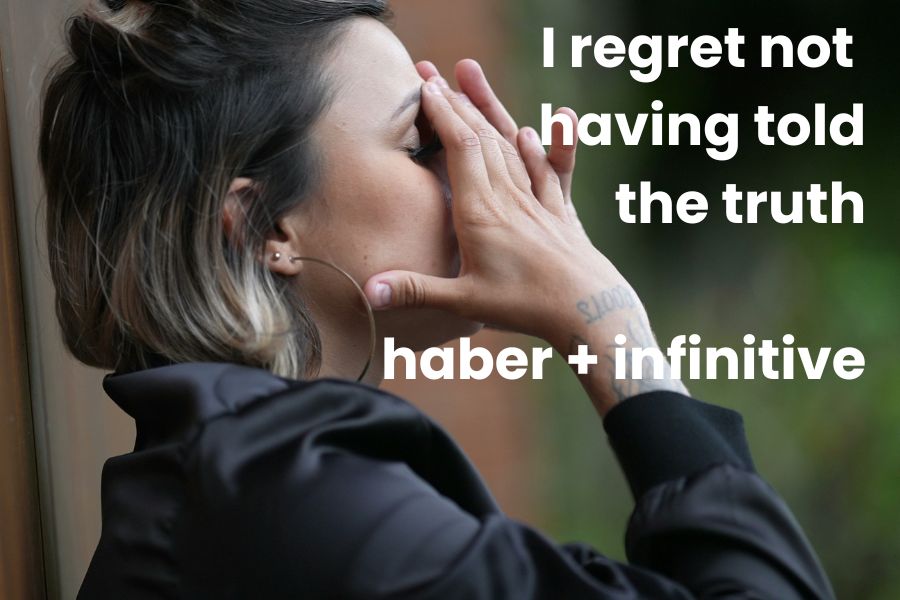
I regret Not Having Told The Truth
✅ Distinction Between Infinitive Perfect and Compound Tenses in Spanish
🔹 Two Separate Categories
Spanish has:
- Compound Tenses (true tenses, conjugated)
- Infinitive Perfect (a structure, not a tense)
1. ✅ Compound Tenses = Conjugated Forms of “Haber” + Past Participle
These are part of Spanish’s official verb tense system.
They express actions tied to a subject and a specific time frame.
| English Name | Example | Meaning |
|---|---|---|
| Present Perfect | he ido | I have gone |
| Past Perfect (Pluperfect) | había dicho | I had said |
| Future Perfect | habré salido | I will have left |
| Conditional Perfect | habría venido | I would have come |
Key Traits:
- Haber is conjugated based on the subject
- Used to build time-based verb tenses
- Cannot appear after prepositions
2. ✅ Infinitive Perfect = “Haber” + Past Participle (Unconjugated)
This is not a tense. It is a verb phrase that functions like a noun or verbal complement.
Used after:
- Prepositions (de, por, sin, hasta, antes de, etc.)
- Certain verbs (e.g., arrepentirse de, olvidarse de, lamentar)
| Function | Example | Meaning |
|---|---|---|
| After a preposition | Me arrepiento de no haber ido. | I regret not having gone. |
| Purpose / cause | Por haber mentido, lo castigaron. | For having lied, he was punished. |
| Time marker | Antes de haber comido. | Before having eaten. |
| Condition | Sin haberlo visto. | Without having seen it. |
Key Traits:
- Haber is in infinitive form
- Works as a verbal noun phrase
- Describes past or unrealized actions, especially after emotional or abstract expressions
- No subject-specific conjugation
🌐 English Parallel
Similar to English phrases like:
- after having eaten
- without having seen it
- I regret not having gone
English:
I regret not telling her.
You can say that in English — it’s natural and correct.
✅ Spanish:
To express that idea in Spanish, you must say:
Me arrepiento de no haberle dicho.
→ I regret not having told her.
📌 Placement of Indirect Object Pronouns
When using the infinitive perfect (haber + participle), indirect object pronouns (like le, me, nos) must attach to haber.
| Pronoun | Example | Meaning |
|---|---|---|
| le | haberle dicho | having told him/her |
| me | haberme ido | having left (myself) |
| nos | habernos perdido | having gotten lost (we) |
| te | haberte escrito | having written to you |
🧩 English Examples That Require ‘haber + participle’ in Spanish
Each of these English sentences should be mentally expanded to “not having [done something]” before translating into Spanish:
| Compressed English | Expanded English | Spanish Structure |
|---|---|---|
| I regret not calling him. | I regret not having called him. | Me arrepiento de no haberle llamado. |
| I regret not helping you. | I regret not having helped you. | Me arrepiento de no haberte ayudado. |
| I regret not saying something. | I regret not having said something. | Me arrepiento de no haber dicho nada. |
| I regret not being honest. | I regret not having been honest. | Me arrepiento de no haber sido honesto. |
| I regret not writing sooner. | I regret not having written sooner. | Me arrepiento de no haber escrito antes. |
| I regret not listening to you. | I regret not having listened to you. | Me arrepiento de no haberte escuchado. |
| I regret not going to the meeting. | I regret not having gone to the meeting. | Me arrepiento de no haber ido a la reunión. |
| I regret not taking the job. | I regret not having taken the job. | Me arrepiento de no haber aceptado el trabajo. |
| I regret not telling the truth. | I regret not having told the truth. | Me arrepiento de no haber dicho la verdad. |
| I regret not staying longer. | I regret not having stayed longer. | Me arrepiento de no haberme quedado más tiempo. |
🔁 Reminder: Spanish Requires the Full Structure, Even When English Doesn’t
English often uses simpler expressions like:
- not telling her
- before leaving
- thanks for coming
…but in Spanish, these must be expressed as:
- no haberle dicho
not having told her - antes de haber salido
before having left - gracias por haber venido
thanks for having come
This structure — haber + participle — is compulsory when expressing regret about a past action (e.g. me arrepiento de no haber ido).
🔹 Common Verbs That Trigger haber + participle:
These are compulsory triggers:
- arrepentirse de (to regret having…)
- olvidarse de (to forget having…)
- acordarse de (to remember having…)
- lamentar (to regret having…)
- alegrarse de (to be glad about having…)
- temer (to fear having…)
🧩 Everyday Spanish with ‘haber + participle’
in most everyday conversational situations, haber + participle can often be avoided by using a simple infinitive instead, especially after prepositions like:
- después de → después de comer
- antes de → antes de salir
- sin → sin dormir
- por → por mentir
These simplified forms are very common in spoken Mexican Spanish.
Después de haber comido, salimos a caminar. (which is more formal, reflective, or used in writing)
→ After having eaten, we went for a walk.
→ After eating, we went for a walk.
More simply though: Después de comer, salimos a caminar.
Sin haber dormido bien, no puedo concentrarme.
→ Without having slept well, I can’t concentrate.
→ I can’t concentrate — I didn’t sleep well.
Simple Version: Sin dormir bien, no puedo concentrarme.
Por haber llegado tarde, perdió el vuelo.
→ For having arrived late, he missed the flight.
→ He missed the flight because he was late.
Simple Version: Por llegar tarde, perdió el vuelo.
Lo castigaron por haber mentido.
→ They punished him for having lied.
→ He was punished for lying.
Simple Version: Lo castigaron por mentir.
Sin haberlo visto, no puedo opinar.
→ Without having seen it, I can’t give an opinion.
→ I haven’t seen it, so I can’t say.
Simple Version: Sin verlo, no puedo opinar.
Después de haber trabajado todo el día, solo quería descansar.
→ After having worked all day, I just wanted to rest.
→ After working all day, I just wanted to rest.
Simple Version: Después de trabajar todo el día, solo quería descansar.
No puedo tomar una decisión sin haber hablado con ella.
→ I can’t make a decision without having spoken to her.
→ I can’t decide until I talk to her.
Simple Version: Sin hablar con ella, no puedo tomar una decisión.
Gracias por haber venido.
→ Thanks for having come.
→ Thanks for coming.
Simple Version: Gracias por venir.
Me sentí mejor después de haberme duchado.
→ I felt better after having showered.
→ I felt better after a shower.
Simple Version: Me sentí mejor después de ducharme.