
The Subjunctive Trigger Needs 2 Clauses
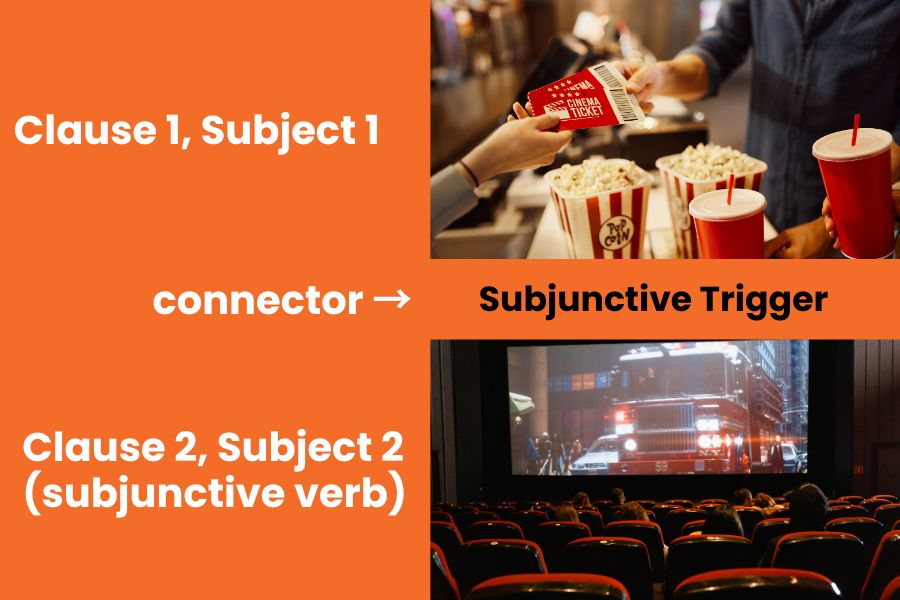
It took me a while, but it turns out that using the subjunctive is not some vague, emotional mumbo jumbo.
The majority of the time, you use a subjunctive verb form directly after a subjunctive trigger.
A subjunctive trigger shows up when:
- ✅ There are two clauses
- ✅ Each clause has a different subject (person or thing)
It’s that simple!
The subjunctive is grammatically mechanical and is used when:
- There are 2 clauses
- There are 2 subjects
- A subjunctive trigger connects the two clauses → The verb after the trigger is in the subjunctive
subjunctive formula
1. Standard / Most Common:
[Clause 1, Subject 1] + Subjunctive Trigger + [Clause 2, Subject 2 → Subjunctive Verb]
Tengo que comprar palomitas antes de que empiece la película.
→ I have to buy popcorn before the movie starts.
- Clause 1: Tengo que comprar palomitas (Subject: yo)
- Trigger: antes de que
- Clause 2: empiece la película (Subject: la película)
2. Inverted / Front-end Trigger Clause:
Subjunctive Trigger + [Clause 1, Subject 1 → Subjunctive Verb] + [Clause 2, Subject 2]
Antes de que empiece la película, tengo que comprar palomitas.
- Trigger: antes de que
- Clause 1: empiece la película (Subject: la película)
- Clause 2: Tengo que comprar palomitas (Subject: yo)
Subjunctive triggers are grammatical connectors
They behave like:
- Prepositions (e.g., a, de, para)
- Conjunctions (e.g., que, aunque, cuando, entonces)
Under the right conditions:
- When here are 2 clauses
- And there is a subject in each clause, either a thing or a person (2 subjects).
🟢 Examples That Don’t Use Subjunctive:
✅ Antes de + infinitive/noun
Because the subject is the same or the second part is not a verb clause.
- Me lavé las manos antes de comer. → I washed my hands before eating.
→ (“I” did both actions → no change of subject) - Tuvimos una charla antes de la reunión. → We had a talk before the meeting.
→ (No second verb clause, just a noun → no subjunctive)
🟡 Examples That DO Use Subjunctive:
✅ Antes de que + subjunctive
Because now there are two subjects or a clause of future/hypothetical action.
- Me lavé las manos antes de que llegara la comida.
→ I washed my hands before the food arrived.
→ (Subject 1: me / Subject 2: la comida → new clause = subjunctive) - Salgo antes de que tú llegues.
→ I leave before you arrive.
→ (Subject 1: yo / Subject 2: tú → subjunctive required)
✅ Remember the Subjunctive Swap Rule:
The subjunctive conjugations swaps out infinitive verb endings.
Infinitive verbs end in -ar, -er, or -ir.
Step 1: Take an -ar verb
Example: hablar
To conjugate hablar in the subjunctive, you make it look like an -er verb:
- hable → singular
- hablen → plural
Step 2: Take an -ir verb
Example: vivir
This next rule works for both -ir and -er verbs.
To conjugate vivir in the subjunctive, you make it look like an -ar verb:
- viva → singular
- vivan → plural
Only the vowel changes — the person endings stay the same (like -es for tú, -an for ellos, etc.), just matched to the new vowel group.
✅ Examples
Necesito terminar este correo antes de que empiece la reunión.
→ I need to finish this email before the meeting starts.
- Clause 1: Necesito terminar este correo (Subject: yo)
- Trigger: antes de que
- Clause 2: empiece la reunión (Subject: la reunión)
- Empezar – to start
- empiece – ar → e
Apaga la estufa en cuanto hierva el agua.
→ Turn off the stove as soon as the water boils.
- Clause 1: Apaga la estufa (Subject: tú)
- Trigger: en cuanto
- Clause 2: hierva el agua (Subject: el agua)
- Hervir – to boil
- hierva – (irregular) ir → a
Te explico todo bien para que sepas qué hacer después.
→ I’ll explain everything clearly so you know what to do later.
- Clause 1: Te explico todo bien (Subject: yo)
- Trigger: para que
- Clause 2: sepas qué hacer después (Subject: tú)
- Saber – to know
- sepas – er → a
No salgas de la casa hasta que pase la tormenta.
→ Don’t leave the house until the storm passes.
- Clause 1: No salgas de la casa (Subject: tú)
- Trigger: hasta que
- Clause 2: pase la tormenta (Subject: la tormenta)
- Pasar – to pass
- pase – ar → e
Te presto mi coche para que puedas ir al supermercado.
→ I’ll lend you my car so you can go to the supermarket.
- Clause 1: Te presto mi coche (Subject: yo)
- Trigger: para que
- Clause 2: puedas ir al supermercado (Subject: tú)
- Poder – to be able to
- puedas – (irregular) er → a
Vamos al parque aunque haga frío.
→ We’re going to the park even if it’s cold.
- Clause 1: Vamos al parque (Subject: nosotros)
- Trigger: aunque
- Clause 2: haga frío (Subject: el clima)
- Hacer – to make/do
- haga – er → a