
How Querer Triggers the Subjunctive
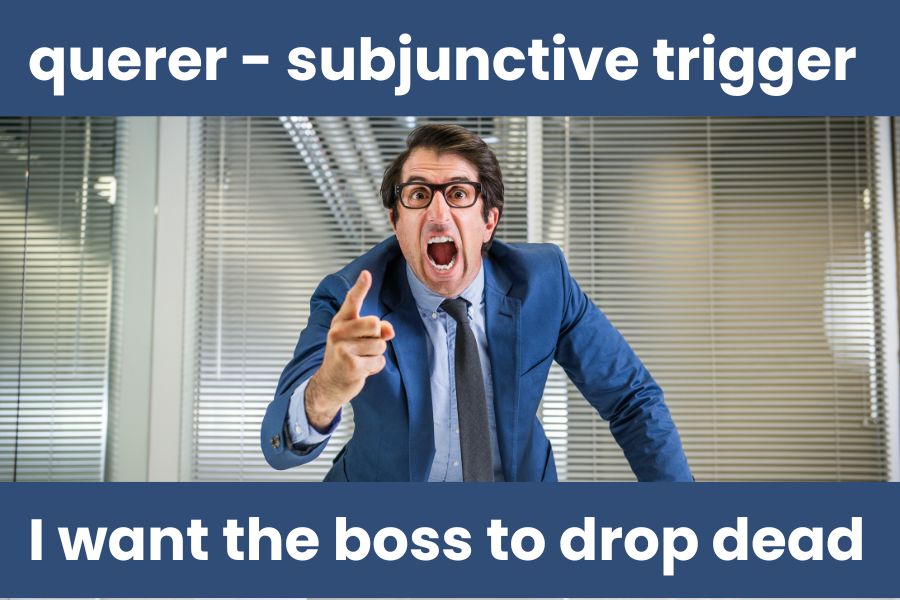
How Querer Triggers the Subjunctive
The subjunctive trigger for querer shows up as querer que in Spanish.
As an English speaker, it’s easy to spot many Spanish subjunctive triggers because we use the word “that” in similar ways:
- I hope that…
- It’s important that…
Even when we drop the word “that,” it’s still understood:
- I hope (that) you get better
- It’s important (that) you get better
🎯 The Querer Problem
With querer, Spanish uses the same subjunctive trigger pattern — querer que — but English doesn’t have the same structure when we use the word “want”:
“I want that you call me” is not grammatically correct in modern English.
It’s unidiomatic and unnatural and phrasing it this way just confuses native English speakers.
Instead, we say:
I want you to call me
This disconnect is what confuses English learners — because we don’t use ‘want that’ in the same way Spanish does.
🧠 Two Ways Querer Works:
- I want an apple.
→ You want a thing (noun)
→ ❌ No subjunctive
→ Spanish: Quiero una manzana. - I want my boss to drop dead.
→ You want something to happen
→ ✅ Subjunctive
→ Spanish: Quiero que mi jefe se muera.
🔥 THE RULE:
✅ If what you want is an action, event, or outcome, not a noun or a person →
AND there’s a different subject doing that action →
You’re in subjunctive territory with querer que.
🧪 English Shortcut:
If in English you find yourself saying:
“I want (…) TO (…)”
→ You’re almost always triggering the subjunctive in Spanish.
Because what comes after “to” is a verb, not a noun.
And that’s what the subjunctive is for — uncertain or wished-for actions.
💡 Quick Subjunctive Clue:
- Same subject → infinitive
Quiero dormir. (I want to sleep.) - Different subject → subjunctive
Quiero que duermas. (I want you to sleep.)
✅ Examples:
I want things to change. → outcome/action → ✅ subjunctive → Quiero que las cosas cambien.
I want to sleep. → same subject → ❌ no subjunctive → Quiero dormir.
I want you to sleep. → different subject → ✅ subjunctive → Quiero que duermas.
I want money. → noun → ❌ no subjunctive → Quiero dinero.
✅ Present Tense Conjugations of querer que
- yo quiero que
- tú quieres que
- él / ella / usted quiere que
- nosotros / nosotras queremos que
- ellos / ellas / ustedes quieren que