
Nos Vemos En El Café
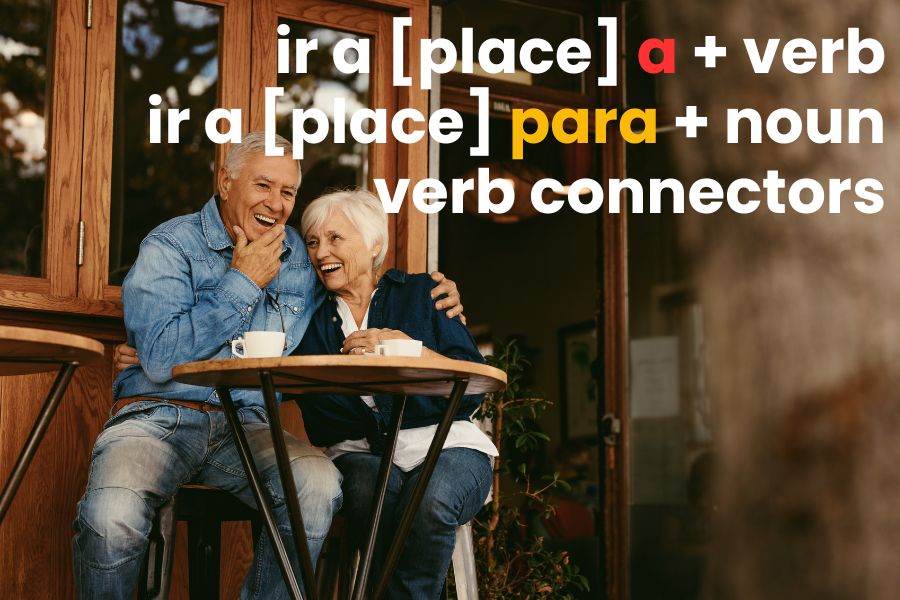
Where are you going — and why?
Stacking grammar blocks:
1️⃣ ir a
→ tells you where someone is going (the place)
2️⃣ a + infinitive
→ tells you why they’re going (the purpose) — if the purpose is a verb
OR
2️⃣ para + noun
→ tells you why they’re going (the purpose) — if the purpose is a thing/noun
Where are you going — and why?
When the reason is to do something, the why is a verb. The second verb will be in the infinitive but it may need some help.
[ir a] + place + [a + infinitive]
✅ When Two Verbs Show Up Together
- Most often, the first verb is conjugated, and the second stays in the infinitive.
- Maybe 2 out of 3 sequential verb combinations need a connector like a, de, or que between the verbs.
- But two infinitive verbs can appear together in the right context — for example:
👉 Vamos a querer comer pronto. – (We’re going to want to eat soon.)
❓Do the two verbs need a connection?
Yes — usually. But it depends entirely on the first verb.
There are 3 main connection types:
1️⃣ No connector (direct connection)
These verbs just flow straight into the next action.
| Spanish | English |
|---|---|
| Quiero comer | I want to eat |
| Puedo dormir | I can sleep |
| Necesitamos salir | We need to leave |
| Debes estudiar | You should study |
2️⃣ “a” (leads toward an action)
These verbs move you into doing something — usually starting, learning, going, helping.
| Spanish | English |
|---|---|
| Empezamos a cocinar | We start cooking |
| Aprendí a manejar | I learned to drive |
| Fue a buscar su bolsa | He went to look for his bag |
| Ayudo a limpiar | I help clean |
| Volvió a intentarlo | He tried again |
3️⃣ “de” (moves away from an action)
These verbs usually involve stopping, finishing, avoiding, or trying.
| Spanish | English |
|---|---|
| Terminé de lavar los platos | I finished washing the dishes |
| Dejaron de fumar | They stopped smoking |
| Trató de llamarte | He tried to call you |
| Me olvidé de pagar | I forgot to pay |
| Se acordó de cerrar la puerta | She remembered to close the door |
4️⃣ “que” (connects to another person or clause)
This one’s different — it connects to a whole new idea or another subject and often triggers the subjunctive.
| Spanish | English |
|---|---|
| Quiero que vengas | I want you to come |
| Espero que no llueva | I hope it doesn’t rain |
| Dudo que esté listo | I doubt it’s ready |
Can you tell by looking at the verb whether it will need nothing, a, de or que?
No — not just by looking at the verb.
👉 It’s built into the meaning and behaviour of the verb itself — and it’s something you have to:
- learn one by one,
- or absorb through use,
- or group by pattern over time.
Meet You At The Cafe : Nos Vemos En El Café
Practicing: ir a place + a infinitive
María terminó de lavar los platos y se secó las manos con una toalla.
“Voy a supermercado a comprar vegetales,” le dijo a su esposo, Luis, quien leía el periódico en la cocina.
“Qué bien,” respondió él. “Voy a ferretería a buscar algunos tornillos. La silla en la sala todavía está rota.”
María recogió su bolsa y miró su reloj.
“Después del supermercado, voy al café cerca del parque. Quiero descansar un poco y tomar algo frío.”
Luis puso el periódico en la mesa.
“Perfecto! Voy al café también – te esperaré allí y tomaré un café.”
María sonrió.
“Nos vemos allí en una hora, ¿sale?”
Luis asientió.
“Suena bien. Voy ahora. Quiero llegar antes de que haga demasiado calor.”
“Yo también,” dijo María. Abrió la puerta y miró atrás por un momento.
“Nos vemos pronto mi amor.”
Los dos salieron de la casa, caminando en direcciones diferentes, con planes de encontrarse en el café.
se secó – she dried her; secar – to dry; secarse – to dry oneself
toalla – towel
Qué bien – Nice!
ferretería – hardware store
tornillos – screws
rota – broken
recogió – she picked up; recoger – to pick up
sale – ok (Mexican)
haga (subjunctive) – hacer; triggered by antes de que
encontrarse – to meet up