
Formal Commands: Instructions
✅ FORMAL COMMANDS: Quick Overview
✨ There are two types of formal commands:
- usted; singular; you (formal, one person)
- ustedes; plural; you all (formal and informal in Latin America)
🔧 How to Form Formal Commands
For -AR verbs:
- Replace -ar with:
- -e for usted
- -en for ustedes
For -ER / -IR verbs:
- Replace -er / -ir with:
- -a for usted
- -an for ustedes
| Infinitive | Usted | Ustedes |
|---|---|---|
| hablar | hable | hablen |
| cortar | corte | corten |
| limpiar | limpie | limpien |
| comer | coma | coman |
| vivir | viva | vivan |
| escribir | escriba | escriban |
🧠 Use ustedes commands when:
✅ You’re giving instructions to two or more people
✅ You’re in Latin America (especially Mexico), where ustedes is used for any group, formal or informal
✅ You’re talking to: a group of strangers, your friends, family members, colleagues, a classroom full of students, any group, really — no need to check the formality level
✅ You’re giving instructions, directions, warnings, or requests to a group
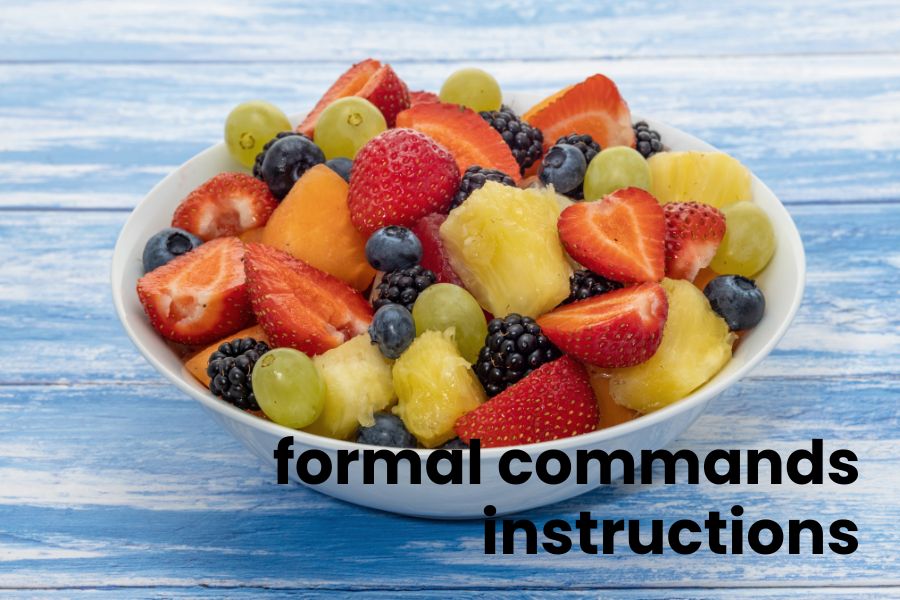
How to Make Fruit Salad
Formal commands are in bold.
¡Hola a todos!
Hoy vamos a preparar una ensalada de frutas fácil y deliciosa.
Sigan estos pasos y disfruten con amigos o familia.
Primero
Laven bien las frutas con agua fría.
Usen manzanas, plátanos, naranjas y fresas.
Segundo
Pelen los plátanos y las naranjas.
Corten las frutas en trozos pequeños.
Tercero
Mezclen todo en un tazón grande.
Si quieren, agreguen un poco de jugo de naranja.
Cuarto
Sirvan la ensalada en platos pequeños o vasos bonitos.
Disfruten con amigos o con su familia.¡Y no lo olviden!
Compartan esta receta con alguien que ama la fruta.
¡Hasta la próxima!
🧠 Use usted commands when:
- You’re giving instructions to one person you’d address formally
- You’re being polite, professional, or respectful
- Talking to strangers, elders, officials, or customers
top 10 most useful irregular ustedes commands
There are many verbs whose imperative is irregular. While their root changes, they use the same regular endings you just learned.
🧠 Why they’re “irregular”:
Their root changes, but they still follow the same formal command endings discussed above.
Example:tener → normally tien-, but still becomes tengan
Formal commands do come up constantly in real-life Spanish.
These are the ones you’re likely to hear, read, or say in real-world situations, especially in recipes, instructions, group settings, and polite requests.
| Verb (Infinitive) | Usted (singular) | Ustedes (plural) | Meaning |
|---|---|---|---|
| ir | vaya | vayan | go |
| ser | sea | sean | be |
| estar | esté | estén | be (state/location) |
| dar | dé | den | give |
| saber | sepa | sepan | know (info) |
| tener | tenga | tengan | have |
| hacer | haga | hagan | do / make |
| poner | ponga | pongan | put / place |
| decir | diga | digan | say / tell |
| venir | venga | vengan | come |
Irregular formal command phrases
This shows both the usted (singular) and ustedes (plural) versions side by side — so you can clearly see the difference and feel how they’d be used in real life:
| Meaning | Usted (singular) | Ustedes (plural) |
|---|---|---|
| Go carefully | ¡Vaya con cuidado! | ¡Vayan con cuidado! |
| Be kind | ¡Sea amable! | ¡Sean amables! |
| Be ready | ¡Esté listo/a! | ¡Estén listos/as! |
| Give me a minute | ¡Deme un minuto! | ¡Denme un minuto! |
| Have patience | ¡Tenga paciencia! | ¡Tengan paciencia! |
| Be quiet / Silent | ¡Haga silencio! | ¡Hagan silencio! |
| Pay attention | ¡Ponga atención! | ¡Pongan atención! |
| Tell the truth | ¡Diga la verdad! | ¡Digan la verdad! |
| Come here | ¡Venga aquí! | ¡Vengan aquí! |