
Hay que: Needs to be done
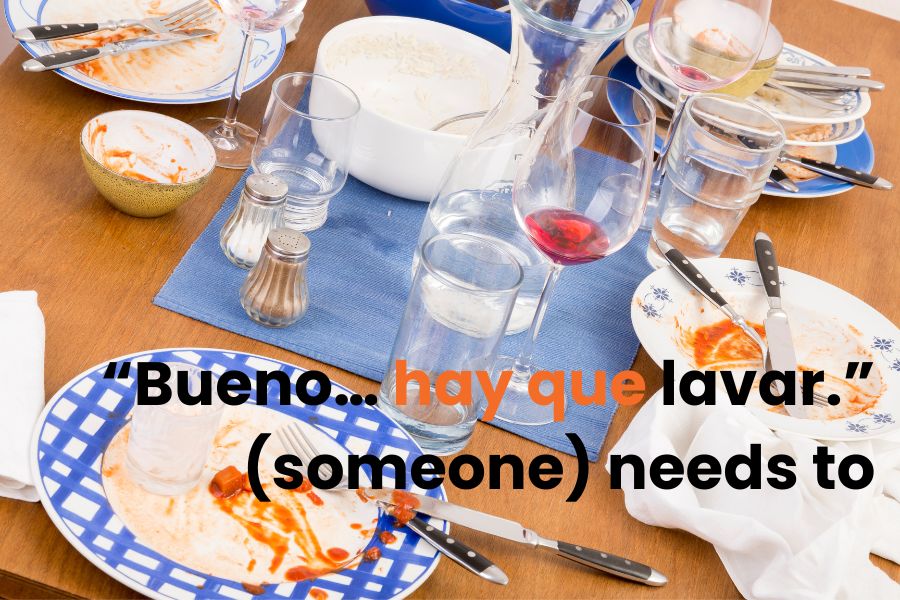
Hay que is a super common phrase used when you want to say that something needs to be done, without saying exactly who should do it.
Hay que can replace necesitar or tengo que but using a softened tone
| Phrase | Meaning | Tone / Use |
|---|---|---|
| Tengo que… | I have to… | Personal + direct |
| Necesito… | I need to… | Personal + emotional / urgent |
| Hay que… | One has to / You have to… | Neutral, softened, shared |
🔁 Hay que means something needs to be done without saying who
It is a soft way of giving instructions.
It’s like saying to my web design client “So we need to get some better images for this product.“. I mean they need to but the ‘we’ softens the request and makes it seem collaborative.
BUT hay que does not mean we or you.
Hay que is a blank canvas. It doesn’t assign the job.
It just says: this needs doing.
The person responsible is often figured out by the listener.
- Hay que tomar estas pastillas después de comer. → You need to take these pills after eating.
🧠 Used by a doctor or caregiver — soft instruction without pointing. - En México hay que saludar al entrar. → In Mexico, you’re expected to greet people when you enter.
🧠 Expresses a social rule without sounding like a lecture. - Hay que decidir pronto si vamos a reservar. → We should decide soon if we’re going to book.
🧠 Nobody’s singled out, but the urgency is there. - Hay que hablar con ella. No podemos seguir así. → We need to talk to her. We can’t keep going like this.
🧠 Expresses emotional weight, but without blame.
Hay que could also replace the need to use formal or informal commands in the right situations.
💬 Examples of the shift in tone with each:
- Necesitar
→ I need to use the bathroom now. (urgent or emotional tone) - Tengo que
→ I have to hang the washing out before I forget and leave it in the machine. (clear and personal duty) - Hay que
→ The power has gone out; we should find some matches for the candles. (gentle, shared reality)
(No one is directly told to do it — it just needs to happen.)
🧠 English Phrases That Signal “Hay que” in Spanish:
1. We need to… / We’ve got to…
2. You have to… / You should probably… (spoken gently)
3. Someone needs to…
4. It’s time to…
5. That needs to be…
6. We’d better… / We probably should…
7. Let’s not forget to… / Don’t forget that we have to…
8. You know what we should do? (soft brainstorming tone)
“Hay que” is everywhere in Mexican Spanish — way more than in many other Spanish-speaking countries.
Mexicans can be warm, expressive, even blunt in humor or affection — but when it comes to instructions, corrections, or confrontation, they are generally not direct. Mexican Spanish leans heavily on softened, inclusive phrases like Hay que…
So yes — you’ll hear hay que all the time in Mexico.
It’s not just useful — it’s part of the tone of the culture.
💬 You’ll hear it in all kinds of situations:
👩⚕️ Doctor:
Hay que tomar esta medicina con comida.
→ You need to take this with food.
👨👩👧 Parent:
Hay que recoger tus cosas antes de salir.
→ Time to pick up your stuff before we go.
🧑🍳 At home:
Hay que lavar los platos.
→ We gotta wash the dishes. (but… not pointing fingers 😏)
👩🏫 Teacher:
Hay que entregar el trabajo mañana.
→ This needs to be turned in tomorrow.
👥 In group conversations:
Hay que hablar con él pronto.
→ We should really talk to him soon. (Nobody wants to, but we all know we should.)
✅ Examples of hay que in questions:
1. ¿Hay que pagar ahora?
→ Do we have to pay now?
(You’re asking politely what the expectation is.)
2. ¿Hay que llevar algo para la reunión?
→ Do we need to bring something for the meeting?
(This is great for workplace or polite group settings.)
3. ¿Hay que sacar cita antes?
→ Do we have to make an appointment first?
(Common at clinics, government offices, etc.)
4. ¿Hay que registrarse en línea?
→ Do we need to register online?
5. ¿Hay que hacer todo esto hoy?
→ Do we have to do all of this today?
(Spoken with a little overwhelm 😅)