
Nos: Each Other
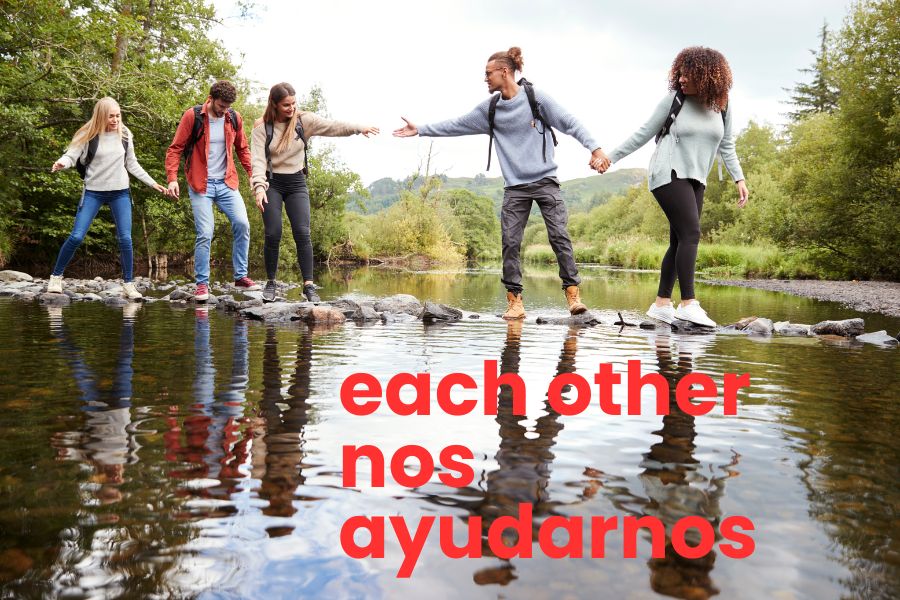
The phrase “Quedamos en vernos el jueves” is super common in conversational Spanish.
We agreed on seeing each other Thursday.
Using quedar (to stay), ver (to see) and nos (each other).
This is NOT a reflexive sentence.
Infinitive + nos is used for ‘each other’.
But it also shows up for reflexive verbs.
How to tell the difference and learn when to use nos/each other
Quedamos en vernos el jueves
It is NOT reflexive
1. Quedamos
- From the verb quedar
- In this case, “quedamos” = we stay / we remain / we end up
But here, it’s used in a common idiomatic structure meaning:
👉 we arranged / we set up (a plan)
2. en
- Preposition = “in”
But really, “quedar en + infinitive” = to fix/agree on an action
🧠 So: “we stay on the idea of…”
- Quedamos → from quedar, which literally means “to stay” or “to be left”
- quedar en 👉 to arrange / settle / agree to do something.
- en vernos → see each other (from ver = to see, + nos = each other)
- el jueves → on Thursday
3. vernos
- ver = to see
- nos = each other / ourselves
So:
🧠 “seeing each other”
4. el jueves
- “on Thursday”
Nos as “Each Other”
Quedamos en vernos el jueves.
so this sentence is actually:
Nosotros quedamos en | ver(each other) | el jueves.
Other examples of nos = each other
| vernos | to see each other / us | ver + nos |
| llamarnos | to call each other / us | llamar + nos |
| ayudarnos | to help each other / us | ayudar + nos |
| decirnos | to tell each other / us | decir + nos |
| escribirnos | to write to each other | escribir + nos |
Attaching Object Pronouns to the end of Infinitives
- We attach object pronouns to the end of infinitives when the infinitive follows another verb (like querer, tener que, ir a, etc.)
- Quiero verte.
→ I want to see you.
(ver + te) - Vamos a llamarnos.
→ Let’s call each other.
(llamar + nos) - Necesito ayudarte.
→ I need to help you.
(ayudar + te)
2. We attach object pronouns to the end of infinitives for ‘each other’. three examples are:
Sometimes They Look Exactly The Same
Nos could mean “ourselves” or “each other”, and we’re forced to rely on the sentence structure alone when the context is not available.
🧥 1. Vestirnos — to dress
| Reflexive | Reciprocal |
|---|---|
| Vamos a vestirnos. | Vamos a vestirnos. |
| We’re going to get ourselves dressed. | We’re going to dress each other. |
No difference in structure.
🧠 Only context or logic can tell you what’s meant. If you’re adults getting ready → reflexive. If you’re helping kids with costumes → reciprocal.
📞 2. Llamarnos — to call
| Reflexive | Reciprocal |
|---|---|
| Tenemos que llamarnos algo. | Tenemos que llamarnos. |
| We have to call ourselves something (e.g., a name). | We have to call each other. |
✅ Very similar — difference is only one word (“algo”)
🧠 Adding “something” forces the reflexive interpretation
🧠 3. Prepararnos — to prepare
| Reflexive | Reciprocal |
|---|---|
| Vamos a prepararnos. | Vamos a prepararnos. |
| We’re going to get ourselves ready. | We’re going to prepare each other. |
Again — 100% identical sentence, two meanings.
No difference in grammar. Only real-world logic tells you which one fits.
Grammatically, there is no change in structure.
The sentence is exactly the same in reflexive and reciprocal uses.
🧠 The only way to know is:
- What would make sense in real life?
- Is this action mutual?
- Can someone reasonably do this to themselves or to someone else?
Nos “each other” only works when we are the people doing the action to each other AND the infinitive follows another verb (like querer, poder, ir a, necesitar, etc)
| Spanish | Literal | Real Meaning |
|---|---|---|
| Vamos a vernos. | We’re going to see-us. | We’re going to see each other. |
| Tenemos que llamarnos. | We have to call-us. | We have to call each other. |
| Podemos ayudarnos. | We can help-us. | We can help each other. |
🔧 NOTE: “Nos” sticks to infinitives in both reflexive and reciprocal structures
Spanish allows object pronouns like nos to attach to an infinitive only when that infinitive is part of a larger phrase — usually with another verb in front.
This happens in both reflexive and reciprocal expressions.
You can only attach “nos” to an infinitive when that infinitive comes after a conjugated verb that requires it.
This happens with verbs like: querer (to want), poder (can), necesitar (to need), tener que (to have to), ir a (to be going to), quedar en (to agree to)
These first verbs are conjugated, and the verb that follows stays in infinitive form — and that’s where “nos” attaches.
✅ [Main Verb] + [Infinitive + nos]
| Type | Example | Meaning |
|---|---|---|
| Reflexive | Necesitamos calmarnos. | We need to calm down (ourselves) |
| Reciprocal | Podemos ayudarnos. | We can help each other |
| Reflexive | Vamos a sentarnos. | Let’s sit down (ourselves) |
| Reciprocal | Queremos hablarnos. | We want to talk to each other |
📌 The structure is identical.
Only context and verb meaning tell you whether it’s reflexive or reciprocal.
✅ Tenemos que llamarnos más seguido.
We have to call each other more often.
🧠 tener que + llamarnos
✅ ¿Vamos a vernos mañana?
Are we going to see each other tomorrow?
🧠 ir a + vernos
✅ ¿Nos vamos a encontrar allá?
Are we going to meet up there?
🧠 ir a + encontrarnos
✅ Vamos a mandarnos un mensaje, ¿no?
Let’s message each other, yeah?
🧠 mandar + nos
✅ ¿Podemos hablarnos después de la reunión?
Can we talk to each other after the meeting?