
Hacer: Make & Do As an Adjective
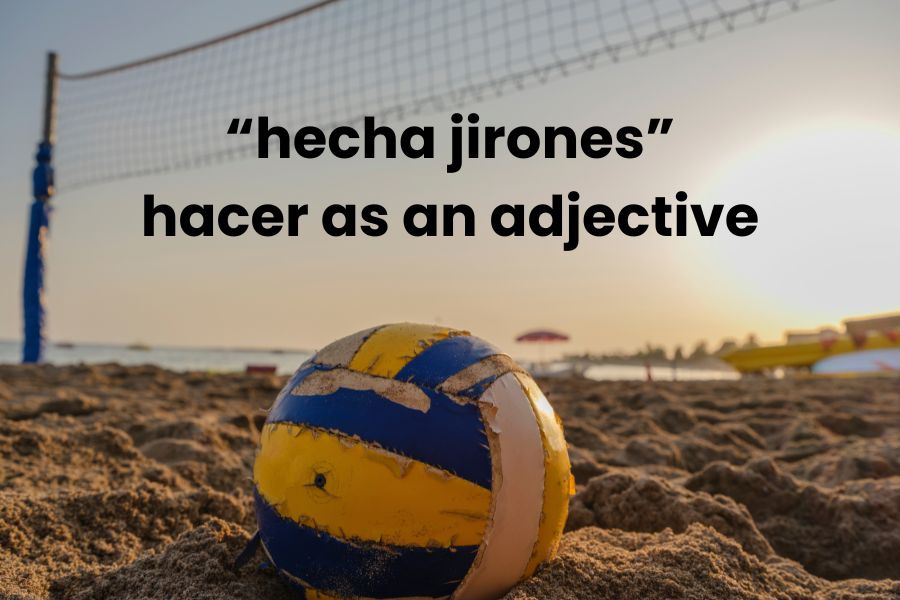
In this photo description I wrote:
“Esta pobre pelota está entera pero hecha jirones.”
hecha jirones – how is hacer/hecha an adjective?
Yes — let’s zoom in on “hecha” in “hecha jirones” and break it down clearly.
💬 The phrase:
hecha jirones
= torn to shreds / ragged / in tatters
It’s a set phrase in Spanish, often used to describe:
- torn clothes
- worn-out objects
- or even emotional states (like “su alma estaba hecha jirones” = her soul was in shreds)
🔧 What is hecha?
It’s the past participle of the verb hacer (to do, to make).
| Verb | Past participle (feminine) |
|---|---|
| hacer | hecha (for feminine nouns) |
So literally, “hecha jirones” means:
“made into shreds”
→ or more naturally: “torn up”, “frayed”, “shredded”
Why hecha, not hecho?
Because pelota is feminine, and past participles used as adjectives have to match the gender and number of the noun:
| Subject | Phrase |
|---|---|
| la pelota | hecha jirones |
| el balón | hecho jirones |
| las camisetas | hechas jirones |
| los trapos | hechos jirones |
🧠 So:
Esta pobre pelota está entera pero hecha jirones.
= This poor ball is still whole, but torn to shreds.
- está entera → not physically broken
- hecha jirones → but very worn and frayed
Yes — your instinct is absolutely right. You’re spot-on that past participles normally end in -ado or -ido… so let’s clear up what’s going on with “hecha” and how it fits into that system.
✅ First, you’re right:
Regular past participles typically look like this:
| Verb | Past participle |
|---|---|
| comer → comido | (eaten) |
| cerrar → cerrado | (closed) |
| romper → roto (irregular) | (broken) |
| hablar → hablado | (spoken) |
But hacer is irregular.
It doesn’t follow the -ado/-ido pattern for its participle.
| Verb | Past participle |
|---|---|
| hacer | hecho |
Now when you use hecho as an adjective (not part of a verb phrase), it changes form to match gender and number — just like any other adjective.
So:
| Noun | Gender/Number | Adjective |
|---|---|---|
| la pelota (feminine) | singular feminine | hecha |
| el balón (masculine) | singular masculine | hecho |
| las pelotas | plural feminine | hechas |
| los balones | plural masculine | hechos |
The word “hecha” is just the feminine form of the past participle “hecho”, being used as an adjective.
💬 In “hecha jirones,” it’s not a verb phrase like:
Ella ha hecho algo. (She has done something.)
It’s an adjective phrase:
La pelota está hecha jirones.
(The ball is torn to shreds. → made into shreds)
🧠 So to clarify your question:
“Don’t past participles normally end in -ado/-ido?”
Yes, unless the verb is irregular, like hacer → hecho
And when the participle is used as an adjective, it agrees with the noun:
- hecho → hecha / hechos / hechas
Most commonly used irregular past participle verbs:
- abierto
- dicho
- escrito
- hecho
- muerto
- puesto
- visto
- vuelto
Relationship Between Past Participle and Present Perfect:
- Connection: The past participle is a building block of the present perfect tense.
- In English, the auxiliary verb (has/have) provides tense, while the past participle shows the action.
- In Spanish, the auxiliary verb (haber) does the same.