Location and Movement Palabras

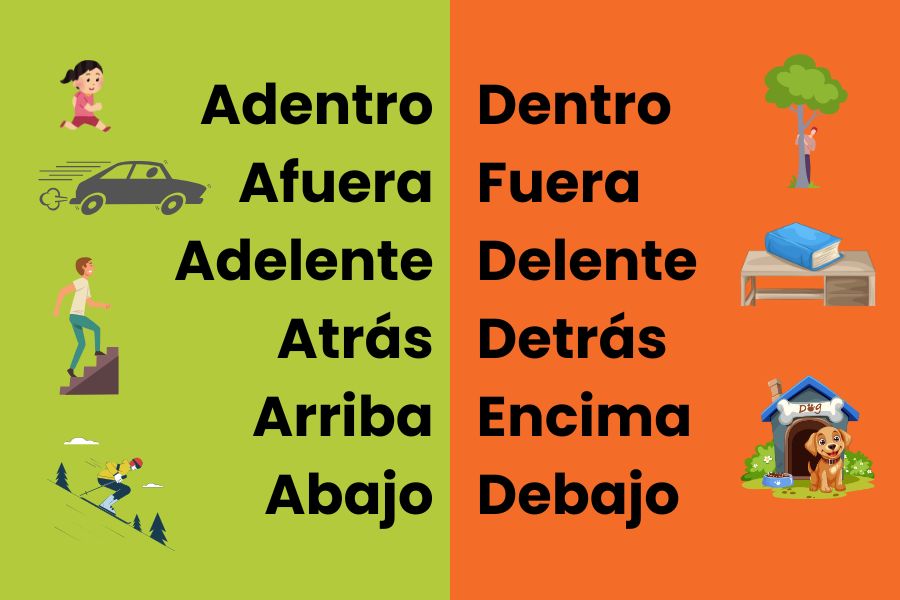
In Spanish, many location words come in two forms: one that implies movement and another that indicates a fixed position. A simple rule of thumb is:

Words that start with “A” (atrás, arriba, abajo, afuera, adelante) indicate movement or direction.

Words without “A” (detrás, encima, debajo, fuera, delante) refer to a fixed location.
IN – Adentro v Dentro

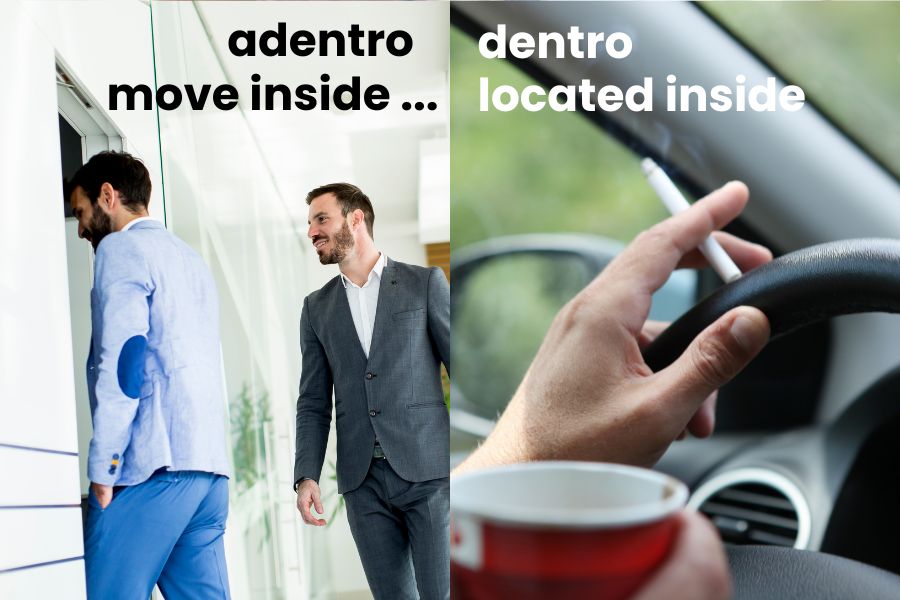
Both “adentro” and “dentro” relate to being “inside,” but they have different uses.

“Adentro” = Movement towards the inside

Think of it like “inward” or “inside” in the sense of direction.
It often appears with verbs of movement (ir, entrar, meter, llevar, etc.).

  • Camina adentro de la casa. → Walk inside the house.
  • Metí la llave adentro del bolsillo. → I put the key inside the pocket.
  • Corre, vamos adentro. → Run, let’s go inside.

“Dentro” = Location (already inside)

It refers to something that is inside a place or container, like “inside” in English.
Often used with “de” to specify location.

  • Las llaves están dentro de la mochila. → The keys are inside the backpack.
  • Hay mucha gente dentro del restaurante. → There are many people inside the restaurant.
  • No puedes fumar dentro de la oficina. → You can’t smoke inside the office.

Here are 10 sentences for you to complete with adentro or dentro.

  1. Dejé mi teléfono __________ de la cartera.
  2. Vamos __________ de la casa antes de que empiece a llover.
  3. Hay muchas personas __ el café esperando ser atendidas.
  4. El gato se metió __________ de la caja y no quiere salir.
  5. No se permite comida __________ del cine.
  6. Si tienes frío, entra __________ y ponte un suéter.
  7. Guardé el dinero __________ de mi cartera.
  8. El niño corrió __________ de la tienda para buscar a su mamá.
  9. ¿Puedes mirar __________ del cajón a ver si están mis llaves?
  10. Escuché un ruido __ de la habitación y me dio miedo.

Begins With “A”

Movement or general direction.

“A” is a prepostion that also means ‘to’ eg Voy a ir a México. I am going to Mexico.

“To” is another way to remember ‘movement‘ and also ‘direction‘.

“To look up” is a kind of directional movement.

Connecting the idea that:

  • the directional words in these notes that begin with “A” often indicate movement or direction
  • AND that the preposition “a” means “to” (implying motion toward something)
  • you can see a pattern that the words beginning with ‘a’ are the movement words, while the directional words not starting with ‘a’ are about position.

Recognising that “movement” isn’t just physical like walking inside (adentro) but it can also be a shift in attention—like looking up (mirar arriba), which still involves movement but in a not-so-physical sense.

“A” moves you—physically, visually, or mentally.
OUT: Afuera v Fuera

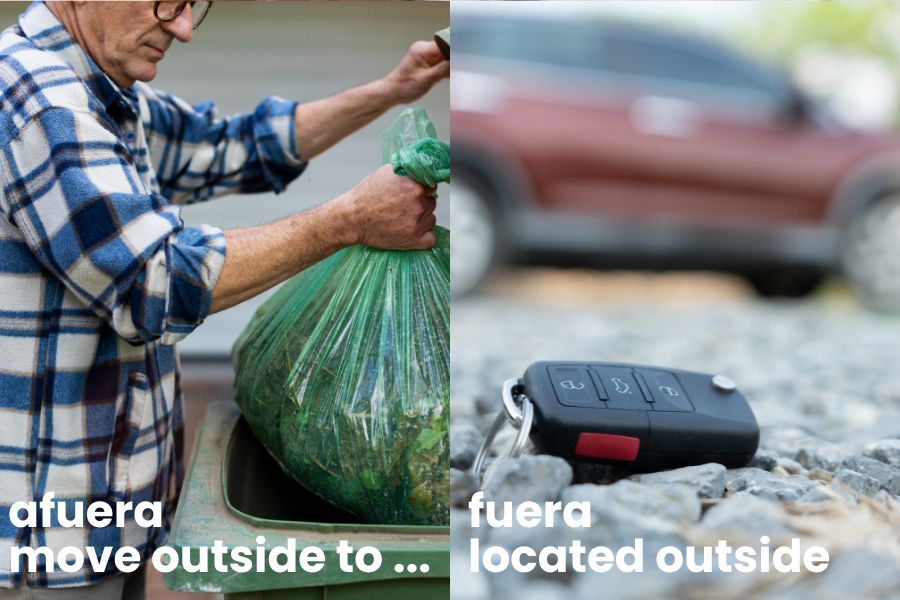
“Afueura” = Movement (going outside) OR emphasis on being outside.

Think of it like “outward” or “outside” in the sense of direction.
It often appears with verbs of movement (salir, ir, llevar, poner, etc.).

  • Sal afuera a tomar aire. → Go outside to get some air.
  • Saca la basura afuera. → Take the trash outside.
  • Vamos afuera, hace calor aquí. → Let’s go outside, it’s hot in here.

“Fuera” = Location (already outside) or figurative use

It refers to something that is outside a place or container, like “outside” in English.
Often used with “de” to specify location.

  • Las llaves están fuera, en la mesa. → The keys are outside, on the table.
  • Dejé el coche fuera del garaje. → I left the car outside the garage.
  • ¡Eso está fuera de lugar! → That is out of place! (Figurative use)
¡Aquí tienes 10 oraciones para practicar la diferencia entre afuera y fuera!

  1. Sal __________ y respira aire fresco.
  2. Dejé mi bicicleta __________ del garaje.
  3. Vamos a jugar __________ porque hace buen clima.
  4. Está lloviendo mucho, mejor no salgas __________.
  5. Dejaron la bolsa __________ de la tienda por accidente.
  6. Si hace calor adentro, podemos sentarnos __________ en el patio.
  7. No podemos fumar aquí dentro, pero sí __________ del restaurante.
  8. Los niños corrieron __________ a jugar en el parque.
  9. ¿Por qué están todas las sillas __________ de la casa?
  10. Hace frío, así que prefiero quedarme adentro en vez de estar __________.

FORWARD – Adelante vs Delante

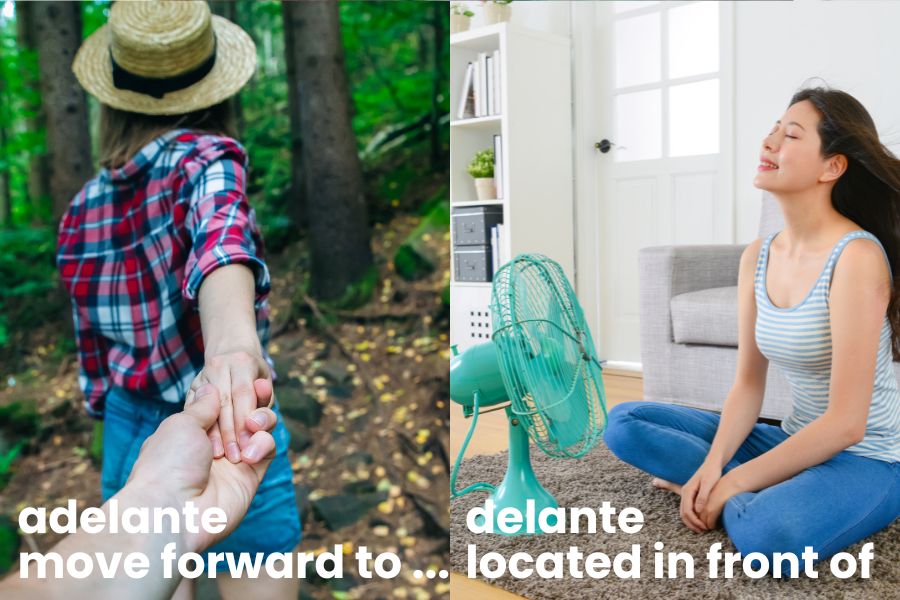
Both “adelante” and “delante” relate to being “in front” or “forward,” but they have different uses.

“Adelante” = Movement forward or permission to go forward

Think of it like “go ahead” or “move forward.”
It often appears with verbs of movement (seguir, ir, pasar, avanzar, etc.).

  • Sigue adelante, casi llegamos. → Keep going forward, we’re almost there.
  • Pasa adelante y toma asiento. → Go ahead and take a seat.
  • Voy adelante, tú sígueme. → I’m going ahead, follow me.

It can also be used figuratively:

  • Tienes que seguir adelante con tu vida. → You have to move forward with your life.

“Delante” = Location (already in front of something)

It refers to something that is positioned in front of a specific point.
Often used with “de” to specify location.

  • El coche está delante de la casa. → The car is in front of the house.
  • Tienes algo delante de ti. → You have something in front of you.
  • Se sentó delante de mí en el cine. → He sat in front of me at the movies.

¡Aquí tienes 10 oraciones para practicar la diferencia entre adelante y delante! 😊

  1. Sigue __________, ya casi llegamos.
  2. El coche está estacionado __________ de la casa.
  3. Si tienes dudas, pregunta y sigue __________ con confianza.
  4. Me senté __________ de la pantalla para ver mejor.
  5. ¿Puedes moverte un poco más __________ para hacer espacio?
  6. Hay una fila de personas esperando __________ de la tienda.
  7. Pasé __________ y saludé a todos en la reunión.
  8. Dejé mis llaves justo __________ de la puerta.
  9. Camina __________ sin miedo, yo te sigo.
  10. El niño se paró __________ de la televisión y no me deja ver.

BACK – Atrás vs Detrás

Both “atrás” and “detrás” relate to being “behind” or “back,” but they have different uses.

“Atrás” = Movement backward or general direction

Think of it like “backward” or “to the back.”
It often appears with verbs of movement (ir, mirar, volver, dar, echar, etc.).

  • Da un paso atrás. → Take a step back.
  • Miré atrás y vi a mi amigo. → I looked back and saw my friend.
  • Echa la silla más atrás. → Push the chair further back.

It can also refer to a past time:

  • Hace años, atrás todo era diferente. → Years ago, everything was different.

“Detrás” = Location (already behind something)

It refers to something that is positioned behind a specific point.
Often used with “de” to specify location.

  • El coche está detrás de la casa. → The car is behind the house.
  • Puse la llave detrás de la puerta. → I put the key behind the door.
  • Hay un parque detrás del supermercado. → There is a park behind the supermarket.

¡Aquí tienes 10 oraciones para practicar la diferencia entre atrás y detrás! 😊

  1. Mira __________, alguien te está llamando.
  2. Dejé mis zapatos __________ de la puerta.
  3. Siéntate más __________ para que todos puedan ver.
  4. El perro está escondido __________ del sofá.
  5. Caminé unos pasos __________ y tropecé con una piedra.
  6. Hay un jardín bonito justo __________ de la casa.
  7. Cuando escuché el ruido, volteé __________ para ver qué era.
  8. La tienda está justo __________ del banco.
  9. Movieron el sillón más __________ para hacer espacio.
  10. Estacioné mi coche __________ del supermercado.

ABOVE – Arriba vs Encima

Both “arriba” and “encima” relate to being “above,” but they have different uses.

“Arriba” = Movement upward or general position

Think of it like “up” or “upstairs.”
It often appears with verbs of movement (subir, ir, mirar, levantar, etc.).

  • Mira arriba, hay un pájaro. → Look up, there’s a bird.
  • Voy arriba a mi cuarto. → I’m going upstairs to my room.
  • Levanta la cabeza arriba. → Lift your head up.

It can also be used figuratively:

  • ¡Ánimo! Siempre hacia arriba. → Cheer up! Always moving forward/up.

“Encima” = Location (already on top of something, touching it)

It refers to something that is positioned on top of a specific point.
Often used with “de” to specify location.

  • El libro está encima de la mesa. → The book is on top of the table.
  • No pongas los pies encima de la silla. → Don’t put your feet on top of the chair.
  • Se cayó y se golpeó encima del ojo. → He fell and hit himself above his eye.
¡Aquí tienes 10 oraciones para practicar la diferencia entre arriba y encima! 😊

  1. Mira __________, el cielo está lleno de estrellas.
  2. Dejé mi teléfono __________ de la mesa.
  3. El gato saltó __________ del árbol y me asustó.
  4. Hay un cuadro bonito colgado __________ de la cama.
  5. Voy __________ a mi habitación, ya es tarde.
  6. No pongas los pies __________ de la silla, por favor.
  7. La lámpara está justo __________ de la mesa del comedor.
  8. Subí las escaleras y ahora estoy __________.
  9. No veo mis lentes, ¿están __________ de los libros?
  10. El helicóptero está volando __________ de nosotros.

BELOW – Abajo vs Debajo

Both “abajo” and “debajo” relate to being “below,” but they have different uses.

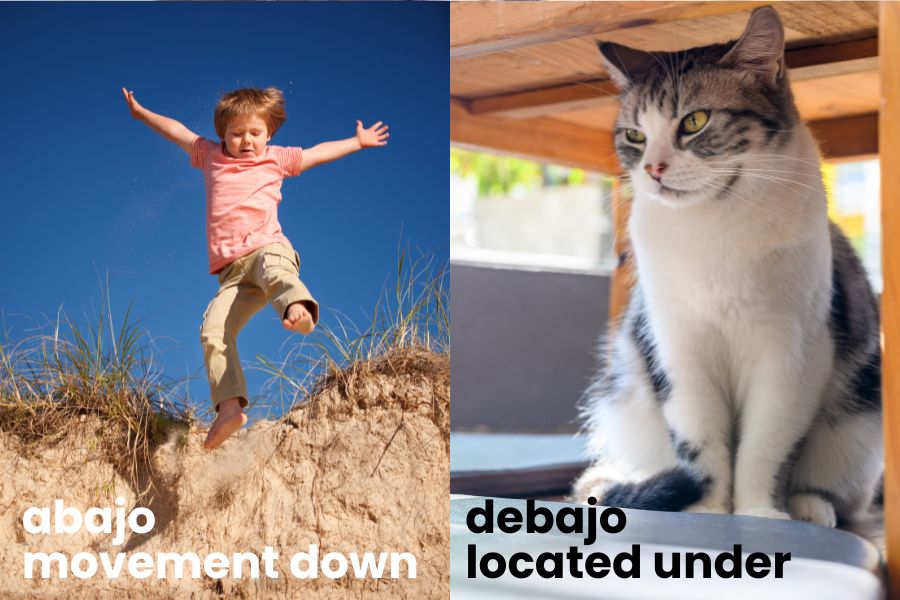
“Abajo” = Movement downward or general direction

Think of it like “down” or “downstairs.”
It often appears with verbs of movement (bajar, caer, ir, mirar, etc.).

  • Mira abajo, hay una moneda. → Look down, there’s a coin.
  • Voy abajo a comprar algo. → I’m going downstairs to buy something.
  • Las hojas cayeron abajo del árbol. → The leaves fell down from the tree.

It can also be used figuratively:

  • ¡Abajo el estrés! → Down with stress! (Expressing opposition)

“Debajo” = Location (already under something, touching or covered by it)

It refers to something that is positioned underneath a specific point.
Often used with “de” to specify location.

  • El gato está debajo de la cama. → The cat is under the bed.
  • Las llaves están debajo de los papeles. → The keys are under the papers.
  • Hace frío debajo del puente. → It’s cold under the bridge.

¡Aquí tienes 10 oraciones para practicar la diferencia entre abajo y debajo! 😊

  1. Mira __________, hay un billete en el suelo.
  2. El perro está escondido __________ de la mesa.
  3. Voy __________ a la cocina a preparar un café.
  4. Las llaves están __________ de los papeles.
  5. Bajé las escaleras y ahora estoy __________.
  6. Hay polvo acumulado __________ del sofá.
  7. No encuentro mi zapato, ¿está __________ de la cama?
  8. El gato se metió __________ del sillón y no quiere salir.
  9. El supermercado está justo __________ de mi departamento.
  10. No puedes ver la sorpresa hasta que mires __________.

Here’s a mixed list of 10 sentences — some express movement inward (adentro), others being inside (dentro). No clues, no Spanish:

  1. She hid the money inside the shoe.
  2. We ran inside when the wind picked up.
  3. The cat is inside the basket.
  4. Put the wet clothes inside the washing machine.
  5. He’s still inside the building.
  6. Toss it inside before they see you.
  7. There’s something glowing inside the box.
  8. Go inside and grab your jacket.
  9. The kids are already inside the classroom.
  10. They carried the boxes inside without help.

10 English sentences mixed between those that would use afuera (movement outward) and fuera (location outside), without any clues or Spanish:

  1. Take the dog outside before dinner.
  2. The car is parked outside the house.
  3. He walked outside to get some air.
  4. They waited outside for over an hour.
  5. She stepped outside and looked at the sky.
  6. Leave your shoes outside the door.
  7. There’s someone standing outside.
  8. Throw that trash outside right now.
  9. We slept outside under the stars.
  10. The bike was outside all night.

Here are 10 English sentences that would correspond to adelante (movement forward) and delante (location in front), all mixed up, no Spanish, no clues:

  1. Move forward and take your shot.
  2. The car in front has its lights on.
  3. She stepped forward to speak.
  4. There was a long table in front of the stage.
  5. He walked forward without hesitation.
  6. The keys are right in front of you.
  7. Come forward if you have something to say.
  8. The statue stood in front of the building.
  9. They pushed forward through the crowd.
  10. A child was standing in front of the screen.

10 English sentences that would use either atrás (movement back) or detrás (location behind), all mixed up and without any clues or Spanish:

  1. Step back, it’s dangerous.
  2. The keys were behind the couch.
  3. He looked back but saw nothing.
  4. There’s a strange car parked behind us.
  5. Don’t go back there alone.
  6. The dog is hiding behind the curtains.
  7. She stayed back while the others went ahead.
  8. There’s a note taped behind the door.
  9. Get back before they notice.
  10. A small box was hidden behind the books.

10 English sentences that would use either arriba (movement upward) or encima (location on top), mixed and without clues:

  1. Climb up quickly!
  2. The book is on top of the table.
  3. She looked up at the sky.
  4. There’s dust on top of the shelf.
  5. He held his hands up in surrender.
  6. The phone is on top of your jacket.
  7. Throw it up to me!
  8. There’s a blanket on top of the bed.
  9. Lift it up a little more.
  10. A spider was crawling on top of the lamp.

10 English sentences that would use either abajo (movement downward) or debajo (location underneath), mixed and with no clues:

  1. Don’t go down there alone.
  2. The cat is hiding under the bed.
  3. He looked down and saw the river.
  4. Your shoes are under the table.
  5. They climbed down the hill slowly.
  6. Something is moving under the couch.
  7. Sit down and relax.
  8. The money was hidden under the floorboards.
  9. She bent down to tie her shoes.
  10. There’s a box under the sink.