
Connecting Words
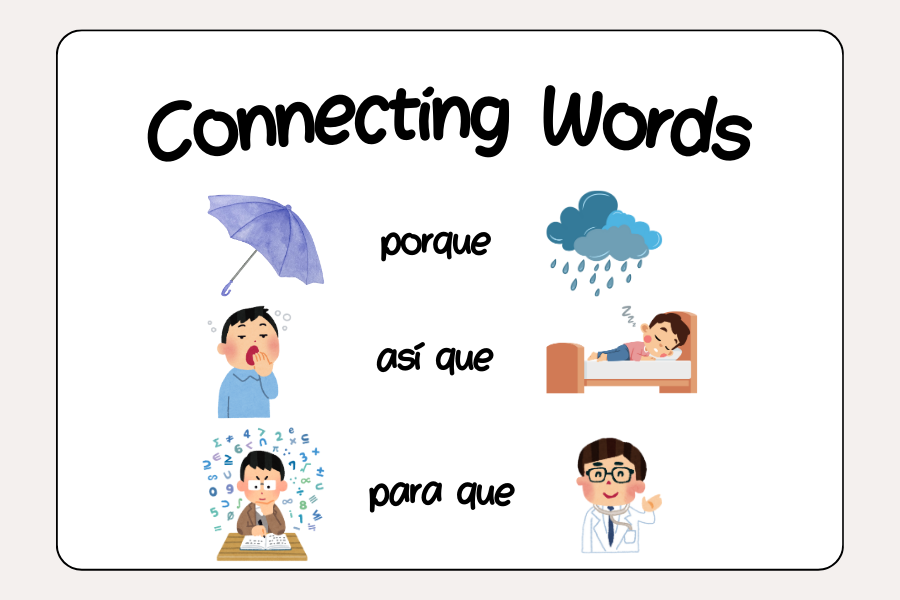
Linking or connecting words are essential tools in Spanish sentences that help clarify relationships between ideas, actions, and thoughts. Each type of connector has a specific purpose—it doesn’t just “glue” ideas together randomly but explains how the ideas interact.
In real life, when you speak or write, you’re often doing more than just stating simple facts. You’re explaining:
- Why something happens
- When something happens
- What you think about a situation
- What the outcome of an action is
Different linking words help you signal these relationships so that your message is clear.
Types of linking/connecting words and their roles:
CAUSE and EFFECT Connectors
Purpose: These show the reason behind an action or statement.
Example: No salí porque estaba lloviendo. (I didn’t go out because it was raining.)
- porque (because)
No fui a la fiesta porque estaba cansado.
(I didn’t go to the party because I was tired.) - ya que (since, because)
Ya que no había transporte público, decidimos caminar.
(Since there was no public transport, we decided to walk.) - así que (so, therefore)
No estudié, así que saqué una mala nota.
(I didn’t study, so I got a bad grade.)
TIME Connectors
Purpose: Show when an action happens in relation to another
Example: Voy a cenar después de que termine el trabajo. (I’ll have dinner after I finish work.)
- cuando (when)
Cuando llegué, ya estaban cenando. (When I arrived, they were already having dinner.) - antes de que (before)
Me lavé las manos antes de que empezara la cena. (I washed my hands before dinner started.) - después de que (after)
Fui a casa después de que terminó la película. (I went home after the movie ended.)
PURPOSE Connectors
Purpose: These show the reason behind an action or statement.
Example: Estudio para que pueda conseguir un buen trabajo. (I study so that I can get a good job.)
- para que (so that, in order to)
Estudio para que pueda viajar por el mundo. (I study so that I can travel the world.)
CONDITION Connectors
Purpose: These show conditions that must be met for an action to happen.
Example: Iré al parque si no llueve. (I will go to the park if it doesn’t rain.)
- si (if)
Vamos a la playa si hace sol.
(We’ll go to the beach if it’s sunny.) - a menos que (unless)
No vamos a salir a menos que deje de llover. (We won’t go out unless it stops raining.)
CONTRAST Connectors
Purpose: Show a difference or contradiction between two ideas
Example: Aunque llovía, salimos a caminar. (Although it was raining, we went for a walk.)
- pero (but)
Quiero ir al cine, pero no tengo dinero. (I want to go to the movies, but I don’t have money.) - aunque (although)
Aunque estaba cansado, fui al gimnasio. (Although I was tired, I went to the gym.)
OPINION or THOUGHT Connectors
Purpose: Explain what you think or believe about something
Example: Estoy seguro de que vendrá mañana. (I’m sure that he will come tomorrow.)
- que (that)
Creo que es una buena idea. (I think that it’s a good idea.) - de que (of the fact that, that) – after certain phrases like “estar seguro/a de” or “darse cuenta de”
Estoy seguro de que nos vamos a divertir.
(I’m sure that we’re going to have fun.)
CONSEQUENCE Connectors
Purpose: Show the result or outcome of an action.
Example: Aunque llovía, salimos a caminar. (Although it was raining, we went for a walk.)
- Entonces (so, then)
Estaba cansado, entonces fui al gimnasio.
(I was tired, so I went to the gym.) - Así que (so, therefore)
Estaba cansado, así que fui al gimnasio.
(I was tired, so I went to the gym.) - Por eso (that’s why, for that reason)
Estaba cansado, por eso fui al gimnasio.
(I was tired, that’s why I went to the gym.) - Por lo tanto (therefore, thus)
Estaba cansado, por lo tanto fui al gimnasio.
(I was tired, therefore I went to the gym.)